Recently, it became possible to image in three dimensions magnetic textures having dimension of 100 nm or even less. The joint teams of the Laboratoire Albert Fert in Palaiseau and the SEXTANTS beamline scientists, helped by colleagues from the Helmholtz-Zentrum Berlin, the University of Augsburg and the Max Planck Institute for Chemical Physics of Solids in Dresden, used a peculiar holography technique called HERALDO, allowing different projection of a sample containing “cocoons” to be acquired.
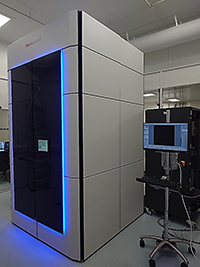
The Titan KRIOS G4 transmission cryo-electron microscope (Cryo-EM) at SOLEIL, POLARIS, was financed by the French government as part of the EQUIPEX France-Cryo-EM (Contract ANR-21-ESRE-0046) and is operated as a user facility by Synchrotron SOLEIL.
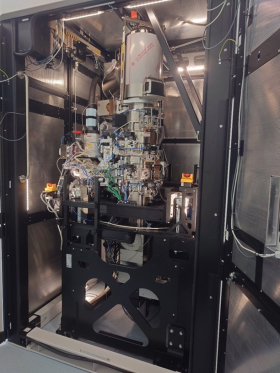
Operational since October 2024, POLARIS delivers a high brilliance, coherent source of up to 300 keV electrons to cryogenically vitrified biological samples prepared on AutoGrids. The samples can be distributed solutions of biological macromolecules or their complexes for Single Particle Analysis (SPA), or thin samples (viruses, vesicles) or sections of either frozen cells or biological tissue samples for Cryo-Electron Tomography (Cryo-ET). Equipped with a cold Field Emission Gun (FEG), an energy filter and a rapid and sensitive direct electron detection camera (Falcon4i), POLARIS can produce high resolution (from 1 – 5 Å resolution) images of biological systems for both pure and applied research in biological science, thus contributing to the palette of techniques available in the Life Sciences scientific section at SOLEIL. The Cryo-EM measurements are highly complementary to X-ray crystallographic and Small Angle X-ray Scattering measurements performed on PROXIMA-1, PROXIMA-2A and SWING beamlines respectively.
Team / Contact
POLARIS Phone number: 01 69 97 59
Members
Facility Manager
Pierre Legrand
01 69 35 96 60
06 86 42 32 97
Facility Operation Manager
Éric Larquet
01 69 35 96 00
06 78 10 61 53
Opérator
Heddy Soufari
01 69 35 96 69
Technical data
- Model
-
Thermo Fisher Scientific KRIOS-G4
- Electron source
-
Cold FEG which can operate at 300 kV or 200 kV
- Detection
-
Falcon 4i (up to 320 frames per second readout speed in EER).
File format: EER format, or TIFF.
- Energy filter
-
Selectris X
- Sample stage
-
X-Y positioning and single axis rotation range from -70 - + 70 degrees
- Additional information
-
The microscope is fitted with a Volta Phase plate, and an autoloader capable of storing up to 12 Cryo-EM auto-grids at cryogenic temperatures.
The POLARIS facility can produce very-high to high resolution 3D images of biological systems.
In Single Particle Analysis mode, a vitrified solution of intact particles in random orientations is imaged with achievable resolution up to 1.1 Å in highly favourable cases but with 2.0 – 3.5 Å structures routinely achievable depending on the sample type. Automation of image processing steps is achieved by the SCIPION3 interface (Biological Imaging , Volume 3 , 2023 , e13 DOI: https://doi.org/10.1017/S2633903X23000132) or Cryosparc live (for academic users). A typical SPA experiment consists of microscope pre-alignment by the facility team, introduction and inspection of Cryo-EM grids and selection of grid co-ordinates to be collected, following by automatic data collection of images. A typical experiment takes 1 – 2 days of measurement time. After data collection, raw and pre-analysed data can be backed up onto external USB disk or recovered by the GLOBUS application. Data can also be pushed to AWS storage or rsynced.
For further information on sample preparation, please contact the operations team.
In Cryo-Electron Tomography Mode, lamella cut from vitrified cells or tissues can be measured by POLARIS using the sample tilt stage to acquire a dose-symmetric tilt sequence of images from which tomographic reconstruction of the sample can be performed for example by using back-projection algorithms.
For further information on sample preparation, please contact the operations team.
Access
Applications for access can be made via the SunSET, selecting the Rolling Access or Block Allocation group (BAG) modality. In Rolling Access, proposals can be submitted at any time, but will be cumulated and reviewed every 2 months. Consequently the time between project submission and attribution of access will be up to 3 months. See more details here.
Access to POLARIS is free of charge to academic projects or industrial-academic partnerships approved by the SOLEIL Programme Committee for biology and health, and for which results will be published in a peer-reviewed journal. For proprietary access to the microscope, users should contact the industrial outreach group for advice and competitive quotation.
Sample Handling
Users are asked to bring or send pre-clipped AutoGrids – (exceptionally, the clipping of the grids can be performed on-site) and their introduction to the microscope will be performed by in-house staff in order to optimise autoloader reliability. Dry-shipping Dewars can be sent to
Synchrotron SOLEIL
L’Orme des Merisiers
Départementale 128
91190 Saint-Aubin
The shipment should be clearly marked with the name of your local contact for the experiment, and tracking numbers should be provided to enable the dry-shipper to be refilled on arrival.
Assistance can be provided in sample preparation for a small number of inexperienced users. SOLEIL is equipped with both Thermo Fisher Vitrobot and LEICA EM GP Cryo-plunge systems.
Data Storage and Analysis
Data will be stored on site according to the principles laid out in SOLEIL’s data management policy, for at least a 5 years. Longer term data storage cannot be guaranteed.
Although processing and analysis of Cryo-EM data is complex and involves several passes through the data, POLARIS is providing a live processing (and is working at implementing the SCIPION3 pipeline for pre-data processing) which runs during the measurements and will give an initial idea of the quality of data being collected.
Advanced spent nuclear fuel recycling, nuclear waste separation and long-term prediction of radionuclide behaviour in geological disposal facilities are all challenges that, to be met, require an understanding of the chemistry of the actinides - the family of radioactive elements that includes uranium, neptunium, and plutonium.
The LEAPS ULTRAFAST network announces the launch of the first call for applications for its prestigious ULTRAFAST postdoctoral program.

The “Cultural & Natural Heritage” scientific section brings together scientists from SOLEIL and IPANEMA to share knowledge and experiences regarding methodological and analytical tools that use synchrotron radiation to study ancient materials. It facilitates collaboration between the beamlines and the supporting laboratories and groups at SOLEIL, and, externally, between SOLEIL and the research networks and infrastructures dedicated to heritage sciences.
The research activities of this section cover the following fields: archaeometry, art history, conservation and restoration, paleontology, paleoenvironment and paleoclimate. Given the common characteristics of ancient materials in these various fields (which are culturally significant, rare, valuable, irreplaceable, heterogeneous, and often poorly characterized), the corresponding research projects also offer an opportunity to study the effects of analytical techniques and ways to improve our analytical methodology in order to preserve samples (for example, monitoring damage caused by synchrotron radiation beams, statistical analysis of imaging to reduce radiation dose).
The section facilitates the link between SOLEIL and the heritage science community, in close collaboration with the IPANEMA laboratory located on the SOLEIL site, as well as through local, national, and international research networks (DIM PAMIR, CAI-RN) or infrastructures (FSP, E-RIHS). It contributes to the dissemination of research results through internal and external seminars and at conferences.
Beamlines and Laboratories of the section




Contact
For general enquiry, please use our contact email: heritage@synchrotron-soleil.fr
Research fields
- Deterioration/Conservation: Ancient objects are constantly changing. They undergo processes of deterioration that alter their appearance and make them difficult to interpret. Among the best-known examples are the fading or discoloration of pigments, which alter the impression conveyed by paintings; the formation of rust, which can lead to the complete destruction of objects; or the degradation of microscopic limestone fossils due to the presence of acidic pollutants (Byne degradation). Conservation science therefore works in two directions: understanding past processes that have affected objects and preventing future changes to preserve them. Once degradation processes are better understood, restoration intervenes to preserve or mitigate the observed changes. The experimental challenge lies in being able to track and determine these physicochemical processes and propose/test technical solutions to address them.
- Archaeometry: The study of ancient objects and the analysis of their provenance and the manufacturing techniques used allow researchers to obtain valuable information about the organization of ancient societies and the circulation of goods during early periods. Each material transformation required to produce the final product corresponds to a physicochemical or mechanical process that must be identified.
The experimental challenges involve developing the technical methods needed to extract “clues” from ancient artifacts.
- Art History: The goal is to uncover the techniques and intentions of artists through the study of art production and various workshops, in order to identify the exchange, transmission, and circulation of ideas and techniques. Each stage of preparation involves a change in the use and properties of the components. All this knowledge is crucial for the conservation and restoration of artworks. The experimental challenge lies in determining the original recipes to reveal the artists’ techniques.
- Paleontology: Fossils, regardless of their size (from macro to nanoscale), constitute a valuable record of past life. They provide insights not only into the evolution of organisms, but also into the environments in which they lived and certain aspects of their functioning. Thanks to synchrotron techniques, it is now possible to:
- visualize all preserved anatomical features, including internal structures, remains still buried in sediments, and surface morphologies that are difficult to detect using traditional laboratory techniques
- spatially characterize both the organic (molecular remains) and inorganic (mineralogy, trace elements) compositions of fossils and sediments, which constitute a rich source of information on the biology of extinct organisms, the mechanisms of fossilization and their biases, and allow us to distinguish true traces of life from forms produced by abiotic processes. Furthermore, these data play a key role in identifying biosignatures, both on Earth and in the search for life on Mars.
- Paleoenvironment/paleoclimate: Sediments, rocks, and fossils contain information about the environments and climates in which they formed, thus serving as archives that allow us to trace the evolution of the climate and major events in Earth’s history. Studying them helps, among other things, to better understand how the planet’s gradual oxygenation transformed surface environments and accompanied the evolution of life; to explore the chemical conditions of the early Earth and the role certain elements may have played in the earliest life processes; and to reconstruct the environments in which past organisms lived. Synchrotron methods, in particular, make it possible to identify new paleoenvironmental indicators (“proxies”), notably those based on metallic elements, and to test the validity of those commonly used in the laboratory.
Analytical techniques proposed by the section
- XRF, XAS, XRD, XEOL, X-ray Raman
- X-ray microtomography, coherent diffraction imaging (ptychography)
- UV-visible-IR imaging, UV-visible spectroscopy, IR microspectroscopy, STXM, XPEEM
The 21st SOLEIL Users’ Meeting will take place on January 14th and 15th, 2027 at SOLEIL.
A collaborative team of micropaleontologists, geochemists, and physicists from ISTerre (CNRS/Université Grenoble Alpes), CEREGE, Institut Néel, SOLEIL, and Rutgers University provides new insights into the mechanisms of skeletal formation in Nannoconus, an extinct calcareous microplankton that played a major role in biocalcification in the Cretaceous seas.
A collaborative study between Aix-Marseille Université, SOLEIL, ESRF and ALBA synchrotrons, recently published in npj Antimicrobials and Resistance, provides new insight into the mechanism of action of NV716, an antibiotic adjuvant capable of restoring the activity of certain antibiotics against the multidrug-resistant bacterium Pseudomonas aeruginosa.
A new partnership will unite expertise, infrastructure and data across borders to accelerate diagnosis, treatment and ultimately prevention of major diseases – starting with women’s health, infectious diseases and pandemic preparedness.
Scientists from ISMO, ICP and ISM used the CERISES instrument at the DESIRS beamline at SOLEIL to investigate how cyclopentadiene (C₅H₆)—a key building block of complex carbon and aromatic molecules—forms in cold interstellar clouds. By combining laboratory experiments and modeling, they identified new ion–molecule reactions and measured their rates, significantly improving predictions of its abundance.