
NEWS
-
 Published on 28/06/2014
One day at SOLEIL for the laureates of the “Olympiades de Physique” 2014
On 24th June, SOLEIL welcomed three students from the Douanier Rousseau High school in Laval. The three of them were the laureates of the 21st edition of the “Olympiades de Physique” which took place (...)Read more -
 Published on 27/06/2014
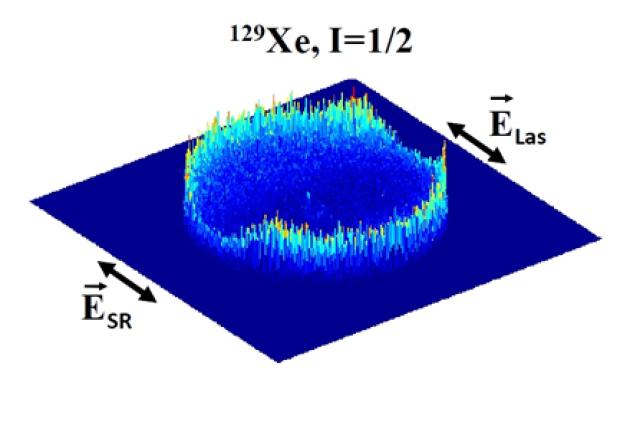
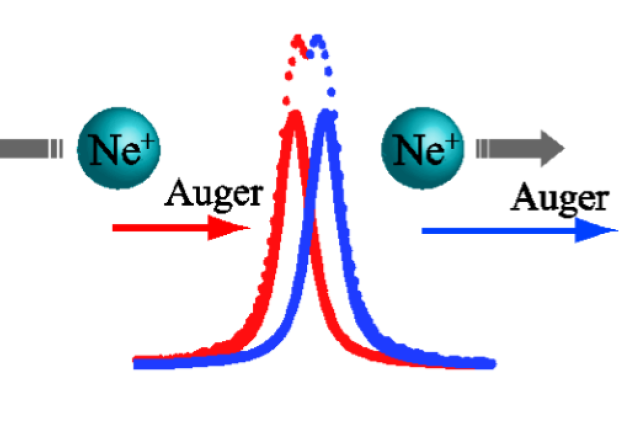
How to obtain a clear electron image when the nucleus of an atom perturbs the ionization (...)
Ionization is a phenomenon scientists have been trying to study closer and closer. Unfortunately, till now they were faced with an important blurring of the image taken. An international team recently (...)Read more -
 Published on 20/06/2014
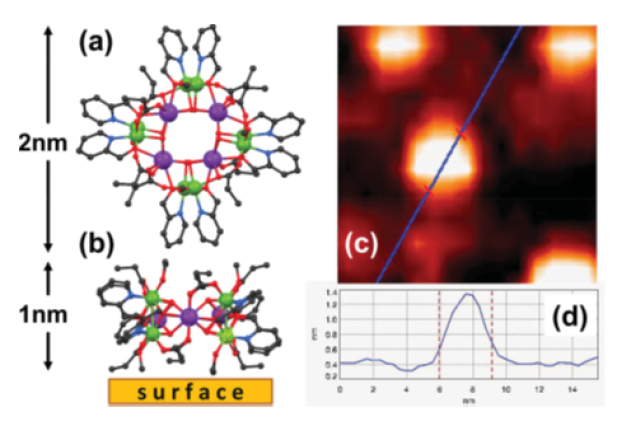
Single molecule cooler: a closer look at Gd4M8 on surface
An Italian-British team has come to SOLEIL to use the DEIMOS beamline to investigate single molecule coolers deposited on a gold surface. They observed that the deposition process did not alter the (...)Read more -
 Published on 11/06/2014
SOLEIL Highlights 2013 are available online
As each year, SOLEIL is glad to bring you its Highlights 2013 digital version, a selection of some striking works carried out in 2013 both on the beamlines and on the machine itself. 4000 visiting (...)Read more -
 Published on 07/06/2014
Doppler effect: a variation in the infinitely small
Thanks to an experimental setup unique in the world, a team of researchers from the Laboratory of Physical Chemistry - Matter and Radiation (UMPC /CNRS), the Free University of Berlin in Germany (...)Read more -
 Published on 05/06/2014
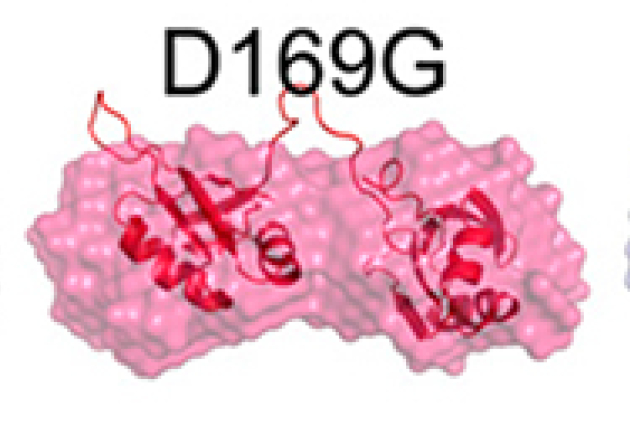
Increased stability of mutant proteins may be responsible for neurodegenerative disease
Scientists working in the Molecular Biophysics Group at the University of Liverpool have discovered that a particular protein’s stability could contribute to the onset of neurodegenerative disease.Read more -
 Published on 01/06/2014
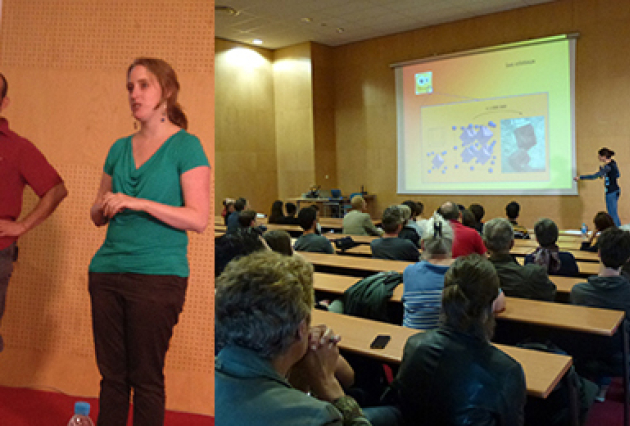
3rd June 2014: Science Break at SOLEIL on Crystallography!
SOLEIL organizes with the Diagonale Paris-Saclay a Science Break entitled: “The crystal, precious stone for researchers”.Read more -
 Published on 19/05/2014
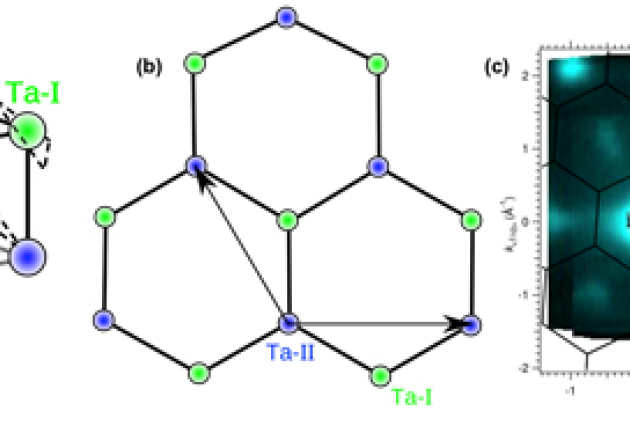
Creation of a two-dimensional metal with hexagonal symmetry on a transparent insulating (...)
2D metallic states are highly promising for the microelectronics of tomorrow. Researchers managed to create such state with hexagonal symmetry at the bare surface of several insulating oxides.Read more -
 Published on 19/05/2014
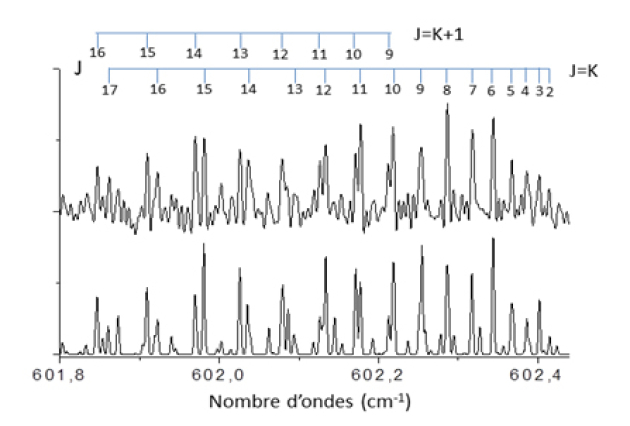
The cyclic ground state structure of HF trimer revealed by the Jet-AILES device.
On the AILES beamline at SOLEIL, the supersonic jet device associated with high-resolution infrared (IR) absorption spectroscopy (Jet-AILES) brought definite proofs of the planarity of hydrogen (...)Read more -
 Published on 15/05/2014
23rd -24th may at SOLEIL: First « #ACTINSPACE » days organized by the CNES
This unique event took place at the same time at SOLEIL and in cities like Bidard, Cannes, Mérignac Toulon and Toulouse. With the help and support of experts of space industry, students, entrepreneurs (...)Read more -
 Published on 09/05/2014
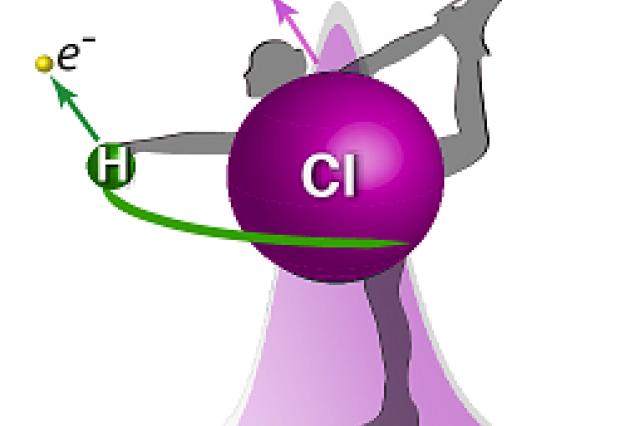
A new way to identify the atomic origin of molecular valence electrons
We often classify the electrons in an atom as being either ‘core’ electrons—those closest to the nucleus— or ‘valence’ electrons, those involved in chemical bonding. Indeed, if the atom is part of a (...)Read more -
 Published on 25/04/2014
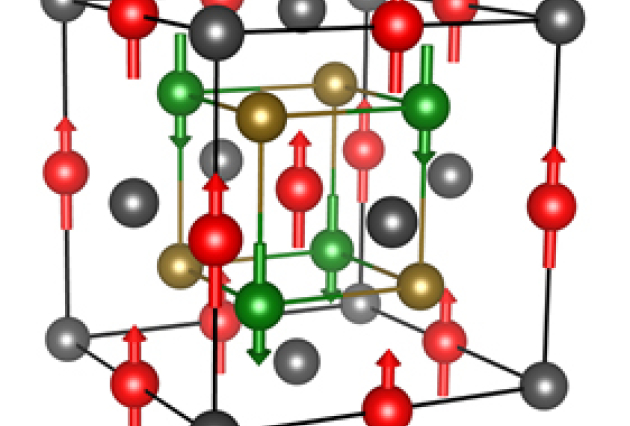
The magnet that isn’t
Technological and social progress has been driven by the mastery of new materials. Think of the massive change in our way of life brought about by the invention of steel or the profound social changes (...)Read more