
The "oldest octopus"'s mistaken identity unmasked using the PUMA beamline
An international team including scientists from the IPANEMA Institute and the PUMA beamline has revealed that a 300-million-year-old fossil, previously thought to be the oldest known octopus, is in fact a very different animal: a nautiloid.
This study, published in the Proceedings of the Royal Society B, resolves a major evolutionary paradox by confirming a much more recent origin for modern octopuses, while providing unique insights into the poorly-known soft tissues of nautiloids.
While the fossil record and molecular clocks* place the origin of modern octopuses in the Jurassic period, about 150 million years ago, a 300-million-year-old fossil named Pohlsepia mazonensis, discovered in the famous Mazon Creek concretions (Illinois), suggests an origin twice as old. This 150-million-year gap, with no intermediate fossils to bridge it, remained one of the greatest mysteries of cephalopod evolution.
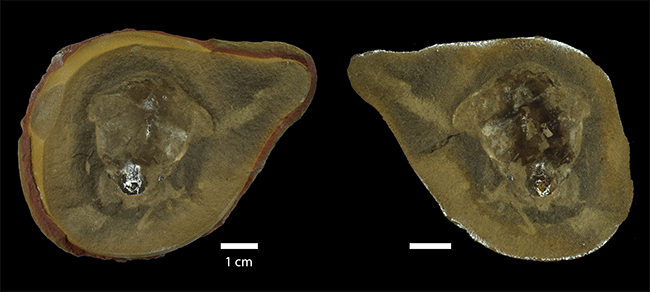
Since its description in 2000, however, the identity of Pohlsepia has remained highly debated, as the soft tissues preserved in the Mazon Creek fossils are often limited to colored spots, which experts consider misleading when examined visually. Taking advantage of new imaging methods that have emerged since the 2010s, which allow for an unprecedented description of fossil anatomy, including internal structures and invisible details, scientists were able to reexamine this fossil in the manner of a true forensic investigation. While the 3D X-ray scanner proved largely uninformative because the fossil is almost entirely flat, another approach using X-rays at the PUMA beamline revealed Pohlsepia’s true identity.
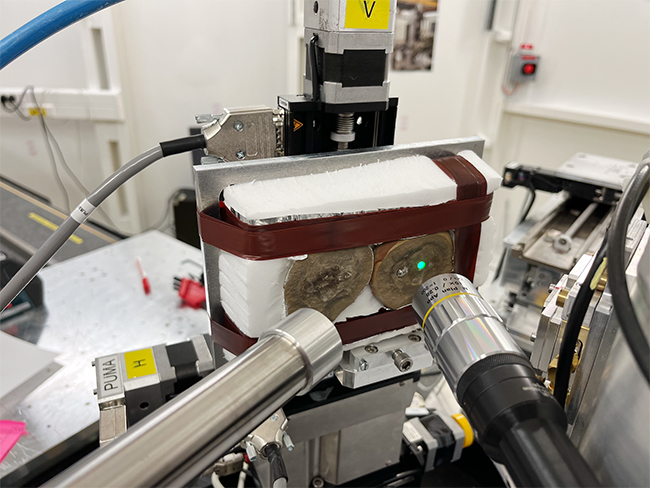
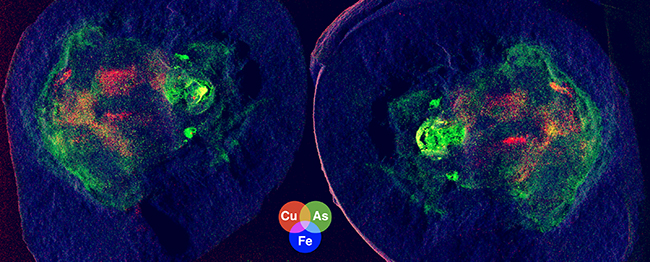
This method, X-ray fluorescence imaging, enabled the team to map the distribution of chemical elements across the entire fossil with high precision. Where the human eye could see only a uniform stain, the maps of copper and arsenic clearly reveal different soft parts of the organism.
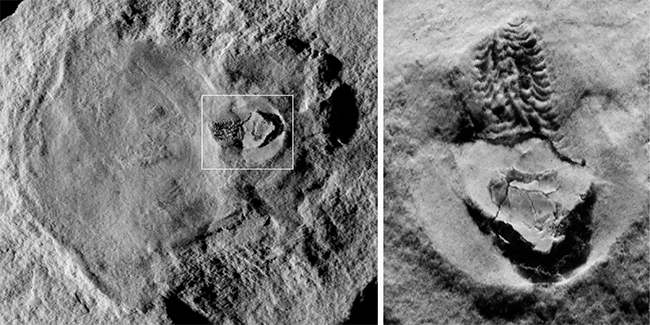
But the irrefutable proof of Pohlsepia’s true identity emerged in a region of the fossil’s mouthparts, called the radula, revealed by the distribution of iron, which offers a highly detailed view of the different rows of teeth that make it up. With between 11 and 13 teeth per row in Pohlsepia, compared to only 7 to 9 in octopuses and 13 in nautiloids, the verdict is in: Pohlsepia is not an octopus but a nautiloid. In fact, the morphology observed in Pohlsepia corresponds exactly to that of the nautiloid Paleocadmus pohli previously described from Mazon Creek, and thus the fossil described as Pohlsepia is in fact a specimen of Paleocadmus.
One final question, likely the source of the confusion, still puzzled the scientists: if this is a nautiloid, where did its shell go? The series of analyses conducted by the team shows that the organism’s body detached from the shell after its death. The shell, filled with gas, floated while the body sank and decomposed significantly before being buried. The structures previously interpreted as octopus fins are in fact the decomposed remains of muscles or digestive organs, leading to an accidental resemblance to the anatomy of an octopus.

This unmasked mistaken identity resolves an anomaly that had been skewing the evolution models for two decades: modern octopuses did indeed originate during the Jurassic period. While paleontology loses its “oldest octopus,” it gains an invaluable scientific treasure, as this fossil preserves the oldest known soft-tissue remains in nautiloids.
* Molecular clocks are methods used to estimate the origin of modern species or groups of organisms, based on the assumption that genetic mutations accumulate in a genome at a constant rate.