
Portrait of Damien Jeangérard, control room operator - At the heart of the accelerators
Through a series of portraits, Synchrotron SOLEIL meets the men and women who bring the synchrotron to life. For this seventh episode, Damien Jeangérard, control room operator, agreed to take part. His main mission? To ensure the smooth operation of the electron accelerators so that scientists on the beamlines can successfully carry out their experiments. A strategic role at the very heart of the synchrotron, where no two days are alike and learning never stops. Much to his delight.
If you ask Damien Jeangérard to name two essential qualities for his profession, he will likely reply: a love of technical challenges and a strong ability to adapt. A control room operator at SOLEIL for the past two years, he works rotating shifts—three eight-hour shifts and sometimes two twelve-hour shifts—requiring his circadian rhythm to adjust regularly.
“It’s a rhythm that suits me,” he notes. “My children are grown up now, and working staggered hours gives me time during the day for personal activities.”
Keeping an eye on everything
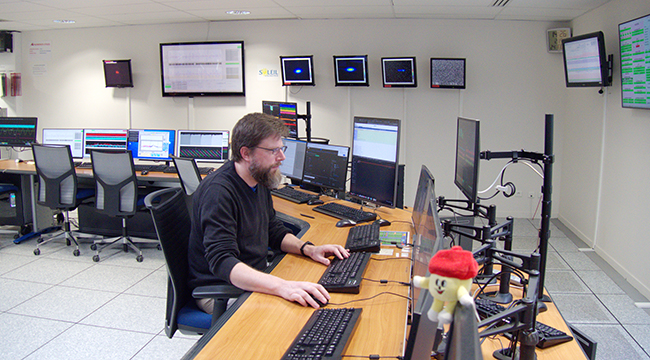
Particle accelerators require constant attention. In the control room, Damien Jeangérard sits at the center of everything happening within the synchrotron. “The range of tasks is vast,” he explains. “The most important is preparing and maintaining a stable and homogeneous electron beam.”
This beam produces the radiation used by SOLEIL’s 29 beamlines—research laboratories that operate simultaneously and independently.
To prepare the beam, Damien and his team must first validate the proper functioning of the accelerator equipment and the injection of electrons into the storage ring. Once this delicate operation is complete, the infrastructure cannot be left unattended.
“We need to keep an eye on hundreds of equipment parameters—on the LINAC, the Booster, and the storage ring—and adjust some of them when necessary,” he details.
In the event of an incident involving “the Machine”—the internal name for the entire set of electron accelerators—control room operators must quickly identify the faulty equipment, restore operations, and, for the most serious technical issues, call in SOLEIL’s support groups.
Operators are also the first to be alerted in the case of personal injury, fire outbreaks, or any other emergency affecting site safety, as the control room also serves as the Security Control Post. During major incidents, they are among the last to leave the synchrotron, ensuring the building has been properly evacuated.
Alongside preparing and maintaining the electron beam, each operator handles a range of additional tasks, sometimes in collaboration with other SOLEIL groups. Damien Jeangérard, for instance, develops software for the control room to improve mastery of the synchrotron’s complex, cutting-edge systems.
During extended beam shutdowns for technical maintenance—lasting several weeks twice a year—his team also plans and coordinates work on the accelerators.
Did Damien ever imagine himself at the heart of such a unique infrastructure? “Not at all. Before working at the synchrotron, I didn’t know about SOLEIL, nor did I really know the research world.”
Returning to hands-on work
Damien Jeangérard moved to Essonne at age 10 and completed his education there: first a vocational certificate (BEP) in electrotechnics, then a vocational baccalaureate in maintenance of automated mechanical systems (MSMA), through an apprenticeship program at the Faculté des Métiers de l’Essonne in Bondoufle.
His company, GIAT Industrie in Versailles, offered him a job at the end of his studies. “And that’s how I entered the workforce.” He remained there for seven years before joining Environne’Tech, later acquired by the EMITEC group, specializing in environmental testing for a wide range of equipment—from toys to aeronautics. Around the same time, just a few dozen kilometers away, Synchrotron SOLEIL was inaugurated.
“I need to handle things, to explore and to find solutions to problems.”
At Environne’Tech, Damien began as a mechanical testing technician specializing in vibration testing and physical measurement. Ten years later, he became laboratory manager but struggled to find fulfillment.
“Despite having a very pleasant team, I didn’t see myself in management. I need to work with my hands, to explore and solve problems.”
He decided to change direction and applied for an assistant engineer position on the PROXIMA-2A beamline at Synchrotron SOLEIL.
“The missions looked appealing on paper, and the interview made me even more motivated to join the synchrotron,” he recalls. “I wanted to return to a more technical position with projects to carry out independently. I wasn’t mistaken—the PROXIMA-2A team offered me exactly that.”
“We aim to achieve high-quality results, giving ourselves the time and the means to get there.”
Gradually, Damien discovered a new world that he quickly came to appreciate.
“I was coming from several years in industry, constantly chasing priorities and deadlines… Here, there’s more serenity,” he says. “We aim to achieve high-quality results, giving ourselves the time and the means to get there.”
What he appreciates most is the culture of knowledge sharing that drives the synchrotron and its community—whether among beamline scientists, “fascinating people,” or during seminars rich in encounters and exchanges. “I remember finding that surprising at first, especially compared with industry.”
A new challenge
After seven years, Damien felt the need for change.
“I wanted to see something different and take on a new challenge,” he explains.
In 2023, he moved into the control room operator position. At first, the task seemed daunting.
“On PROXIMA-2A, I learned how a beamline operates, but that’s only one part of SOLEIL,” he explains. “I wasn’t familiar at all with the accelerators, which are the heart of the synchrotron.”
He feels he has “crossed a bridge between two different worlds,” without regret—and even “with pride.”
“I’m very happy to have discovered another world. On PROXIMA-2A, we focused on the beamline, whereas the control room is SOLEIL’s nerve center. Here, we interact with all the teams,” he says. “And my experience on a beamline gives me a better overall understanding of the synchrotron.”
His daily work is highly varied. Two years later, he says he is still discovering new features. “But that’s what I like,” he smiles.
Still, the job comes with moments of stress: “Outside normal working hours, you’re alone with the Machine, responsible for keeping it running properly. There’s no room for error.”
To unwind, when he’s not listening to one of his favorite metal bands, Damien—once an avid video gamer—above all enjoys tinkering in that same universe: “I always have a computer in my hands, with something geeky to experiment on.”
At work or at rest, there is always a machine to master...

Damien Jeangérard's ' mini biography
1995: Vocational certificate (BEP) in electrotechnics, Lycée Léonard de Vinci, Saint-Michel-sur-Orge, France
1997: Vocational baccalaureate in maintenance of automated mechanical systems (MSMA), Faculté des Métiers de l’Essonne, Bondoufle, France
1997–2005: Test technician, GIAT Industrie, Versailles, France
2005–2012: Mechanical testing technician (vibration testing and physical measurement), Environne’Tech (later EMITECH), Villebon-sur-Yvette, France
2012–2016: Head of climate-mechanical testing laboratory, EMITECH, Villebon-sur-Yvette, France
2016–2023: Assistant engineer on the PROXIMA-2 beamline, Synchrotron SOLEIL, Saint-Aubin, France
2023–present: Control room operator, Synchrotron SOLEIL, Saint-Aubin, France
Damien Jeangérard’s Playlist
“It’s really not an easy exercise…” We asked Damien Jeangérard, a passionate metal music fan, to introduce some of his favorite bands through a selection of tracks.
- Draconian - Rivers Between Us
“A very melancholic piece. The lyrical singer’s voice is simply magnificent, paired with a restrained death voice (guttural vocals). A great blend that helps me focus during coding sessions—and reminds me of my gothic phase.” - Tagada Jones - Tout va bien
“A French punk metal band. Since I also listen to some punk, this hybrid sound really appeals to me. The lyrics resonate with me, and it’s great for singing at the top of your lungs.” - Metallica - Ride The Lighting
“I took my first steps into metal as a teenager with Metallica. A cult band.” - Ultra vomit - Doigt de métal
“A parody metal band from Nantes. Very skilled musicians, incredibly creative in their parodies, and amazing live. TOP!” - Within Temptation - We Go To War ; Epica - Cross the Divide ; Nightwish - Wishmaster
“I really like female operatic vocals combined with powerful music. Here are a few examples—I couldn’t choose just one.” - Pitbulls in the Nursery - Rule the Plight ; Gorod - Bekhten's Curse
“I love technical death metal, and in France we have real gems. Gojira is one of them but since they’re very well known, here are two other excellent, perhaps more underground, bands.”
“There are also bands like Opeth, Leprous, Haken, X Japan, Dimmu Borgir… Too many to name. To sum up, I mostly listen to European bands, with almost no nu metal or metalcore.”