
How a reactive ion turns small gas molecules into complex organics
Scientists from ISMO, ICP and ISM used the CERISES instrument at the DESIRS beamline at SOLEIL to investigate how cyclopentadiene (C₅H₆)—a key building block of complex carbon and aromatic molecules—forms in cold interstellar clouds. By combining laboratory experiments and modeling, they identified new ion–molecule reactions and measured their rates, significantly improving predictions of its abundance.
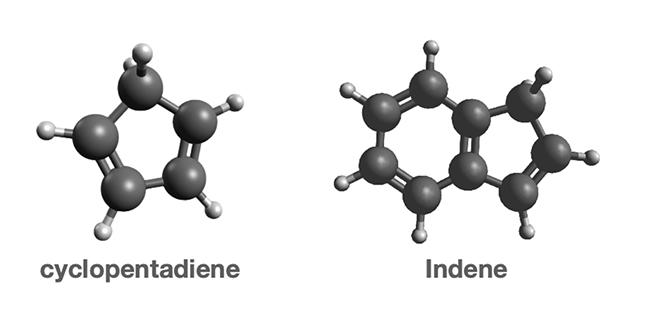
Cold molecular clouds such as TMC-1 (Taurus Molecular Cloud-1) are key laboratories for understanding the build-up of molecular complexity in space. Over the past decade, radioastronomical surveys have revealed an unexpectedly rich inventory of cyclic and aromatic species, including cyclopentadiene (C₅H₆), indene (figure 1), and several cyano derivatives. However, despite these detections, astrochemical models have consistently underestimated the abundance of C₅H₆ by factors of several, highlighting a lack of reliable data about formation pathways from simple acyclic precursors toward the first five-membered aromatic ring.
Before this work, two main routes were considered for C₅H₆ formation: ion–molecule chemistry leading to the protonated precursor C₅H₇⁺ followed by dissociative recombination, and neutral–neutral chemistry involving radicals such as CH + C₄H₆ or radiative association processes. Both approaches suffered from major uncertainties, either due to missing key ion–molecule reactions or poorly constrained intermediate species such as 1,3-butadiene. As a result, no model could simultaneously reproduce the observed abundance of C₅H₆ and remain chemically consistent with the broader hydrocarbon network in TMC-1.
In this work, the scientists combined laboratory experiments, quantum chemical calculations, and astrochemical modelling to refine the formation routes of C₅H₆. Using the CERISES tandem mass spectrometer at the DESIRS beamline, they measured absolute reaction rates for the ion–molecule system C₂H₄⁺ + C₃H₄, identifying efficient production of C₅H₇⁺ with a rate coefficient of ~10⁻⁹ cm³ s⁻¹. These results were incorporated into the NAUTILUS gas–grain model together with an updated network of ion–molecule and neutral reactions. They identified two dominant reactions to form C₅H₇⁺, namely C₂H₄⁺ + CH₃CCH and C₃H₇⁺ + C₂H₂, significantly improving the ionic contribution to cyclopentadiene formation. The chemical network leading to the formation of C₅H₆. is presented in Figure 2.
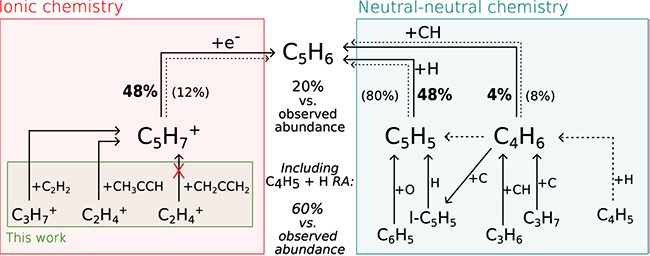
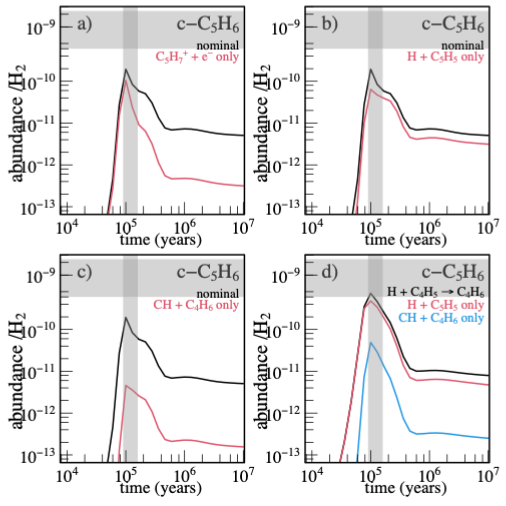
The model reproduces only ~20% of the observed C₅H₆ abundance, as shown in Figure 3, with main leads to improvments reside within neutral chemistry. In particular, radiative association between H and C₅H₅ emerges as the main neutral pathway, while routes involving C₄H₆ are strongly limited by its uncertain abundance and rapid destruction by atomic carbon. This highlights the need for a consistent treatment of radical chemistry in dense clouds.
The contribution of SOLEIL was crucial in this study, providing tunable vacuum ultraviolet radiation and offering the posibility to perform isomer-selected ion chemistry measurements under controlled single-collision conditions. This allowed the scientists to directly constrain reaction rates and how the products are distributed among different possible pathways (branching ratios) that are otherwise inaccessible, thereby reducing key uncertainties in astrochemical networks.
These results open several perspectives. The next step is to extend this approach to the formation of benzene (C₆H₆), the first fully aromatic six-membered ring, using an isomer-specific treatment of key intermediates such as C₃H₃⁺. This will allow to refine the chemical network up to the first aromatic ring closure, providing a robust foundation for modelling the formation of larger polycyclic aromatic hydrocarbons. Ultimately, this work moves us closer to a predictive framework for molecular growth from simple hydrocarbons to complex carbonaceous structures in the interstellar medium.