Understanding the chemical behaviour of spent nuclear fuel by probing actinide electronic orbitals using a high-resolution X-ray spectroscopy analysis technique (X-ray scattering)
Advanced spent nuclear fuel recycling, nuclear waste separation and long-term prediction of radionuclide behaviour in geological disposal facilities are all challenges that, to be met, require an understanding of the chemistry of the actinides - the family of radioactive elements that includes uranium, neptunium, and plutonium.
To better understand how actinides interact with their chemical environment, researchers from the University of Manchester and CEA Marcoule used the MARS beamline at SOLEIL, one of the very few synchrotron beamlines worldwide capable of conducting high-resolution X-ray spectroscopy experiments on highly radioactive materials.
At the heart of this research lies a longstanding problem in actinide science: the role of the 5f orbitals in chemical bonding. These are radially extended into the valence region, and their involvement in covalent bonding – i.e. the sharing of electron density - influences important chemical properties such as reactivity, ligand selectivity and oxidation-state stability. Despite decades of research, direct experimental measurements of how 5f orbitals participate in covalent bonding are rare. This lack of experimental evidence limits our ability to validate computational models, which are heavily relied upon for predicting the long-term behaviour of spent nuclear fuel.
Breakthrough results
In a study published in Chemical Science, researchers from The University of Manchester, Synchrotron SOLEIL, and CEA Marcoule have demonstrated that resonant inelastic X-ray scattering (RIXS) can provide unprecedented experimental insight into the nature of actinide 5f orbitals. The team studied a series of actinide (An) hexachloride [AnCl6]2- complexes containing uranium, neptunium, and plutonium. Subtle features in the RIXS spectra were identified and analysed using ligand-field density functional theory and state-of-the-art multiplet theory RIXS simulations. The researchers showed that the technique is sensitive not only to the overall extent of 5f covalent bonding in each complex, but also to how electron density is distributed within the 5f orbital shell.
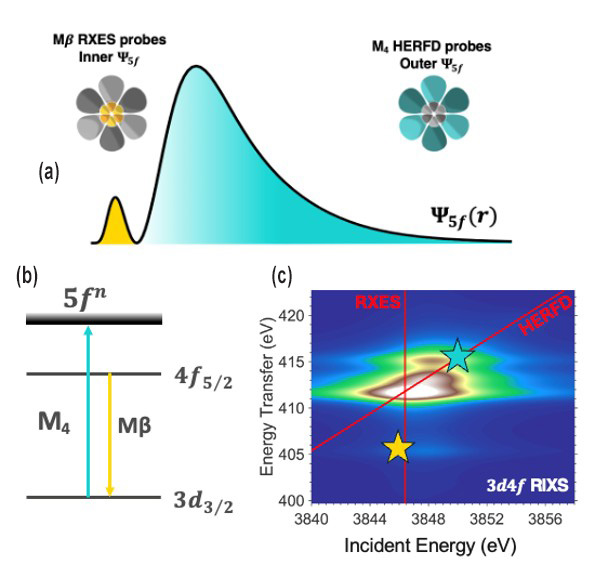
The measurements revealed that different parts of the 5f orbital radial wavefunction respond differently to bonding. The outer region of the orbital expands as covalency becomes stronger (central-field covalency), while the inner region remains constrained by the increasing nuclear charge across the actinide series. These two phenomena can be accessed from the RIXS by taking ‘cuts’ through the 2D RIXS plane. A constant emission energy cut, known as high-energy resolution fluorescence detection (HERFD) accesses fine structure governed by 5f-5f interelectron repulsion, and gives insight to the outer part of the 5f orbital wavefunction. A resonant X-ray emission spectroscopy (RXES) measurement detects a second satellite feature, which relates to 4f-5f spin-exchange interactions, which are dominated by the inner part of the 5f wavefunction.
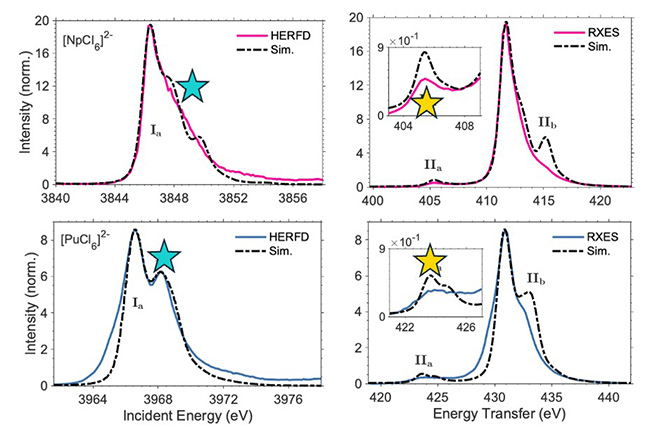
These unique sensitivities allowed the researchers to quantify trends in actinide covalency directly from experiment, and rationalize them in the context of the ‘actinide contraction’, a known effect where the 5f orbitals become less expanded as the actinide series is traversed. The results provide some of the clearest experimental evidence to date for how the 5f orbitals respond to chemical bonding, and enhance our ability to establish structure–function relationships and bonding trends in actinide chemistry. This work adds to the growing body of research demonstrating the power of M4-edge RIXS as a probe of actinide electronic structure and provides much-needed experimental data to validate theoretical models.
SOLEIL's contribution
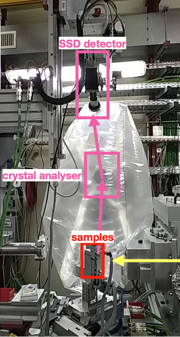
These measurements were performed at the MARS beamline at Synchrotron SOLEIL, one of the very few synchrotron beamlines worldwide capable of conducting high-resolution X-ray spectroscopy experiments on highly radioactive actinide materials. For this study, the beamline's CX3 endstation was used to perform high-resolution M4-edge HERFD and RXES measurements on neptunium and plutonium complexes under strict radiological containment conditions. The high spectral energy resolution achieved at MARS enabled the researchers to resolve fine-structure signatures in RIXS that carry information about the 5f orbitals and their response to chemical bonding. By providing access to the unique RIXS capabilities for transuranium elements, SOLEIL continues to play a key role in advancing our understanding of the fundamental chemistry of radioactive materials.