
Observing skyrmionic cocoons in three dimensions
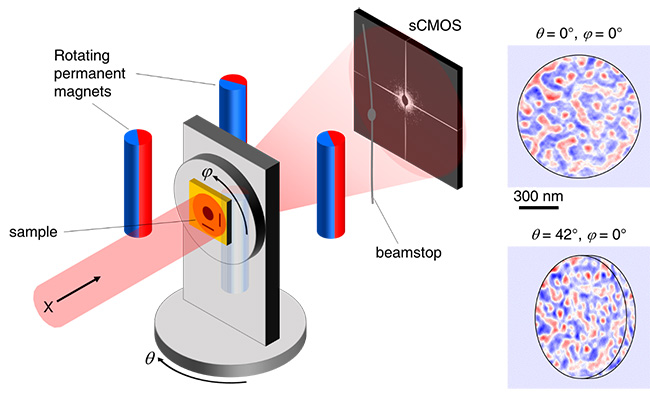
Recently, it became possible to image in three dimensions magnetic textures having dimension of 100 nm or even less. The joint teams of the Laboratoire Albert Fert in Palaiseau and the SEXTANTS beamline scientists, helped by colleagues from the Helmholtz-Zentrum Berlin, the University of Augsburg and the Max Planck Institute for Chemical Physics of Solids in Dresden, used a peculiar holography technique called HERALDO, allowing different projection of a sample containing “cocoons” to be acquired. Digitally combining these projections delivers a 3D map of the 3D magnetization inside the sample.
Sub-micronic three dimensional (3D) magnetic textures, notably the ones having a peculiar topology and chirality, are attracting a renew attention these last few years, partly thanks to the progresses in the imaging techniques. Among them, some are topologically non-trivial, meaning that they cannot be continuously deformed into a uniform state. Their non-trivial topology gives rise to a number of physical effects, such as the skyrmion Hall effect or the topological Hall effect. Understanding the chiral interactions allowing their stabilization and imaging their 3D internal structure has enabled the control of such effects. Among the imaging techniques stand in good position the ones based on soft X-ray imaging: the photons energy is tuned at an energy at which the absorption depends on the magnetic state of the sample, providing magnetic contrast with high spatial resolution.
At SOLEIL, on the SEXTANTS beamline, HERALDO measurements were performed. HERALDO is a form of holography measurements which uses slits instead of holes as reference sources. The advantage of the slit is notably that it allows the sample to be tilted in the X-ray beam and hence record different projection of the sample and its magnetic state. Using a recursive algorithm, after a fairly complex treatment of images including nm-precision alignment, the 3D magnetization is reconstructed in 3D (Fig. 1).
Using HERALDO, they studied a specific texture called skyrmionic cocoon. Cocoons are stabilized by a precise engineering of magnetic interactions, notably the Dzyaloshinskii-Moriya interaction (DMI), the perpendicular magnetic anisotropy (PMA) and the Zeeman energy through an external magnetic field. DMI and PMA are related to interfacial effects that the spintronics team at Laboratoire Albert Fert has been studying for years, and hence controls very well in Pt|Co|Al-based multilayers.
Multilayers are often realized to increase the stability of the textures or the signal, using regular repetitions of the same bi- or tri-layers. In 2020, they started to study the possibility to use aperiodic multilayers to modulate the interactions strength through the thickness of the multilayer, allowing us to stabilize new magnetic textures. By engineering multilayers with a reduced anisotropy (varying the Co thickness) in the central part of the multilayer, they stabilized skyrmionic cocoons, a discretized version of the torons also known as dipole strings.
With HERALDO, the scientists imaged two cocoon-hosting aperiodic multilayers coupled with a periodic multilayer with higher PMA, allowing textures to potentially extend throughout the entire multilayer stack. Using Ni in the high-PMA region, taking advantage of the chemical selectivity of the technique, they could easily determine if the central region of large PMA was switched or not, confirming the 3D reconstructions (Fig. 2).
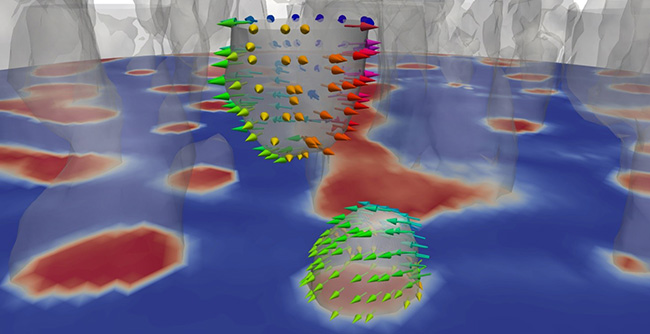
As could be observed, even though Fourier shell correlation analysis (a standard metric for estimating the resolution of 3D reconstructions) indicates that the resolution should be close to 30 nm, there are a few discrepancies that point to the fact that the reconstruction is imperfect, partly due to the fact that the direct beam is masked, blocking the low frequencies, and hence altering the calculation of each projection.
3D reconstruction of magnetic textures measuring less than 90 nm is still a feat!