
Electronic structures of quantum materials - Shining new lights on the fractional quantum anomalous Hall effect
Researchers from Tsinghua University (Beijing, China) and their collaborators used NanoARPES at SOLEIL’s ANTARES beamline to reveal how a moiré pattern in rhombohedral graphene fundamentally transforms its electronic behaviour.
Their findings offer key insights into the microscopic mechanisms underlying the fractional quantum anomalous Hall effect.
When two ultrathin materials, such as graphene (a single layer of carbon atoms arranged in honeycomb lattice), are stacked with a small twist angle, they form a large-scale “moiré” pattern (figure 1a) that can profoundly reshape their electronic behaviour.
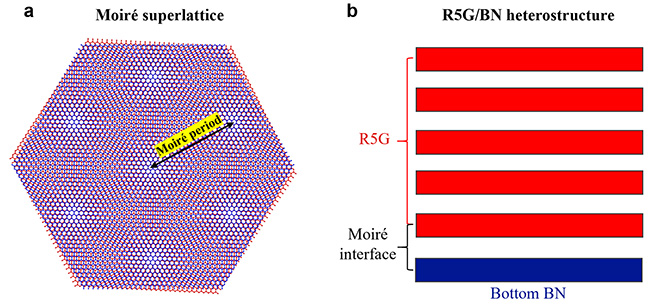
In recent years, such moiré superlattices have become a platform for discovering novel quantum phenomena. A prominent example is the fractional quantum anomalous Hall effect (FQAHE) observed in rhombohedral graphene moiré superlattice (Figure 1b).
However, a key mystery remains: although the moiré pattern exists only at the interface of the stacked materials, the FQAHE often emerges in graphene layers far from that interface. How can a nanoscale modulation confine to one-layer influence electrons several layers away?
To address this question, Shuyun Zhou’s team at Tsinghua University, together with collaborators from Shanghai Jiao Tong University and Peking University, investigated a five-layer rhombohedral graphene/boron nitride heterostructure—a system where FQAHE has been observed. Their goal was to directly visualize how the moiré potential reshapes the electronic structure throughout all five layers. Collaborating with Dr. Pavel Dudin and Dr. Jose Avila at the ANTARES beamline, the researchers employed NanoARPES, a technique that maps electronic energy-momentum relations with sub-micron spatial resolution. This level of precision was crucial because the samples are only a few micrometres in size, well below the capabilities of conventional ARPES (Figure 2).
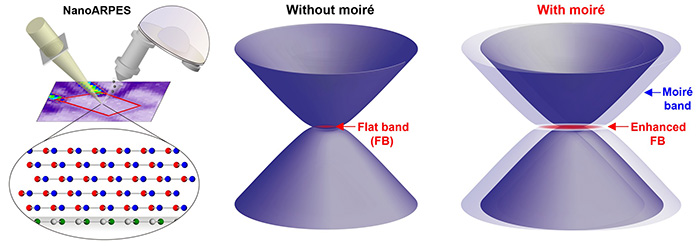
The measurements revealed two key findings. First, the researchers directly imaged topological flat bands, by which electrons move with extremely low velocity and strong interactions, providing long-sought experimental evidence in this system.
Second, they observed clear moiré bands not only at the moiré interface but also in graphene layers far from it, along with a strongly enhanced topological flat band due to the moiré potential (Figure 3).
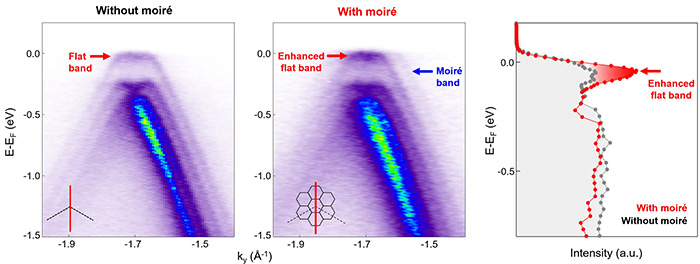
These results demonstrate that the moiré potential has a surprisingly long-range impact, modifying electronic states well beyond the interface where the moiré pattern formed. To understand this behaviour, theoretical simulations show that the strong interlayer coupling enables moiré-induced modulations of charge and electronic states to propagate through the entire stack.
This mechanism offers a possible explanation for why the FQAHE can emerge away from the interface, providing critical information to resolve an important open question in the field.
* The fractional quantum Hall effect (FQHE) is a landmark quantum phenomenon discovered decades ago in ultra-clean two-dimensional electron systems at extremely low temperatures and strong magnetic fields. Under these conditions, electrons no longer behave as independent particles but instead form a strongly correlated quantum fluid. Their collective motion produces fractionally quantized steps in the Hall resistance. This behavior is remarkable because individual electrons carry an indivisible charge; yet the many-body state behaves as if it supports quasiparticles with fractional electric charge.
This paper investigates an exotic version of this physics known as the fractional quantum anomalous Hall effect (FQAHE). The term “anomalous” indicates that the effect appears without any external magnetic field. This is possible in specially engineered materials where the electrons’ motion and the geometry of the electronic energy levels mimic the influence of a magnetic field — essentially creating quantum effects purely from the structure of the material. In this configuration, a topological flat band (electrons that share the same energy level and behave collectively) exists and is enhanced by the moiré potential in aligned five-layer rhombohedral graphene on hexagonal boron nitride (R5G/BN heterostructure).