The study of Gallo-Roman curse tablets discovered in Orléans continues at the PSICHÉ beamline
After conducting a first series of highly conclusive test measurements in October 2024 on the PSICHE beamline, two archaeologists from the Archaeology Department of the City of Orléans returned in December 2025 with the aim of accessing the texts inscribed on 17 Gallo-Roman curse tablets. Their five intense days of X-ray microtomography on PSICHE have already yielded a wealth of results.
In Orléans, as part of the redevelopment of the former Porte Madeleine hospital, a previously unknown Gallo-Roman necropolis was uncovered thanks to two successive archaeological excavation campaigns carried out between 2022 and 2025. During these excavations, 23 Gallo-Roman lead curse tablets (defixiones, from the Latin defixio, meaning curse or spell) were discovered in the graves, some folded in half, others completely rolled up on themselves.
In order to access the texts engraved on these fragile and precious objects, a few rare tablets were able to be opened, with great expertise and care and following a stabilisation treatment, by a conservator-restorer. However, in most cases, examination of the tablets showed that opening them manually would risk damaging them and, with them, the unique texts they bear.
Yet, using X-ray microtomography, the PSICHÉ beamline team succeeded in 2023 in virtually unrolling a 1,700-year-old lead talisman, revealing an engraved text in the Mandaean language that could then be deciphered.
Having learned of these impressive results obtained on a research question comparable to their own, Caroline Millereux and Julien Courtois, archaeologists at the Archaeology Department of the City of Orléans (SAVO), contacted the beamline scientists. After first assessing the feasibility of studying one of their tablets during a short visit to PSICHÉ in October 2024, Caroline and Julien—encouraged by the very promising results obtained—subsequently submitted a proposal to SOLEIL in order to pursue their research further. The verdict: the project was accepted, and five full days of beam time were allocated to them.
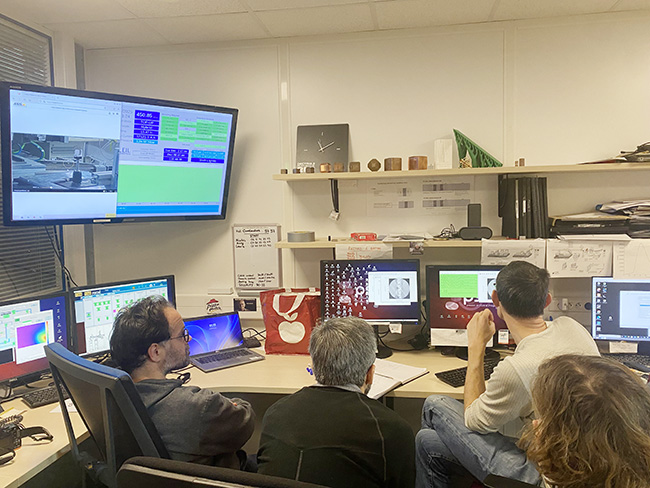
On 2 December 2025, the archaeologists arrived on PSICHÉ with 17 curse tablets in their luggage! At the end of the allocated experimental time, 10 of the 17 folded or rolled tablets had been fully scanned (see Figure 1).
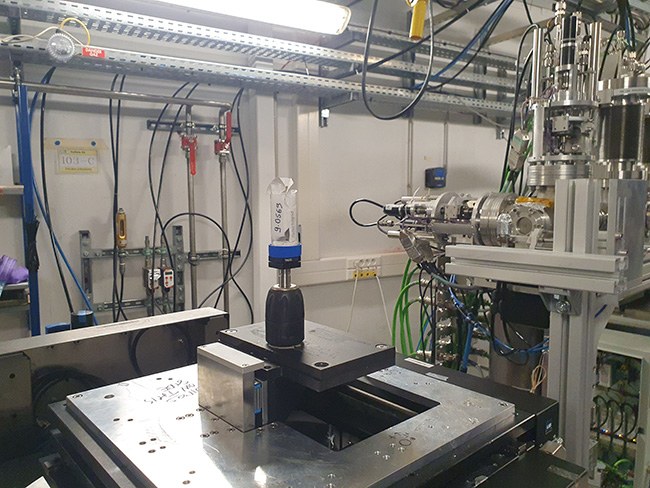
A lengthy process of digital data processing and manual corrections, based on the X-ray microtomography images obtained (e.g. Figure 2), can now begin. Its aim is, for each tablet, to precisely define the shape of the metal sheet from which it is made, including all its deformations. This information is essential in order to virtually unfold or unroll the tablets, to visualise the texts engraved on their surfaces and, ultimately, to decipher them, with the help of several specialists in ancient languages.
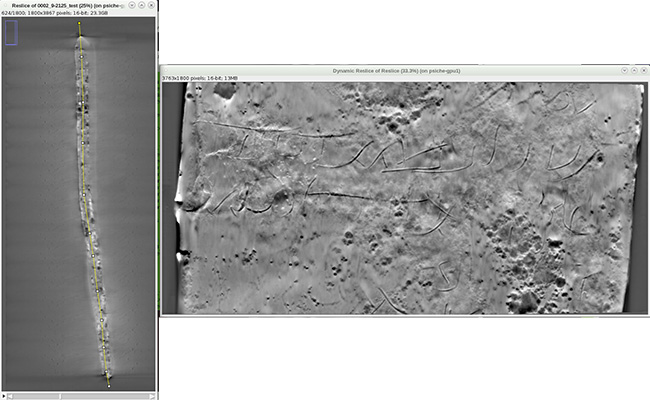
There is still much work ahead, as it appears that all ten of the first scanned tablets bear inscriptions—sometimes even on both sides! It will therefore be necessary to wait a little longer to find out whether, as is generally the case for this type of object, the tablets from the Orléans necropolis contain messages of curses or of so-called “white magic”, involving intercession with the deities.