
A world-first NAP-ARPES capability now operational on SOLEIL’s TEMPO beamline
The TEMPO beamline at SOLEIL Synchrotron has reached a major milestone with the successful commissioning of the world’s only facility dedicated to near-ambient-pressure angle-resolved photoemission spectroscopy (NAP-ARPES).
This breakthrough is the result of a close partnership between SOLEIL Synchrotron and Sorbonne Université, within a broad international collaboration involving researchers from France, Germany, Japan, South Korea and the United States. It brings angle-resolved photoemission spectroscopy into conditions much closer to those encountered in real-world applications. It further establishes TEMPO as a pioneering platform for operando studies of catalysis, energy materials and quantum materials.
Developed from Sorbonne Université’s near-ambient-pressure photoemission station installed on TEMPO, this unique instrument makes it possible to directly probe the electronic structure of surfaces while they are exposed to gases and during catalytic reactions. The design, development and commissioning of the instrument are described in a recent publication in Review of Scientific Instruments.
Probing the “electronic fingerprint” of a surface in operando
Unlike conventional NAP-XPS, which primarily provides information about the chemical composition of surfaces and the nature of their chemical bonds, NAP-ARPES gives direct access to the electronic states that govern the interaction between a material and its environment and play a key role in its chemical reactivity. In other words, the technique provides access to the electronic fingerprint of a surface while it is operating.
This new capability opens unprecedented opportunities for understanding the fundamental mechanisms underlying catalytic reactions. By directly probing the electronic structure of a material under realistic conditions, researchers can investigate how its electronic properties evolve as it interacts with its chemical environment—and how these changes are linked to reactivity.
From quantum materials to future energy technologies
The new capability offers particularly exciting prospects for quantum materials. Topological insulators, a class of materials emerging from the field of topological phases of matter recognized by the 2016 Nobel Prize in Physics, are being investigated as potential catalysts. Yet a fundamental question remains: do their distinctive surface electronic states actually contribute to chemical reactions?
TEMPO’s NAP-ARPES now provides a unique opportunity to address this question directly by observing these electronic states under gas exposure and in conditions close to those encountered during operation.
The technique is also particularly well suited to studying reactions involving hydrogen, a key element in future energy technologies. While hydrogen can be difficult to detect directly using conventional photoemission techniques, its interaction with a material can strongly modify the material’s electronic properties. NAP-ARPES can directly track these changes, providing new insights into the role of hydrogen in catalytic processes and energy-conversion mechanisms.
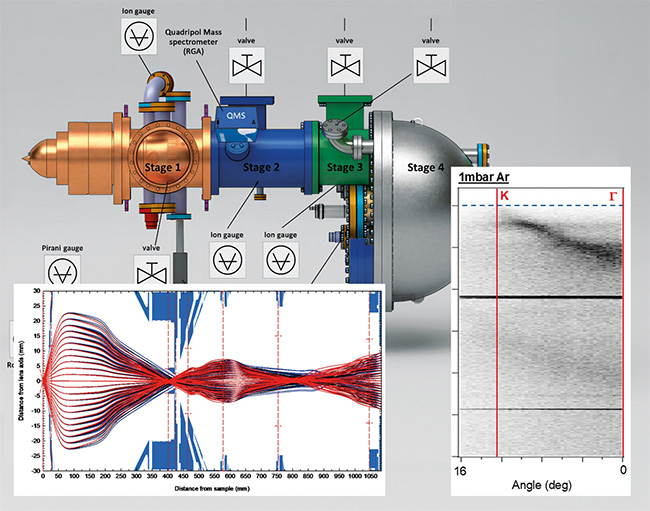
An integrated platform for studying materials under realistic conditions
The full potential of this new capability also lies in its combination with the complementary techniques already available on TEMPO. By bringing together NAP-ARPES, NAP-XPS and NAP-NEXAFS, along with the beamline’s established expertise in time-resolved experiments, researchers can now correlate chemical composition, electronic structure and process dynamics on the same sample and under the same reaction conditions.
TEMPO therefore provides a powerful integrated platform for investigating catalytic surfaces, energy materials, quantum materials and reactive interfaces directly under operando conditions.
The commissioning of this new capability is the result of a collective effort across SOLEIL Synchrotron. The commitment of Alignment and Vacuum groups, and of the Materials Laboratory, notably, were decisive.