
Unclogging life: restoring blood circulation by direct inhibition of myosin in capillaries – The discovery of a promising new molecule
In acute myocardial infarction notably, the capillaries that carry blood might remain blocked, significantly increasing the risk of death. Current therapy is based on vasodilators that affect the entire body and cause unwanted side effects.
Clinch Biosciences (Boston, USA), with the Structural Motility team (Institut Curie, Paris), discovered a new molecule that directly inhibits myosin, the vasoconstriction motor. X-ray diffraction data acquired on the PROXIMA-2 beamline at SOLEIL helped understand how this molecule works. Their findings have been published in Nature.
In acute myocardial infarction, kidney injuries, heavy surgeries (e.g. transplantations) and other severe clinical situations, blood capillaries might remain blocked and compromise oxygen supply to essential organs, significantly increasing the risk of death. This phenomenon, named “capillary no-reflow”, increases by sevenfold the chances of death after a heart attack. Current therapy is based on vasodilators that affect the entire body and cause unwanted side effects.
A game-changing strategy to restore blood circulation: direct inhibition of vasoconstricting motors
Clinch Biosciences (Boston, USA) identified a chiral myosin inhibitor with a curious specificity profile: one of the enantiomers has better specificity for smooth muscle myosin, and its handedness is the opposite of the canonical myosin inhibitor Blebbistatin. The Structural Motility team (Institut Curie, Paris), specialized in the structural biology of myosins and kinesins, were the best placed to solve this puzzle. They obtained crystal structures of the smooth muscle myosin in complex with the two enantiomers at 2.3 Å and 2.5 Å resolution and found, very surprisingly, that enantiomer with the opposite handedness binds to a completely different pocket in myosin. The low dose, fast X-ray data collection in the PROXIMA 2A beamline at SOLEIL gave an important contribution for their success. The complete story is published in Nature.
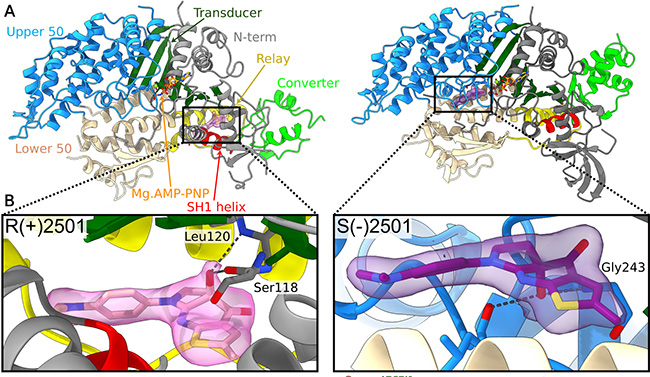
(B) Close-up views of R(+)2501 (left) and S(-)2501 (right) binding pockets, highlighting their distinct spatial localization. Electron density of the compound is shown.
More than a astonishing finding that explains the specificity of the enantiomer called R(+)2501, the discovery of this new chemical scaffold for a different allosteric binding site opens a new route for the development of myosin modulators of increased efficiency and specificity. Myosin modulation has already been proven efficient against conditions as diverse as inherited cardiomyopathies, spasticity, addiction and malaria.
Now that this new scaffold has been revealed, its exploration has begun, and there is certainly more drug candidates to come.
Related Protein Structures (PDB): 29ZY, 29ZZ