Right- or left-handed? Photoelectrons reveal the twist of molecular helices
Helices are chiral objects, i.e. they cannot be superimposed to their mirror images. How detecting molecules exhibiting such a chirality and characterize their handedness, especially in the gas phase where the matter is very dilute?
Researchers from the DESIRS team at SOLEIL, in collaboration with ISMO (Orsay) used tiny quantities of carbo[6]Helicene synthetized at Universities of Rennes, Aix-Marseille and Hangzhou, to show that photoelectron circular dichroism (PECD) can directly probe the helical chirality of molecules. Experiments on the DESIRS beamline revealed strong chiral signals, reaching 25%, demonstrating the exceptional sensitivity of PECD and its universality.
A sensitive way to probe molecular handedness
Chiral molecules exist in two forms that are mirror images of one another but cannot be superimposed, known as enantiomers. Although these molecules have the same chemical composition, their three-dimensional shapes can provide them with very different properties. This phenomenon, known as chirality, plays a central role in chemistry and biology, from molecular recognition to the action of pharmaceuticals.
One particularly striking form of chirality is found in helicenes: molecules made of several fused aromatic rings that adopt a twisted, screw-like shape. The resulting right- and left-handed “staircase” are known as P and M enantiomers. Helicenes are of particular interest because their unusual structure gives rise to distinctive properties, with potential applications in molecular electronics and materials with chiral optical responses.
A powerful method for detecting chirality in molecules is photoelectron circular dichroism (PECD), observed as a very intense forward/backward asymmetry in the angular distribution of photoelectrons created by ionization of a single enantiomer by circularly polarized light (CPL), making PECD an exceptionally sensitive probe of molecular chirality especially in dilute gas phase matter.
Until now, however, PECD had only been investigated using molecules with other types of chirality, especially central chirality based upon a chiral center, such as the Ca carbon atom of amino-acids. The question was whether this technique could also detect the helical shape of helicenes, exhibiting no specific symmetry-breaking elements.
A strong chiral signature from a single molecular helix
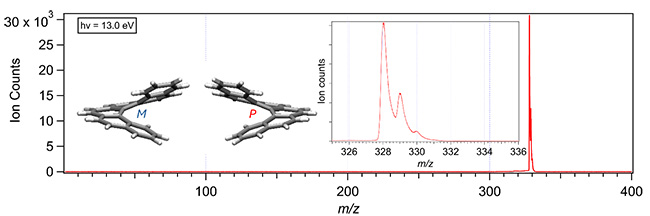
To address this question, researchers studied carbo[6]helicene (hexahelicene), the first member of the helicene family whose two enantiomers are sufficiently stable to be investigated as isolated molecules in the gas phase (see Fig.1). The experiments were carried out at the DESIRS beamline, delivering VUV CPL, and using the DELICIOUS 3 double-imaging photoelectron–photoion coincidence spectrometer.
They observed clear and remarkably strong PECD signals from the two enantiomers of carbo[6]helicene (see Fig. 2 top). For several molecular orbitals, the asymmetry reached about 25%, meaning that the difference in electron emission in opposite directions can be very substantial. The measurements also revealed a rich variation of the PECD signal with the kinetic energy of the electrons and with the molecular orbital from which they are emitted, as tentatively rationalized by the calculated electron density of these various initial orbitals (see Fig.2 bottom).
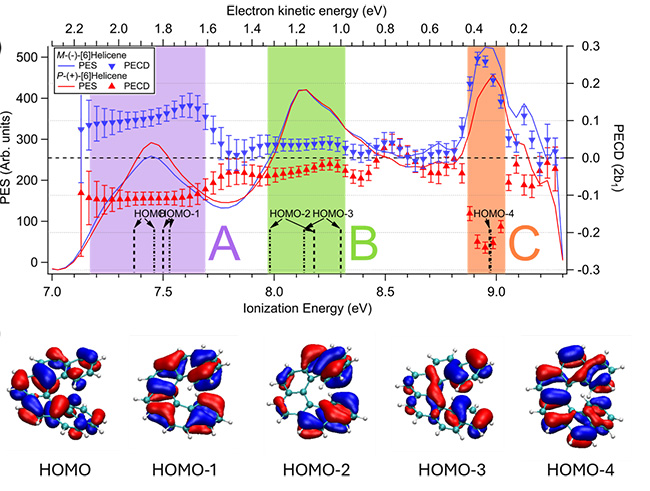
These observations provide the first direct chiroptical study of an helicene in the gas phase and demonstrate that PECD is sensitive not only to classical central or even axial chirality, but also to helical chirality, making it a genuinely universal chiroptical probe, capable of detecting and characterizing handedness across a broad range of chemical systems.
Besides these fundamental motivations, exploring PECD in helicenes might have some astrochemical relevance in the context of the search for the origin of homochirality of life. Indeed, PECD has been suggested as a possible symmetry breaking process by which enantio-enriched helicenes could be found in a given region of space, constituting a chiral substrate on which non-racemic elementary bricks of life, such as amino-acids, could have been formed.