
A rapid route to building Carbon nanoparticles in space
Polycyclic aromatic hydrocarbons are widespread in space, yet their observed abundance cannot be explained by known chemical growth mechanisms.
Using the DESIRS beamline at Synchrotron SOLEIL, researchers from the University of Hawaii at Manoa and National Dong Hwa University, in collaboration of the DESIRS-SAPHIRS team, have identified a new pathway that could allow these carbon-rich molecules to grow much more rapidly.
Polycyclic aromatic hydrocarbons (PAHs) are molecules made of fused carbon rings. They are found throughout the Universe—from meteorites such as Murchison and asteroids like Ryugu to interstellar clouds and the envelopes surrounding aging stars—and contain a substantial fraction of the carbon present in space. But one question has remained unresolved: how can these molecules grow quickly enough to reach the abundances and size observed/predicted by astronomers? The best-known high-temperature growth mechanism—Hydrogen Abstraction–aCetylene Addition (HACA)—builds PAHs one ring at a time, which is too slow to match detected abundances. Even faster pathways proposed more recently remain unable to fully account for the rapid formation of large aromatic molecules. This suggests that unexplored pathways may contribute to their growth.
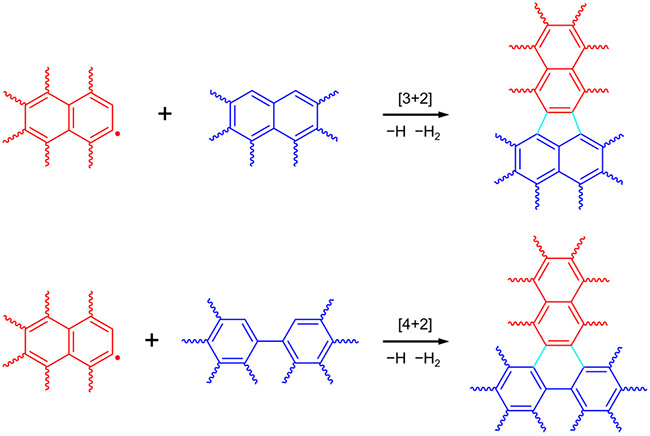
Researchers from the University of Hawaii at Manoa and National Dong Hwa University, working with the DESIRS-SAPHIRS team at Synchrotron SOLEIL, investigated whether larger aromatic radicals could provide a means for rapid PAH growth. They studied reactions of naphthyl radicals with naphthalene and biphenyl at high temperatures representative of carbon-rich circumstellar environments. The experiments revealed a mechanism termed Aryl Addition–dehydroCyclization (AAC). In contrast with mechanisms which form one ring at a time through multiple successive reactions, AAC can create a large mass increase following a single reactive collision, allowing three or more rings to be incorporated into a larger aromatic framework.
The DESIRS beamline was essential for determining exactly which molecules formed. The reaction products from a pyrolytic micro-reactor containing suitable precursors, placed in the source chamber of the molecular beam SAPHIRS set-up (see Fig.1) were analyzed by fragment-free photoionization using tunable vacuum-ultraviolet synchrotron radiation and the DELICIOUS 3 double-imaging photoelectron photoion coincidence (i²PEPICO) spectrometer placed inside SAPHIRS.
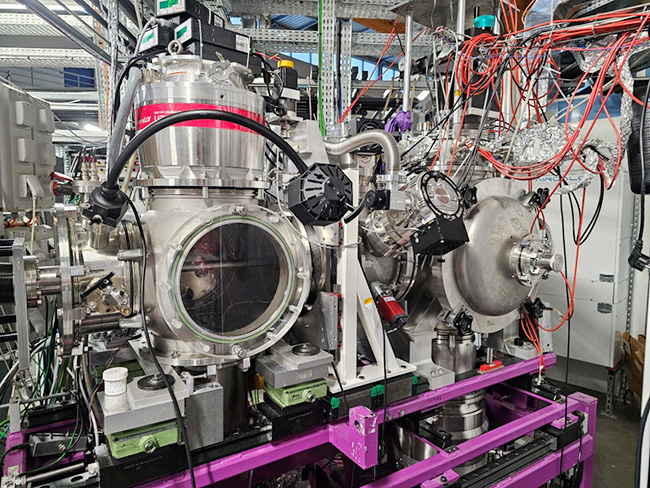
By recording photoionization efficiency curves and photoelectron spectra, the researchers were able to detect, identify and quantify the following five-ring PAH products isomer-selectively: benzo[b]triphenylene, benzo[4]helicene, benzo[k]fluoranthene, benzo[j]fluoranthene, and perylene.
These measurements also revealed two ways in which AAC can reshape the carbon skeleton (See Fig. 2). Formation of six-membered rings favors flat aromatic structures, while five-membered rings introduce curvature. Such chemistry could therefore contribute not only to the growth of PAHs, but eventually to the formation of larger carbon nanostructures such as graphene sheets, nanotubes, and fullerenes. Note that such processes are also relevant to combustion chemistry known to involve PAHs growth as intermediates between products and soots.
Future work will apply the discussed techniques to establish how far the process can continue with larger aromatic radicals and molecules, and to explore new routes of PAH growth. Incorporating such reactions into astrochemical models could ultimately help connect laboratory measurements of molecular growth with the evolution of cosmic carbon from small aromatic molecules toward complex carbonaceous matter.