A new method for probing chirality with X-rays
Chirality is one of the most studied physical properties in science with two otherwise chemically identical molecules significantly impacting its behaviour in many chemical and biological systems. Since the discovery, at the end of the XIXth century, that solutions of chiral molecules absorb left and right circularly polarised light differently, Natural Circular Dichroism (NCD) has been one of the most powerful tools for investigating this fascinating physical property.
A collaboration between the Synchrotron SOLEIL, the University of Bordeaux, the ESRF and Sorbonne University has succeeded in further extending this methodology to the hard x-ray spectroscopy technique Resonant Inelastic X-ray Scattering (RIXS) at the GALAXIES beamline.
Natural Circular Dichroism (NCD) has been one of the most powerful tools for investigating chirality. NCD has been extended into the x-ray regime (XNCD) where differences in the photoelectric absorption of circularly polarised light enables element- and site-selective sensitivity to chiral electronic structures in both solid and molecular systems.
In this new work, published in Physical Review B, researchers have extended the XNCD technique to the high-resolution nature of RIXS, predicting that these new results will enable more robust modelling and analysis of chirality. RIXS-NCD provides richer information over XNCD as the incident and emitted x-ray energies can be both varied, as well as the detection angle of the emission. An important finding by the researchers was that the RIXS-NCD amplitude significantly exceeded that of conventional XNCD, thus providing a more sensitive probe of natural dichroism.
The experimental layout for a RIXS-NCD measurement is shown in Fig. 1: Circular polarised hard x-rays excite 1s electrons of the sample’s transition metal ion into unoccupied 3d/4p orbitals which is then followed by 2p → 1s decay. The emitted x-rays are energy-selected by a spherical crystal analyser (SCA) and recorded by an x-ray detector (not shown).
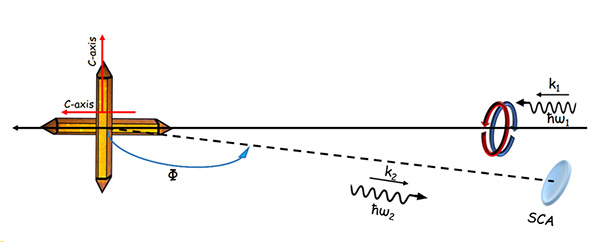
Spectra are recorded by measuring the detector signal as a function of both incident and emission energies and the difference between these measurements made with alternating left- and right- handed incident circular polarisation, provides the dichroic response. The effect of the RIXS-NCD spectra on the orientation of the sample’s optical axis with respect to the direction of the incoming x-rays depends upon the crystal symmetry and can be described by existing theory developed for XNCD.
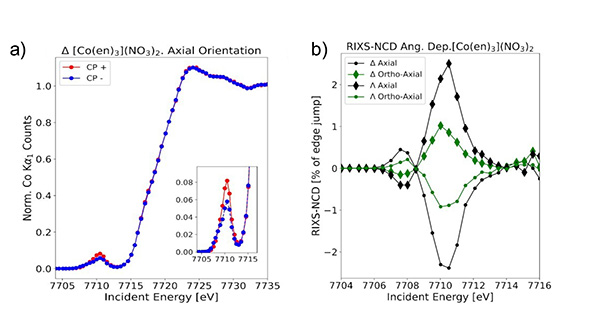
The first published RIXS-NCD measurements were performed on the enantiomeric model compound [Co(en)3](NO3)]2 [1]. A large dichroism effect was evidenced at the cobalt pre-edge (Fig. 2a) and the angular dependence followed that predicted by theory according to the crystal’s P6322 symmetry (Fig. 2b).
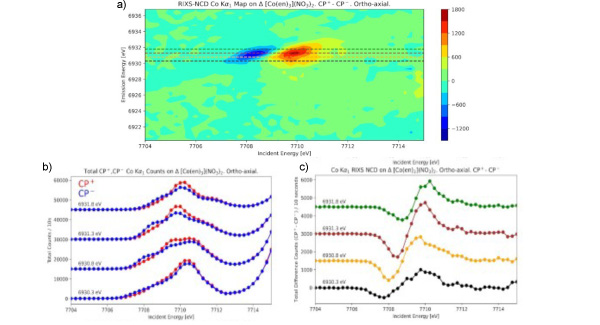
By measuring the natural dichroism as a function of both incident and emission energies, a RIXS-NCD map is generated, providing the full spectral landscape of the dichroic response. Fig 3a shows such a map on the Δ enantiomer of [Co(en)3](NO3)2 in ortho-axial geometry. By taking cuts at specific emission energies, through the RIXS-NCD map, complicated dichroic spectra can be extracted as shown: Fig.3b (spectra taken with each circular polarisation) and 3c (the difference between the spectra shown in 3b). In order to pursue the collection of RIXS-NCD benchmark data and to understand the relationship between the fine electronic-structure of the 3d transition elements and the shape and intensity of the RIXS-NCD signal, a study on the chiral complex manganese bipyridine hexafluorophosphate ([Mn(II)(bpy)3](PF6)2) was performed.
À la suite de ces premières observations expérimentales du RIXS-NCD, une étude a été menée sur le complexe chiral hexafluorophosphate de tris(2,2’-bipyridine)manganèse(II), ([Mn(II)(bpy)3](PF6)2).
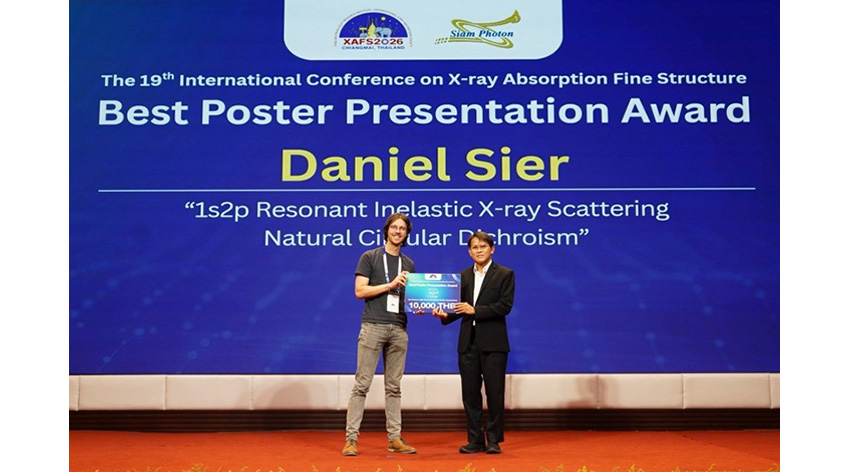
These findings have been presented at several international conferences including at the 2026 19th international conference on X-ray Absorption Fine Structure in Chaing Mai Thailand where, Daniel Sier, GALAXIES postdoc and key contributor to these results, received the prize for best poster presentation (see photo below).