
Molecular view of an electron transfer process essential for Fe-S protein biogenesis
Iron-sulfur clusters are ubiquitous cofactors made of iron and inorganic sulfur. They are essential for the function of proteins involved in a great range of activities: electron transport in respiratory chain complexes, regulatory sensing, photosynthesis, response to oxidative stress, free iron ions supply, DNA repair… In most iron-sulfur proteins, the cluster(s) acts as electron-transfer group in mediating one-electron redox processes. Scientists from Florence University studied the recognition between 2 human key proteins involved in the assembly of the Fe-S clusters.
Several diseases linked to defects in the Fe-S cluster biogenesis
It is now evident that several rare and apparently dissimilar human diseases are attributable to defects in the basic process of Fe-S cluster biogenesis. Although these diseases (which include Friedreich’s ataxia, ISCU myopathy, a rare form of sideroblastic anemia, an encephalomyopathy caused by dysfunction of respiratory chain complex I and multiple mitochondrial dysfunctions syndrome) affect different tissues, a feature common to many of them is that mitochondrial iron overload develops as a secondary consequence of a defective Fe-S cluster biogenesis.
Therefore the understanding of the iron-sulfur cluster biogenesis is of key relevance. As the proteins involved in the biogenesis of Fe-S clusters are evolutionarily conserved from bacteria to humans many molecular details on the process of Fe-S cluster biogenesis come from studies of model organisms, including bacteria, fungi and plants.
Complex machineries are required for this biogenesis
Because inorganic sulfide and ferrous/ferric iron atoms are toxic in vivo, biogenesis of iron–sulfur cluster proteins is a highly regulated process that requires complex protein machineries. In the cytosolic iron–sulfur protein assembly machinery, two human key proteins NADPH-dependent diflavin oxidoreductase 1 (Ndor1) and anamorsin form a stable complex in vivo that was proposed to provide electrons for assembling cytosolic iron–sulfur cluster proteins. The Ndor1–anamorsin interaction was also suggested to be implicated in the regulation of cell survival/death mechanisms.
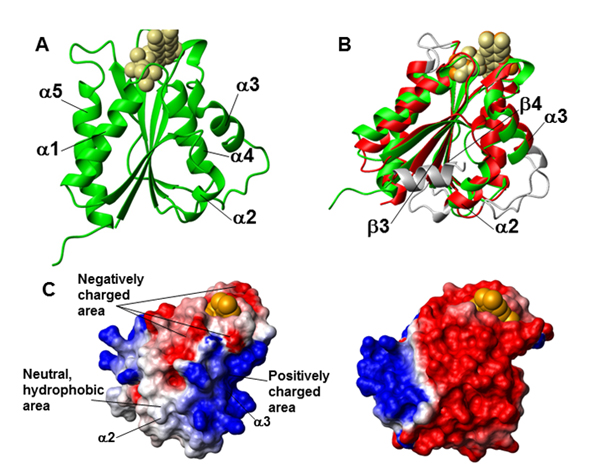
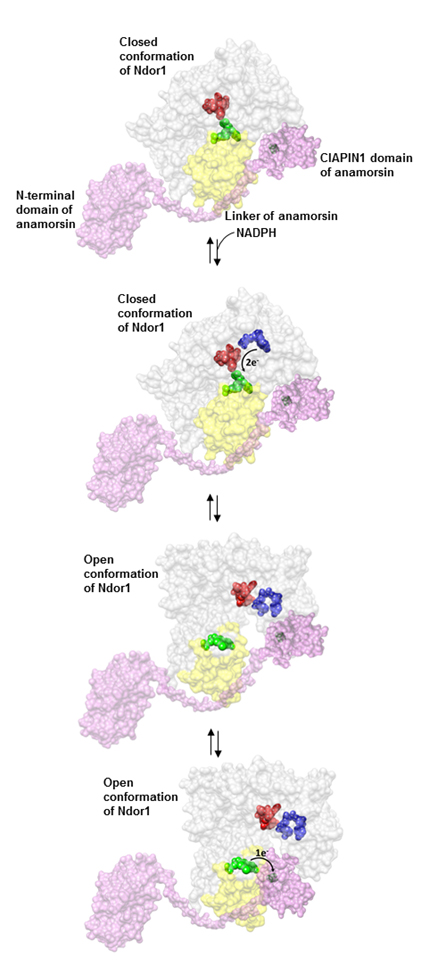
In the present work the scientists unraveled the molecular basis of recognition between the FMN-binding domain of Ndor1 and of the C-terminal region (linker and CIAPIN1 domain) of anamorsin containing the [2Fe- 2S] cluster in the oxidized state and of the electron transfer process. This is based on the combined NMR and X-ray (experiments carried ou on PROXIMA1) structural characterization of Ndor1 (Fig. 1) and anamorsin, on the investigation of the electron transfer process (Fig. 2), and on the identification of those protein regions involved in complex formation and those involved in electron transfer.
The scientists found that an unstructured region of anamorsin is essential for the formation of a specific and stable protein complex with Ndor1, whereas the C-terminal region of anamorsin, containing the [2Fe-2S] redox center, transiently interacts through complementary charged residues with the FMN-binding site region of Ndor1 to perform electron transfer.
The molecular model of the proposed electron transfer process provides significant information on the functional processes in which Ndor1-anamorsin interaction is implicated, i.e., the assembly of iron-sulfur clusters (1), diferric proteins (2) and the regulation of cell survival/death mechanisms (3, 4). Indeed, the disruption of the stable interaction between anamorsin and Ndor1 might provoke the interruption of the electron flow between the two proteins within the cell and, as a result of that, its essential function for cellular survival is abolished and consequently cell death mechanisms might be activated.
References
1. Dukor RK, Keiderling TA. (1991) Biopolymers 31(14):1747.
2. Arnesano F, et al. (2003) J Am Chem Soc 125(24):7200.
3. Shen Yet al. (2009) J Biomol NMR 44(4):213.
4. Bertini I, et al. (2001) J Biomol NMR 21(2):85.