Astrophysical environments, a closer look to carbon monoxide
Carbon monoxide is the second most abundant molecule in our galaxy. The photochemistry of CO and its isotopologues affects the structure and evolution of many astronomical environments, including interstellar clouds, circumstellar disks around newly formed stars, and the envelopes surrounding highly evolved stars. Isotope-dependent “self-shielding” in CO has been invoked to explain the unusual oxygen isotope ratios observed in primitive meteorites and in the Sun. A comprehensive database of line positions, oscillator strengths, and line widths for all relevant CO isotopologues is needed to assess this hypothesis and for the development of models of astrophysical environments.
A collaboration of spectroscopists from Wellesley College, Arizona State University, Observatoire de Paris, Leiden University, Université de Cergy-Pontoise, and Toledo University has been working with scientists on the DESIRS beamline to produce a definitive database of CO absorption spectra in the 90–115 nm region, and to use that database to develop a molecular model aimed at unravelling the complex spectroscopy of CO. This effort relies on the exceptional resolution and signal-to-noise capabilities of the VUV-FTS (Fourier transform spectrometer) end-station and the associated molecular absorption chamber on one branch of DESIRS.
The CO bands studied at SOLEIL display a wide range of strengths, line widths, and rotational contours; the DESIRS measurements have been tailored to capture as much of the varied spectroscopic information as possible. At the longest wavelengths, transitions to low-v vibrational levels of three Rydberg states are prominent. Below 100 nm, the spectrum becomes progressively more congested and complex as additional excited electronic states are accessed. There are striking variations in line widths from band to band, with some bands exhibiting unusually diffuse structures and others appearing sharp at the highest spectral resolutions studied in the laboratory. Line strengths and line widths are found to be strongly affected by isotopic substitution. A small portion of a high-resolution CO spectrum is shown below.
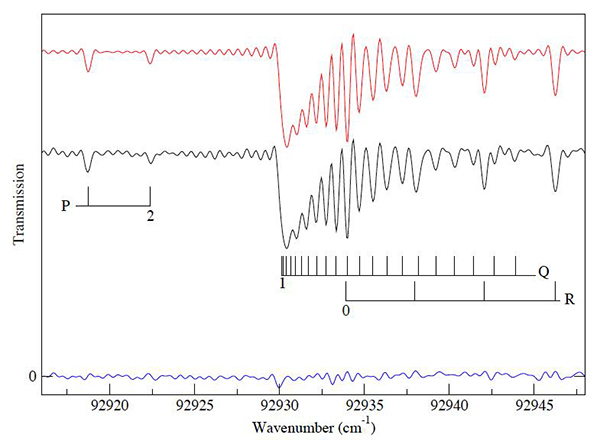
Differences in the strengths of absorption bands in CO isotopologues directly affect CO fractionation patterns in high column-density astronomical environments; in this important context, the uncertainties in the literature isotopologue f-values are unacceptably large. Currently, efforts are underway at DESIRS to quantify, at a high level of precision, the ratios of absorption strengths within the complex array of vacuum ultraviolet CO features.