SUCCESS STORY – ESR Programme – NEPHEWS Aleksandra Krajcer, hosted at the ANATOMIX beamline from 24 to 28 November 2025
PhD candidate at the Faculty of Chemistry of the Jagiellonian University in Kraków (Poland), Aleksandra Krajcer works on the preparation and functionalisation of biomaterials. As part of the NEPHEWS ESR programme, her stay at SOLEIL enabled her to explore the potential of synchrotron-based methods and to open up new perspectives for the development of her research.
“As an early-career researcher, I was wondering whether synchrotron methods could support or enhance my work,” explains Aleksandra. “I experienced this stay as a unique opportunity to gain valuable experience and to observe professionals working in their everyday environment. Without this programme, I would never have had such an opportunity, which has been truly inspiring for my further scientific development.”
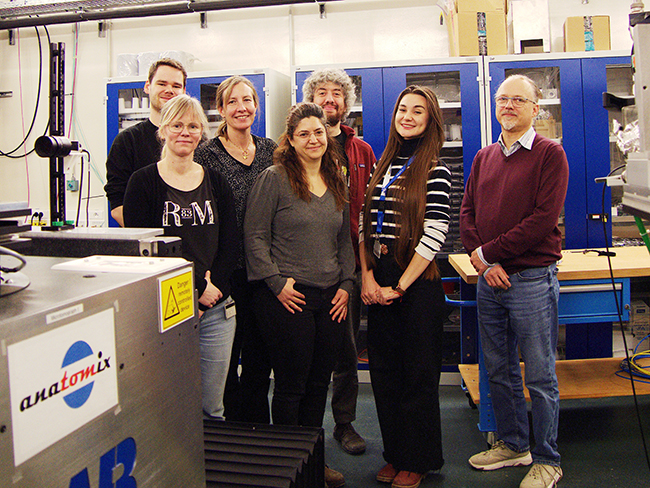
The young PhD student’s stay began with a “private” tour of the synchrotron, thanks to Brenna Conin from the Communications team. She was then welcomed by Gabriel David and Blandine Pineau at the biology laboratory, before meeting Alexandre Moutardier from the Operations team, which is in charge of running the electron accelerators. He not only presented the facilities to her, but also introduced her to the ACO Museum (Museum of Light and Matter, predecessor of the SOLEIL synchrotron).
Her application to the ESR programme was part of a broader reflection on her future career path. Aleksandra wanted to better understand the skills and qualifications required to work in a research center of this scale, or to benefit from its facilities in future projects. The programme also represented an opportunity for her to broaden her scientific perspective, gain hands-on experience, and learn from specialists working directly with large-scale research infrastructures.
Arriving at SOLEIL with a strong sense of curiosity, Aleksandra was interested in understanding the daily operation of the synchrotron, the work of beamline scientists, and the research opportunities offered by the facility. She wanted to see how work is organised in such a large scientific environment and to gain a clearer picture of the professional possibilities that such an institution could offer her. “I had never imagined that I would be given the chance to work directly with the synchrotron equipment and experience the use of such advanced instrumentation,” she says.
Her stay at the ANATOMIX beamline was particularly intensive. For this first immersion, Aleksandra not only observed the experiments but also took part in several stages of the analysis. She was able to understand how the measurements are carried out, what distinguishes synchrotron tomography from conventional laboratory tomography, and how the experiments and samples are prepared. She also visited the material preparation station and observed how the samples are mounted at the measurement station.
In addition, she gained insight into the use of research equipment, data acquisition systems and the initial steps of data analysis, helping her to better understand what constitutes good-quality data and in which situations a measurement needs to be repeated. Aleksandra highlights the importance of having discovered the full logistics involved in conducting an experiment at a beamline.
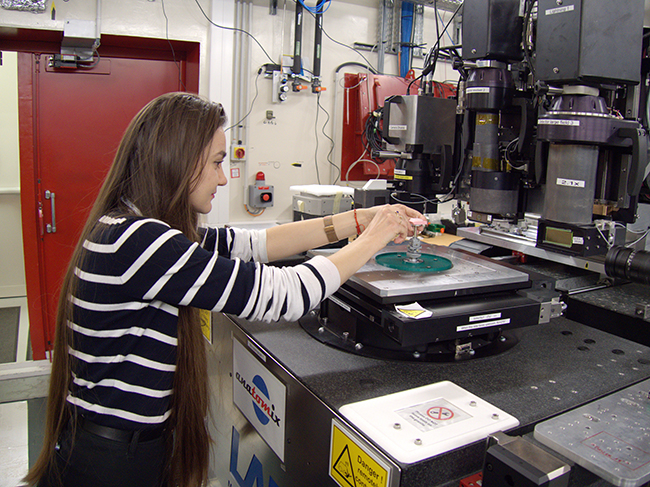
After completing her stay, she now feels encouraged to consider applying the techniques offered by the ANATOMIX beamline in her future scientific work. She has gained a concrete understanding of the types of samples that can be analysed, how the measurement procedure unfolds, how samples are prepared and exchanged, as well as the subsequent stages of tomographic data processing and validation. Close observation of the work of the beamline team, led by Timm Weitkamp, also allowed her to better identify the skills and expertise required to work effectively with this type of research infrastructure.
Finally, Aleksandra emphasises the quality of the interactions she experienced during her stay, in particular within the group of users led by Professor Karin Tran-Lundmark, who welcomed her warmly and involved her in every step of the measurement process. An experience marked by excellent teamwork, a highly professional approach to research, and a level of organisation that will continue to inspire her.
We look forward to seeing you again at SOLEIL, Aleksandra!