SUCCESS STORY – NEPHEWS Twinning Program – Ali Güzel, hosted at the PSICHE beamline from 3 to 8 December 2025
After completing a PhD in archaeometry, Ali Güzel aims to continue his research in the study of cultural heritage materials. In this context, his stay at SOLEIL, within the NEPHEWS Twinning Programme, allowed him to explore first-hand the possibilities offered by synchrotron infrastructures for the analysis of archaeological objects. During his immersion at the PSICHE beamline, he was able to observe how synchrotron radiation can reveal essential and complementary information about cultural heritage that is not accessible with standard laboratory instruments, while providing high resolution and very short measurement times.
“After completing my PhD in archaeometry, I want to further develop my research in this field. SOLEIL is recognized for its major contributions to cultural heritage studies, and this visit allowed me to explore in practice the opportunities offered by synchrotron-based methods,” explains Ali.
His application to the Twinning Programme stemmed from his doctoral work on Neolithic plaster samples from the Çatalhöyük site, located in Central Anatolia and listed as a UNESCO World Heritage site. Aware of the limitations of standard laboratory instruments to fully address his scientific questions, Ali wanted to evaluate in person the feasibility, resolution, and measurement times enabled by synchrotron techniques, in a real experimental environment.
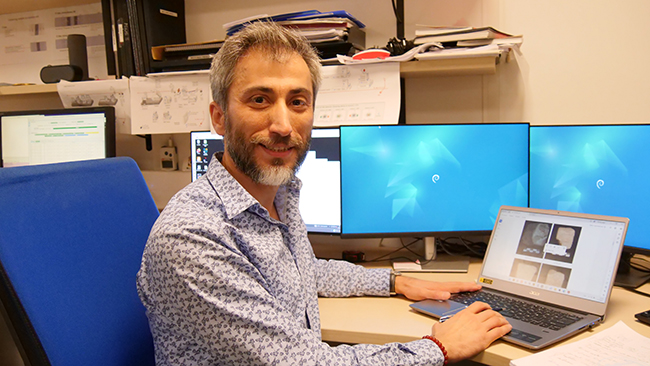
Before arriving at SOLEIL, he knew that the facility hosted state-of-the-art beamlines relevant to cultural heritage research. He hoped to observe the beamlines suited to his planned analyses, understand their technical characteristics, and see how these infrastructures support high-resolution and time-efficient measurements for archaeological studies.
At the PSICHE beamline, Ali had the opportunity to interact directly with Beamline Scientist Andrew King, who guided him through the full experimental process, from sample preparation to measurement and data evaluation. He particularly observed the implementation of high-resolution micro-CT imaging following minimally invasive sample preparation.
“This experience has strengthened my technical skills, as well as my ability to plan and carry out synchrotron-based analyses in my future archaeometric studies,” he emphasizes.
A highly enriching scientific and human experience, opening new perspectives for the continuation of his research at the intersection of archaeology and material science.
We look forward to welcoming you again at SOLEIL, Ali!