
STAT-IR 7
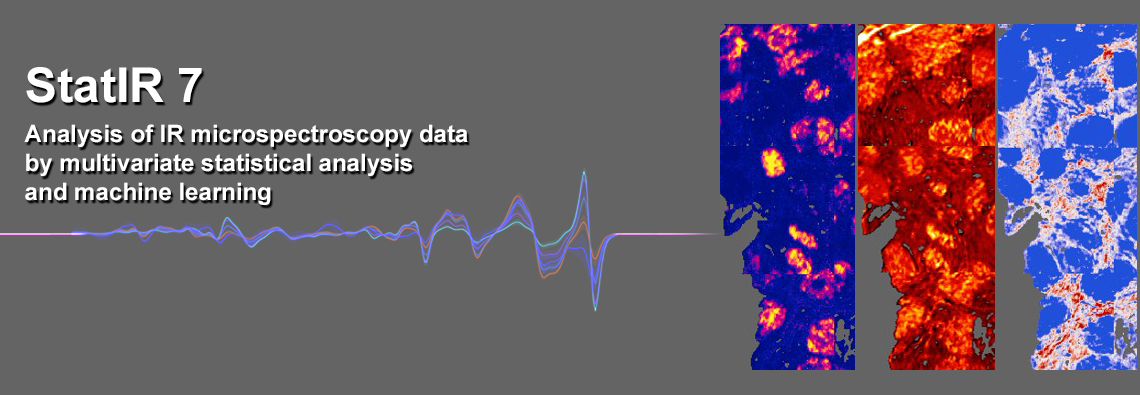
The SMIS beamline at SOLEIL synchrotron is pleased to announce the 7th edition of its school, STAT-IR 7, which is dedicated to training scientists in the field of multivariate and machine learning analysis of infrared microspectroscopy data. The course is scheduled to take place from Monday 16th to Wednesday 18th October 2023 at the SOLEIL synchrotron and will be conducted in English.
Computers will be available in the training room (personal computers are accepted).
The training is limited to 20 participants.
The aim of this school is to provide attendees with hands-on training in the use of Multivariate Analysis (MVA) techniques like PCA, and Machine Learning (ML) methods such as unsupervised and supervised clustering for analyzing infrared microspectroscopy data. The course will also cover spectral preprocessing techniques used in preparation for MVA and ML. Additionally, the applications of MVA and ML techniques for analyzing hyperspectral images and maps will be taught. The training program will emphasize the use of biomedical datasets, though the methodologies learned can also be applied to data related to cultural heritage and polymer sciences. The techniques can also be applied to data obtained from Raman microspectroscopy.
Infrared microspectroscopy and imaging provide essential insights into the chemical composition, spatial organization, and molecular conformation of complex materials with spatial resolutions ranging from microns to submicron. Data analysis plays a pivotal role in unravelling the information-rich content within the infrared spectra of complex systems and numerous specific techniques can be employed. With the use of modern instrumentation large datasets comprising tens to hundreds of thousands of spectra can be rapidly collected. Therefore, it is necessary to use automated techniques to extract information.
One of the most successful approaches to exploit large datasets lies on statistical analyses to explore their spectral variability, find correlations between data, perform objective classifications, train identification algorithms, correlate data from different techniques, or establish predictive models for quantification. Such methods can only be successful if specific spectral preprocessing methods are applied to remove artefacts and confusing variations. Specific software, preprocessing techniques and strategies must be applied requiring specialized training combining signal processing, MVA and ML.
The SMIS beamline is the infrared microspectroscopy beamline of SOLEIL synchrotron facility located in Gif-sur-Yvette near Paris. The SMIS beamline staff has 15-year experience in the measurement and analysis of microspectroscopy data. The course will be given by Ferenc Borondics (expert in physical chemistry), Marko Toplak (machine learning specialist and one of Quasar developers), and Christophe Sandt (biospectroscopist).
The course will be done with the open-source software Quasar. Hand-on session with participant data will be held.
Speakers
The course will be given by
Ferenc Borondics (an expert in physical-chemistry),
Marko Toplak (a machine learning specialist),
and Christophe Sandt (biospectroscopist).
Program
Provisional programm
October 16th |
October 17thSupervised learning |
October 18thUnsupervised learning |
|
| 09:00 - 10:30 |
SESSION 1 |
SESSION 1 |
SESSION 1 |
| 10:30 - 10:45 | Coffee Break | Coffee Break | Coffee Break |
| 10:45 - 12:00 |
SESSION 2 |
SESSION 2 |
SESSION 2 |
| 12:00 - 13:30 | Lunch break | Lunch break | |
| 13:30 - 15:30 |
SESSION 3 |
SESSION 3 |
|
| 15:30 - 15:45 | Coffee Break | Coffee Break | |
| 15:45 - 16:00 |
SESSION 4 |
SESSION 4 |
|
| 19:00 | Diner at SOLEIL restaurant | Diner at SOLEIL restaurant |
The formation will be held on site at SOLEIL synchrotron and opened to all past and future users of the beamline.
The cost for the formation will be 66€ TTC.
Registration is closed (limit of seats reached).
SOLEIL Access
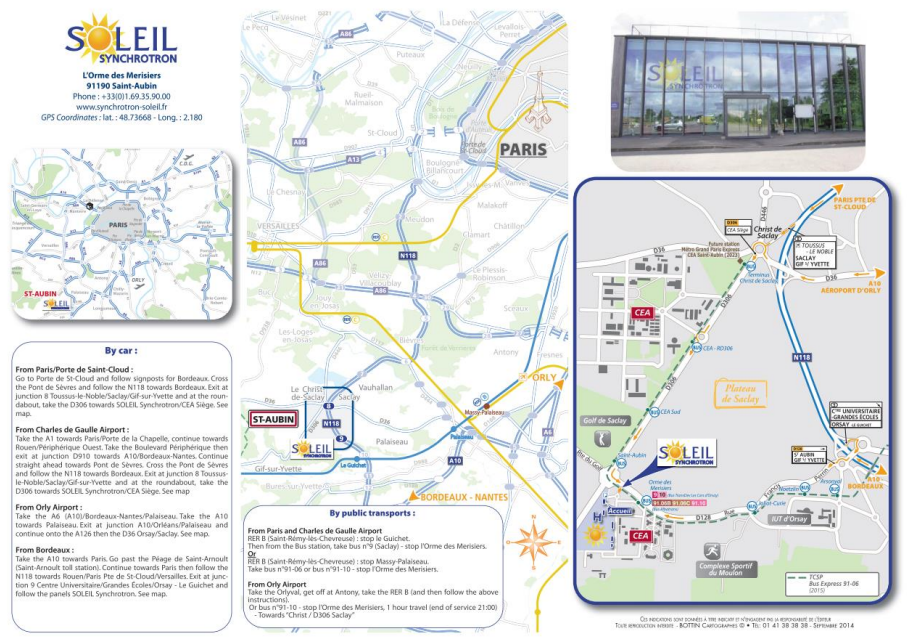
If you come by car:
Geographic Address:
Synchrotron SOLEIL
l'Orme des Merisiers
Départementale 128
91190 Saint Aubin
GPS coordinates:
Latitude: 48.711922
Longitude: 2.146156
at the intersection of RD306 and D128
If you come by public transport:
From PARIS and CHARLES-DE-GAULLE airport
RER B direction SAINT-RÉMY-LÈS-CHEVREUSE until:
the station "MASSY-PALAISEAU" then BUS no. 91-06 B or C direction SAINT-QUENTIN GARE, stop "L'ORME DES MERISIERS".
Timetable bus 91-06
the station "LE GUICHET" then join the bus station, take bus no. 9, direction SACLAY, stop "L'ORME DES MERISIERS".
Timetable bus 9
station "GIF SUR YVETTE", take bus no. 10, stop SAINT AUBIN
Timetable bus 10
From Orly Airport, take the ORLYVAL, get off at ANTONY, take the RER B (see above) or take the BUS n°91-10 direction "Christ / N
Timetable RER B
Accommodation (non exhaustive)
SOLEIL Guest House - Overnight: 33 €
L'Orme des Merisiers - 91190 GIF-SUR-YVETTE
Tel: +33(0)1 69 35 82 00 - hebergement@synchrotron-soleil.fr
Hôtel Les Chevaliers des Balances - près de SOLEIL
Place de la Mairie - 91190 SAINT-AUBIN
Tél.: +33 (0)1 69 41 20 55 - Fax: +33 (0)1 69 85 50 75
E-mail: leschevaliersdesbalances@gmail.com
Web: www.leschevaliersdesbalances.fr
Hôtel Le Village**
4 rue Neuve - 91190 GIF-SUR-YVETTE
Tél.: +33 (0)1 69 28 82 51 - Fax: +33 (0)1 69 28 53 93
E-mail: hotel.le.village@wanadoo.fr
Web: http://hotellevillage.fr/
Hôtel d'Orsay - près du RER B
2 rue François Leroux - 91400 ORSAY
Tél.: +33 (0)1 64 86 17 47 - Fax: +33 (0)1 64 86 17 48
E-mail: hotel.orsay@orange.fr
Hôtel B&B
Plateau du Moulon - 91190 GIF-SUR-YVETTE
Tél.: +33 (0) 892 78 80 91 - Fax: +33 (0)1 69 35 34 59
Web: http://www.hotel-bb.com/
Hôtel Campanile Paris Sud
9 Ter Rue Joliot Curie - 91190 GIF-SUR-YVETTE
Tél.: +33 (0) 1 84 00 85 35
Web: https://www.campanile.com/fr/hotels/campanile-paris-saclay
Appart Hôtel Residhome Bures-Sur-Yvette La Guyonnerie
1 Rue de la Guyonnerie, 91440 BURES-SUR-YVETTE
Tél.: +33 (0) 1 64 86 36 00
Web: https://www.myresidhome.com/bures-sur-yvette/residhome-bures-la-guyonnerie/apparthotel-residence-hoteliere.html
For further information please contact: Conf-statir7-2023@synchrotron-soleil.fr