RESEARCH ON OUR SITE
 
 
Archives news 2008
SOLEIL Company Contents > All the news > News 2008

Hepatitis C, when an ultra-virulent strain helps to understand how the virus operates
Hepatocellular carcinomas (HCC) are the most common form of malignant tumor in the world. The principal risk factors are chronic hepatitis B and C virus infections, mainly at the cirrhotic stage of these infections (1, 2). The high prevalence of hepatitis C virus (HCV) (about 3% of the world population) makes it a major cause of HCC. In the developed world, this prevalence is of the order of 1% (780,000 people affected in France), so chronic HCV infection is the primary cause of more than half the cases of HCC (3)...


Detection in the gas phase in the mid infrared range of tributyl phosphate (PO(C4H9O)3):
a tracer of nuclear activity with low volatility - AILES beamline

Tributyl phosphate (TBP) is a liquid, viscous solvent used in various industrial sectors such as plastic coatings, metallurgy, hydraulic brakes, etc.


SOLEIL synchrotron portrayed in a strip cartoon
Cartoon Jean-Yves Duhoo, who paid us a visit last September, shares with you his impressions of the (very full) day he spent at SOLEIL.
We would like to thank the Journal de Spirou and Jean-Yves Duhoo.


An High resolution THz measurements of the pure rotation spectrum and low-frequency movements of dimethyl sulfoxide (SO(CH3)2)  - AILES beamline
Hybrid photovoltaic cells combine the light-harvesting and charge transport properties of semiconductor and metal oxide nanoparticles with polymer semiconductors...


An Investigation into the Electronic Structure of Nanoparticulate Lead Sulphide and the Implications for Novel Hybrid Photovoltaic Cell Design - TEMPO beamline
Hybrid photovoltaic cells combine the light-harvesting and charge transport properties of semiconductor and metal oxide nanoparticles with polymer semiconductors...


First high resolution measurement of the centrifugal distortion spectrum of methane (CH4) - AILES beamline
Methane is a small molecule present in many planetary atmospheres, including that of the Earth (where it is a powerful green-house gas), Mars, giant planets, Titan (Saturn’s satellite), giant exoplanets and brown dwarfs. Due to its great symmetry, the methane molecule does not possess a permanent dipole moment. Centrifugal distortion can, however, induce a very weak pure rotational spectrum. This is very important in planetology as it allows, in particular, the quantity of methane in Titan’s atmosphere to be measured using the CIRS instrument in the (NASA/ESA) Cassini probe. Until now, measurements have been based on old, low-resolution laboratory data.

We measured for the first time this high resolution spectrum (0.0011 cm-1) on the infra-red AILES beamline, with an optical path length of 150 m. The data obtained will permit the absolute intensities in this region to be measured. The resulting model will act as a reference for interpreting data on present and future space missions.


H-induced metallization of 3C-SiC(100)3x2 surface 

Using valence band photoemission spectroscopy, we performed first band structure measurements of the 3C-SiC(100) 3x2 surface metallised by atomic hydrogen exposure.


Infrared microspectroscopy used in the search for spectral markers of liver disease - SMIS Beamline
Diseases of the liver (steatosis, hepatitis, cirrhosis and cancer) are a major cause of death, both in Western society and in other parts of the world...


S-SAD used to determine the structure of a virus protein on PROXIMA1 
The structure of an atypical viral protein has been determined on Proxima1 thanks a diffraction experiment on the native protein. 


Replacement of the Internet access infrastructure at SOLEIL
Because our Internet firewall had reached the limits of its performance and scaleability, we had to start planning its replacement. That is why we called for tenders at the beginning of the year, and the contract was won by INTERDATA with an architecture based on JUNIPER hardware. They also suggested replacing the input router that connects us to RENATER in order to maintain a coherent infrastructure.
The new infrastructure has some distinct advantages:

- Two firewalls have been installed (one in each of our computer rooms) so that Internet access can be maintained in the event of a hardware failure. With this infrastructure, we will have fully redundant access as soon as we have a second Internet connection.

- The hardware has much higher performance (1 GB/s scaleable interfaces) and will allow us very comfortably to increase the load of experimental data that we transfer, whilst still guaranteeing secure access.

- Finally, administration of the whole system will be greatly simplified (ability to create independent virtual firewalls managed via a common interface).

The new infrastructure was installed almost transparently as far as users were concerned, thanks to the skilful work of the INTERDATA personnel and the flawless preparation for this operation by the Networks team.


Measuring the elastic properties of a thin film under compression
We study the elastic behaviour of thin nano-structured films. The characterisation of the mechanical behaviour of these polycrystalline structures with respect to their microstructure is an essential step towards the development of technological applications, but has not yet been explored in depth.


Generation of 360° domain walls in magnetic tunnel junctions
Magnetic tunnel junctions (MTJ) are probably one of the most studied devices in the so called spintronics research field. Their active part is composed of two ferromagnetic electrodes separated by an insulating layer thinner than 3 nm that a tunnel current exists between the two electrodes.


How does glycine in ice evolve under irradiation? 
TEMPO beamline


Performance of the AILES beamline in the THz domain
Premiers spectres de photoémission résolue en spin sur CASSIOPEEThe infrared beamline (AILES) connected to the SOLEIL synchrotron radiation source is now complete. The purpose of this beamline is to provide a high flux, high brilliance source extending continuously from infrared to the THz domain whilst keeping the noise level as low as possible. The important parameters (flux, spatial distribution of photons, and useable spectral domain) have been evaluated experimentally.
These measurements confirm that this source extends into the THz domain; they also check that the operation of the device allows the entire source to be used without an iris, even for higher-resolution measurements (10-3 cm-1 or ~0.1 μeV). The lower figure shows the gain obtained by synchrotron radiation and the fact that it extends into the THz domain. The upper figure was obtained from the division of two simultaneous spectra, and illustrates the signal-to-noise ratio made possible by the stability and high intensity of synchrotron radiation.


This use of spectroscopy in the THz range paves the way for research in many areas (astrophysics, solids, soft materials, etc.)


Time Resolved Photoelectron spectroscopy using synchrotron radiation time structure - TEMPO beamline


The team « Astrochimie et Origines » on DESIRS beamline
The “Chiral-MICMOC“ experiment of the team " Astrochimie et Origines " - Institute of Spatial Astrophysics (IAS - Orsay)-, was successfully mounted onto the SOLEIL DESIRS beamline to study the possible formation of enantiomeric excesses in chiral amino acids formed during the VUV irradiation, with circularly polarized light, of interstellar ices analogues. This experience led by Louis d' Hendecourt, in collaboration with Laurent Nahon (SOLEIL) and Uwe Meierhenrich (Université de Nice) produced two samples of organic matter each with a different polarization (helicity), two other samples having been produced in similar conditions at the IAS with unpolarized UV light. Analysis, mainly by GC-MS is in progress at the University of Nice.


The experimental set-up has been installed on SOLEIL during six days by Pierre de Marcellus and Dominique Deboffle. The cryostat where the sample is made can be seen together with the FTIR spectrometer that controls the ices deposition. On the left arrives the VUV-CPL beam from the monochromator of DESIRS selecting photons of a given energy (6.83 eV) corresponding to a circular dichroism transition known in amino-acids in the solid state.


Band structure of reconstructed Cu2O(-110) - TEMPO beamline


Adsorption of NH3 on Si(001)-2x1 surface


SOLEIL presents the capabilities of synchrotron light to Pollutec 
SOLEIL's laboratories and scientific equipment are especially suited to the field of eco-activities: analysis of polluted media and effluents, processing and recycling of waste, soil rehabilitation, characterisation of water, gases, and sediments, sensor calibration, detection of trace substances in living organisms, ecotoxicology, etc. Most of the concerns that currently interest professionals in this field can benefit from tests performed on the synchrotron. At SOLEIL, at least eight experimental installations (beamlines) are set up for these issues, and use imaging techniques and spectroscopy ranging from infra-red to x-ray.


How magma is formed
The depths of the earth in diamond anvil cells
By artificially creating in the laboratory the conditions that exist several tens of kilometres down in the Earth, scientists aim to improve their understanding of the “major recycling” stages of the elements linked to volcanic phenomena. The group at the ’Institute of Mineralogy and Physics of Condensed Matter (Paris VI) has thus used the diamond anvil cell technology on the DIFFABS beamline. Ready to up the pressure and temperature?...


First angular resolved photoemission experiments on CASSIOPEE
First angular resolved photoemission experiments have been carried out on the CASSIOPEE beamline by A. Nicolaou (SOLEIL and Laboratoire de physique des Solides, Orsay) and V. Brouet (Laboratoire de physique des Solides, Orsay) supported by the whole CASSIOPEE team. The studied sample is a [Bi2Ba2O2][CoO2] compound, made of cobalt oxide (CoO2) triangular planes separated by stacked BiO and BaO rectangular planes. The CoO2 planes are doped with electrons coming from the stacked planes. They become electrically conducting and form “bidimensional metals”, similar to the CuO2 planes in cuprates, these superconducting compounds (with no electrical resistance) up to -170°C.
In the experiments carried out on CASSIOPEE, a crystalline sample is exposed to a monochromatic beam. Atoms excited by the photons emit electrons which energy and emission angle are analyzed. One can hence directly image the occupied electronic states in the crystal. We especially studied the Fermi level, which is the last occupied electronic state in a solid. It is the most outer electronic level with the less bound electrons to the atom. In insulators, this level is empty, whereas in conducting materials (metals), it is occupied.
In this image, the clearer the colour, the larger is the intensity at the Fermi level. Each point accounts for an electron emission direction (defined with respect to two kx and ky axis). The intensity map (the Fermi surface) reproduces roughly the hexagonal symmetry of the CoO2 planes, which confirms that these planes are the main origin for the conduction properties of this material, rather than the triangular planes. Further analysis of the results is of course necessary to understand the topology of the Fermi surface in more details.
All the points of one line in the intensity map are measured simultaneously thanks to the large angular acceptance (30°) of the Scienta R4000 electron analyzer. 


Fête de la Science 2008 
 
A little magnetism at Supelec, archaeology at Etiolles... 
A new 'magnetic attractions' workshop will be presented from 21st to 23rd November at SUPELEC alongside some of the usual partners (CEA, INRA, Institut d'Optique, INRIA, Air Liquide, and many others). Also note that SOLEIL will be participating in Operation "From wheelbarrow to test tube: science at the service of archaeology" at Etiolles, with a lecture entitled "Digging into matter: synchrotron light at the heart of relics" given at 3:30 PM on 22nd November by Loïc Bertrand, Head of the Ancient Materials Group.

SOLEIL at the Grand Palais, with ESRF, DIAMOND, ELETTRA and SLS 
With France holding the Presidency of the European Union this year, a preview event to kick off the Fête de la Science science festival (taking place this year from 14th to 23rd November) will be held in the nave of the Grand Palais: La Ville Européenne des Sciences (European Science City), from 14th to 16th November*. The 70 exhibiting stands will include SOLEIL's European Crossroads of Light, federating four synchrotrons with the participation of ESRF, ELETTRA and DIAMOND alongside us.

*For more than 15 years, the annual science festival initiated by government minister Hubert Curien has been held in mid-October, but this year, because of France's Presidency of the European Union and for reasons of availability of the venue chosen for this year's event—the prestigious nave of the Grand Palais, it has been postponed nation-wide to November.


Reaction kinetics of N,N,N’,N’ tetramethylethylenediamine on Si(001)–2×1


October 19th, 2008 - A current of 400 mA was successfully stored in the ring
Since autumn 2006, the maximum current which could be injected into the storage ring was limited to 300 mA. This was corresponding to the maximum intensity at which the single RF cryomodule was able to compensate the energy lost by the electrons, providing a maximum power of 300 kW.
A 2nd RF cryomodule was installed on the ring in May 2008. One of the 2 cavities of this cryomodule is now operational, the second requiring yet some further conditioning.


Patterns of X-ray diffration of a unique grain of gold
Premiers spectres de photoémission résolue en spin sur CASSIOPEEX-ray diffraction is a method of choice to study the atomic structure of crystals. For well defined incident angles, intense peaks of reflected radiation are produced: the Bragg peaks. The knowledge of the Bragg peaks intensity allows one to obtain the structure of the crystal. But there is more to learn from these peaks: their intensity distribution is related to the shape of the crystal and (if it exists) to the local strain due to external stress. Interference fringes can be observed, whose angular spacing is inversely proportional to the crystal size. However two conditions must be fulfilled to observe them. First, the crystal has to be small enough to resolve the fringes. And secondly, the x-ray beam must be transversely coherent over the size of the crystal: in other words the same wave front must illuminate all the parts of the crystal. A synchrotron radiation x-ray beam is coherent and brilliant enough to make small crystal fringes observable. Moreover, the high-performance of the detectors and diffractometers available on modern beamlines allows for the measurements of such effects. These assets were used to study the diffraction of a unique grain in a polycrystalline gold thin film.
Researchers from the “Institut Matériaux Microélectronique Nonosciences de Provence” have studied a thin film (200 nm) of polycrystalline gold at the CRISTAL beamline. Such a thin film consists of small micrometer sized grains, in close contact through grains boundaries. This interaction induces stress and consequently strain inside the grains. The ultimate goal of the experiment was to obtain the shape of a grain and the local strain inhomogeneities. By using high-precision slits located 10 cm before the gold film, it was possible to illuminate only 10 µm x 10 µm of the sample. The power of diffraction is that amongst the illuminated grains, only one is oriented such that the diffracted beam hits the detector: the grain selection is naturally obtained. This image shows the coherent diffraction pattern of the (111) Bragg reflection of a single grain. In spite of the lost of the diffracted beam phase, iterative algorithms have recently been developed to reconstruct the shape and the local strain of the grain, knowing oversampled diffraction patterns as the one presented here. The measurement of such patterns, which is now possible at SOLEIL, opens the way for such novel and challenging studies. 


Molecular simulation at the interface between experiment and theory – Theoretical Biophysics Group, SOLEIL and the Molecular Biophysics Centre, CNRS Orleans.


The DESIRS beamline : a fully calibrated variable polarization facility in the VUV range

OPHELIE 2, the HU640-type undulator acting as a photon source for the VUV beamline DESIRS is an electromagnetic versatile polarization insertion device. By playing with the power supplies driving the 3 sets of main coils, it is possible to continuously tune the horizontal and vertical magnetic fields as well as their longitudinal phase. Therefore any kind of elliptical polarization can be produced.


High Resolution Spectroscopy of N-Methylformamide in the Far-Infrared at AILES.
The high brilliance of the far infrared beamline AILES was exploited by D. Mc-Naughton (Monash University, Australia) and the AILES team to record the first rovibrational spectrum of N-methylformamide. The absorption spectrum is fully resolved despite the congestion of lines thanks to the combination of the high resolution interferometer with a 200 m path cell at low pressure. These measurements will provide the most precise data set about the structures of the important system: cis- and trans-N-methylformamide which is a model for understanding the amide linkage involved in complex phenomena such as protein folding. Contact : Pascale ROY
First high resolution (resolution=0.001 cm-1) far-infrared spectrum of N-methylformamide at AILES. The absorption spectrum shows several thousands of fully resolved rovibrational lines which will provide very accurate information about the structures of cis- and trans-N-methylformamide which are model systems for understanding the amide linkage involved in complex phenomena such as protein folding. 
 

First spin_resolved photoemission spectra on CASSIOPEE
Premiers spectres de photoémission résolue en spin sur CASSIOPEESpin-resolved photoemission spectra have been measured on a thick epitaxial Fe layer covered with two atomic planes of MgO. The sample was remanently magnetized along the in-plane horizontal axis. Due to the experimental setup geometry we are able to record simultaneously the spin polarizations along the surface normal and the in-plane horizontal axis.
The spectra exhibit two different regions: at about -5 eV, there are the MgO valence states while the Fe 3d states appear around -1 eV, in the MgO energy gap.
As expected, there is no spin polarization along the surface normal while the Fe 3d states exhibit a spin polarization of about 30 % along the magnetization axis.
These spectra are a reference for a set of measurements on different magnetic materials developped to be used as electrodes in magnetic tunnel junctions and allowing an improvement in the tunnel magneto-resistance.
This study is performed by the Prof. S. Andrieu's team from LPM (Nancy).
Contact : Amina TALEB


Magnetism under extreme condition using the ODE beamline at SOLEIL


Interplay between morphology and metallization in amorphous-amorphous transitions


Diffusion of Ferrous Products in the Middle Ages
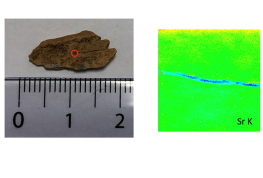
Study of the diffusion of mediaeval ferrous objects using microanalysis of trace elements. The contribution of x-ray microfluorescence (DIFFABS beamline)
The project investigates the circulation of ferrous products from two major production centres in the Middle Ages: the Pyrenees and the Italian Alps. In that era, many prestigious products were manufactured in the Italian Alps, such as very high-quality Lombard steel armour, which was sold all over Mediaeval Europe. The first stage is to identify a trace element signature for each region, and then to track these signatures in the artefacts via non-metallic inclusions trapped inside the metal. When classical techniques are not effective—in particular, for inclusions in tiny samples taken from rare or precious objects—x-ray microfluorescence is an especially useful technique to track these signatures in inclusions.


Left : Archaeological ferrous object found on a site in the Pyrenees
 
Right : Inclusion trapped in the object's metallic matrix


Courses of the Professor Svante Svensson
Novembre 21st-28th, 2008


The wine, a complex matter of taste
Certain wine growers can judge the grapes maturity just by tasting them. Doing it, they detect the right moment, when balance between good and bad tannins is the most favourable for the organoleptic qualities of the wine. Aude Vernhet and Francis Canon, scientists at UMR 1083 Oenology Science at Montpellier, undertook to complement this empirical method making link between the shape and structure of tannins and the astringency they create when they interact with salivary proteins. Welcome on SWING and DISCO, two beamlines that lend themselves particularly well to the – very difficult – study of these flexible molecules.


70 European young people on visit in SOLEIL
21/10/08


Professor Svante Svensson joins PLEIADES team
He will stay at SOLEIL for 2 years, thanks to a funding of "RTRA – Triangle of Physics".


Spotlight on the Synchrotron
The Regional Centre for Educational Documentation of the Academy of Versailles and the SOLEIL Synchrotron have just launched “lumière”, a new series of the DOCSIENCES publication, for teachers, pupils and all readers who enjoy increasing their general knowledge and understanding of the universe. 


Machine schedule
The machine schedule is now available on the Web site of SOLEIL.


Comet dust
By studying grains of comet dust, scientists hope to increase their understanding of the Solar System. 


Research on antibiotic resistant bacteria: a structure solved by the Institut Pasteur and SOLEIL
A group from the Institut Pasteur have recently solved the structure of a protein - DNA complex (from a bacteria of the same family as the hospital super-bug MRSA) to 3.2 Angstroem resolution. The structure was solved by collecting diffraction patterns on the PROXIMA1 beamline and using the "anomalous" scattering of Selenium in order to solve the crystallographic phase problem.

Caption: an electron density map


Giant magnetoresistance

Since the discovery of magnetoresistance, a number of devices (sensors, detectors etc.) using this phenomenon have been developed. But at the end of the 1980s, more than 100 years after Lord Kelvin's discovery, researchers thought that no more progress could be made in this field. That was when Albert Fert and Peter Grünberg arrived on the scene… 


A Franco-Japanese team demonstrates a new free-electron laser (FEL) concept experimentally
A Franco-Japanese team has succeeded in producing intense, coherent radiation in the extreme ultraviolet domain. This result validates the seeding concept developed for the 'ARC-EN-CIEL' project, a fourth-generation light source thought of by the French synchrotron radiation teams.


Made-to measure stoving for the vacuum chambers
To obtain a good vacuum quickly (i.e. very low gas pressure and few heavy elements) in the vacuum chambers where the photon and electron beams circulate, it is necessary to heat them after every exposure to air.
This operation, called “stoving”, can sometimes prove to be difficult due to the lack of space between the exterior surface of the vacuum chamber and the beam’s bending or focusing magnets.
The Ultravide group have had some heating elements made to measure that take up very little space. They are composed of metallic tracks sandwiched between two sheets of polyimide. An electrical current is passed through this assembly. The “heating film” thus created is less than 0.5mm thick and permits the temperature of the chambers to be raised to 200°C for several hours.
 

Several small films placed in series enable the surfaces of sharp bends to be covered


SOLEIL in the RTRA network

SOLEIL is not only a member of the network’s steering committee, but is also active in the RTRA via several projects already selected or submitted to calls for projects currently underway. 


PULSSE: energy storage and synchrotron radiation
Four SOLEIL beamlines are involved in the ANR project "PULSSE". Its purpose is to show that synchrotron radiation is useful in characterising battery materials.

IPANEMA, the European Institute for Ancient Materials, soon to be at SOLEIL
Unique in the world, IPANEMA (Institut Photonique d’Analyse Non-destructive Européen des Matériaux Anciens—European Photonic Institute for the Non-Destructive Testing of Ancient Materials) is the SOLEIL synchrotron's instrumental platform dedicated to the study of ancient and historical materials.

IPANEMA can accommodate around forty scientists in an area of 1600 m2, and is designed to supplement the range of techniques, involving both the synchrotron and classic light sources, available for the study of materials in the fields of archaeology, paleontology, and conservation of the cultural heritage and ancient environments. IPANEMA will open in 2010.

A dedicated full-time team of around fifteen scientists will staff the facility, offering its expertise and support to users both for one-off projects lasting a few days and for longer-term projects. IPANEMA will welcome research scientists, postdocs and doctoral students for periods of up to three years. Special synchrotron equipment will be installed at SOLEIL for the study of ancient materials.

Developed by the 'heritage and archaeology' interface of the SOLEIL synchrotron, the IPANEMA project is financed (construction and fitting out) equally by the French Government and the Île-de-France Region. 

Culture and Math Games Fair 2008

The ninth annual Culture and Math Games Fair will be held this year from Thursday, 29 May to Sunday, 1 June, at Place Saint Sulpice in Paris. The theme of this year’s fair will be: “Nature and Mathematics”.
SOLEIL, together with many of its partners (INRA, EDT, CEA, CNES etc.), will contribute by composing a short essay on light for a brochure, of which over 10,000 copies will be printed for free distribution during the fair and other upcoming events. The essay will describe light from a “mathematical point of view”, focussing in particular on observed phenomena and light-related magnitudes, with a presentation of the mathematical tools required to understand, measure and predict them. It will also deal with such concepts as colour vision, the wave properties of light and polarization.
This brochure, published by the CIJM (the International Mathematical Games Committee), follows in the tradition previous brochures, such as Maths Europe Express (2004), Maths Physique Express (2005), Maths Images Express (2006), intended to accompany various exhibitions on such topics as colour, piezoelectricity, water, flight, turbulence, weather, radioactivity, the sun, light, and even life itself.

A second RF cryomodule in the SOLEIL storage ring!
This second cryomodule, containing two superconducting accelerating cavities, was delivered to SOLEIL on May 20th, 2008. With both cryomodules in operation, it will be possible to increase the intensity of the electron beam in the storage ring from 300 mA up to 500 mA. 


SOLEIL at Opticsvalley
PRISME, the measurement and metrology network in Ile-de-France, is offering businesses and laboratories in the Greater Paris region the expertise of seven affiliated research centres. These centres are: the Institut d’Optique Graduate School, the LNE (Laboratoire National de métrologie et d’Essais), the Lycée Fresnel, Supélec, Thales Research and Technology, the SOLEIL Synchrotron and the University Paris-Sud 11, through the Institute of Fundamental Electronics, the Orsay IUT and the Laser Centre.

--> See the video on the SOLEIL Metrology beamline


SOLEIL, partner of “2008: the International Year of Planet Earth”
Come and meet us on April 9th at Cité des Sciences. The theme of the day will be 'The Earth of tomorrow', and we will give an educational presentation entitled 'L’eau sous pression, ça laisse de glace' ('Pressurised water leaves us cold'), designed by IMPMC (Paris), Alberta Congeduti (SOLEIL) and Jean-Paul Itié (SOLEIL - on the photo).


Exhibition LHC at SOLEIL

SOLEIL is happy to welcome from february 22th in march 31th the IN2P3 exhibition dedicated to the LHC.


HERCULES 2008
HERCULES the Higher European Research Course for Users of Large Experimental Systems, will take place in Grenoble (France) from February 17th 2008 to March 20th 2008 (5 weeks). It includes lectures, tutorials and practicals. One week is organized at SOLEIL, St Aubin from 10th to March 14th 2008.

DiagOn: an imager for soft x-ray beamlines
The DiagOn imager was the first active device on the soft X-Ray beamlines at SOLEIL From the first prototype on TEMPO beamline up to the last DiagOn installed on the PLEIADES beamline in December 2007, it allowed to characterize the undulator beam and to come up to the beamline scientists expectations.
Today, the DiagOn enters its 2nd phase with optimized versions which will be installed on the future soft X-Ray beamlines of SOLEIL (LUCIA, ANTARES, DEIMOS, MICROFOCUS).

Visit CNRS-JSPS
The CNRS, NATIONAL CENTRE FOR SCIENTIFIC RESEARCH, and its Japanese partner the JSPS (Japan Society for the promotion of Science) organize on March 6th and 7th in the headquarter of the NATIONAL CENTRE FOR SCIENTIFIC RESEARCH a energy seminar: "Energy supply and demand in the 21st Century" Questions and options for sustainable development. This seminar is organized in the whole of the events which, in 2008, will celebrate the 150th anniversary of the relationships between France and Japan. In that occasion, several Japanese personalities will be welcomed or a visit and a conference on the performances and the possibilities of the SOLEIL French synchrotron. 

"Bouge la science" to SUPELEC
The forum "Bouge la science" is organized by the students of SUPELEC for an audience of pupils (secondary school). For the 5th edition, SOLEIL will be present on February 20th, 2008 with teaching workshops about the light and the waves, interactive quiz, models and many other surprises.


French competitiveness poles to meet at SOLEIL
Five competitiveness poles, including two of global caliber, located in the department of Essonne, are today active in Ile-de-France. The principal objectives of these poles are to encourage exchanges between research and industry, to create jobs, and to increase the attractiveness of the area at the national and international levels.

February 5, 2008 : METROLOGY beamline received its first photons
Several problems will be studied at VUV or X-ray wavelengths: reflectivity measurements or gratings diffraction efficiency, scattering measurements and performance test of optical components. The use of X-ray beams for the characterization of optical surface shapes is also considered.
This project is build in collaboration with the Laboratoire National d’Essais (LNE)) and the CEA DIF. For the LNE, the metrology beamline of SOLEIL could become the national primary standard source. For the CEA DIF, the use of this beamline is very important to characterize with very high accuracy all diagnostics design for the Megajoule laser.


World record: neither one nor two, but 3 electron beams stored in the SOLEIL Ring
when the physicists want to decrease the length of the electron bunches, some unexpected phenomena can occur...


Arrival of the first SOLEIL's users
On Wednesday, January 23th, the new Guest House of SOLEIL will welcome its first users.

January 22nd, 2008 : opening of the beamlines to the users
Further to our information of July, 2007 relative to the postponing of the starting of the beamlines because of severe defects in the water cooling network supplying of the beamlines, we are happy to announce that the repair works are now almost finished and that beamlines should be available for the users in January 2008 , the 22nd.

Which collaborations with mechanics subcontractors?
With the 3rd-generation SOLEIL synchrotron, Ile-de-France gains access to an exceptional instrument for the exploration of matter, the performance of which places it among the best on the planet. Though small and medium-sized businesses in the region have not participated largely in its realization up to this point, they can now have the opportunity to participate in subcontracting and supplies markets for part of the equipment still to be installed. 


 Archives 2007

 Archives 2006 and archives of the previous years

Archives Workshops

Accueil