RESEARCH ON OUR SITE


News 2012

SOLEIL Company Contents > All the news > News 2012
 
Spintronics on CASSIOPEE: understanding the behavior of tunnel junctions using photoemission

Stéphane Andrieu’s group, from the Material Physics Laboratory in Nancy, continues its collaboration with the CASSIOPEE beamline (see 2008 article). A collaboration that is still successful as their new findings provide, for the first time, an explanation, notably, for variations in the tunnel magnetoresistance measured in Fe1-xCox (001) /MgO/ Fe1-x Cox (001) -type magnetic tunnel junctions, depending on the percentage of Co. These results were recently published in Physical Review Letters.


2-butyne on Si(001) at room temperature: An XPS and NEXAFS study

The research activity on the beamline started with experiments on various molecules deposited on Silicon surfaces: deposition of NH3[ref. 1], n- Propyltriethoxysilane[ref. 2], water[ref. 3], and 2-butyne[ref. 4]. During these experiments we defined the experimental procedures for fast NEXAFS and fast photoemission experiments to follow the adsorption process at low partial pressures of the deposited molecule. Experiments were performed in real time to follow the reaction kinetics and to define the more interesting coverage configurations.


Gilding without gold – Cordoba leather on SMIS

Polychrome gilt leather, a forerunner of our present-day wallpaper, also known as “Cordoba leather”, was all the rage between the sixteenth and eighteenth centuries in Europe. Used in castles and bourgeois mansions as tapestries or wall hangings, but also for cushions, screens and furniture upholstery, as well as for altar frontals in churches, these decorative leathers are obtained – without the use of gold – by a special technique that conservator Céline Bonnot-Diconne is studying with the help of the SMIS infrared beamline , in collaboration with the “Istituto Superiore per la Conservazione ed il Restauro” (ISCR) in Rome and the “Centre de Recherche sur la Conservation des Collections” (CRCC) in Paris.


The LUNEX5 project: planning future generations of light sources

LUNEX5 (free electron Laser Using a New accelerator for the Exploitation of X-ray radiation of 5th generation), a new advanced Free-Electron Laser (FEL) project proposed by a consortium of laboratories in France, aims at investigating the production of ultra-short (fs), intense, and coherent pulses in the soft X-ray region (20 - 4 nm).

It consists of a single FEL line designed for the seeded configuration (high order harmonic in gas seeding and echo enabled harmonic generation) including in-vacuum undulators with two accelerators: a 400 MeV linac or a 0.4-1 GeV laser wake field accelerator, and experimental stations for time-resolved pilot user experiments on gas phase species and magnetic samples. After completion of the conceptual design report followed by a project review, complementary studies to be coupled to further R&D activities have been started.


The Physics Olympiad comes to SOLEIL

On the 29th and 30th of next May, we will be delighted to welcome to SOLEIL four students from the Lycée Saint-Jacques de Hazebrouck. The students won the 19th annual Physics Olympiad that was held at the Palais de la Découverte last 27 and 28 January. They will naturally be accompanied by the teachers who guided them throughout this fantastic adventure. After brilliantly passing the initial regional selection, their work on the electron succeeded in drawing the attention of a national jury.

The Physics Olympiad France is an experimental science competition, focussed mainly on physics, targeted at groups of secondary school students under the supervision of their teachers. It aims to sensitize students to science by empowering them to engage in research and by awakening them to scientific vocations while teaching them to communicate their results and their approach.


Light on stem cells

Research carried out on the SMIS beamline at SOLEIL demonstrates the value of a highly sensitive analytical technique, infrared microspectroscopy, in the study of stem cells. The results obtained on SMIS by the INSERM UMR S 935 team, University Paris Sud 11 at the Paul Brousse Hospital (Institut André Lwoff) can be exploited in order to characterize stem cells used for biomedical purposes.
 
> Published in PLoS ONE.
> SMIS beamline
> INSERM UMR S 935


First HAXPES spectra on the GALAXIES beamline

The first HAXPES spectra have been obtained at high kinetic energy and high resolution on GALAXIES using the SCIENTA EW4000 analyzer installed on the beamline The spectrum in inset shows the Au valence band measured at 9.84 keV incident energy (with a Si(444) monochromator) and 200 eV pass energy, at room temperature.


High resolution microanalysis of wood and dendochronology on tropical trees

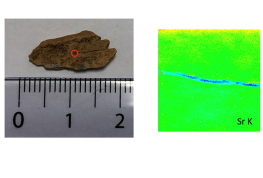
The spatial distribution of trace elements in the wood of tropical trees was investigated by X-ray fluorescence elemental analysis on the DIFFABS beamline. The results revealed cyclic patterns of variation useful for tree dating and retrospective growth analysis of tropical trees.


AILES beamline: an interstellar compound reveals its secrets

The NH compound is a highly reactive molecule which exists in the forms 14NH and 15NH: one nitrogen atom whose nucleus has 7 or 8 neutrons + one hydrogen atom. This is a key species and its 14NH form has been detected in our atmosphere and also in space, for example, in stellar atmospheres or around comets...


Science moves at Supelec: SOLEIL is there as promised

Some high school pupils from the Essonne may have missed their scheduled dates with SOLEIL Pursuit at the synchrotron, so this light-hearted encounter was brought to them, in the SUPELEC sports complex during the “Bouge la Science” event, this year with image as the theme...


Launching of a European Detector Consortium

On the 19th of December 2011, ten radiation synchrotron facilities have signed a Collaboration Agreement for the Establishment of a Framework for a European Detector Co-operation. The director boards of Alba (Spain), ISS-Anka, HZB, Desy (Germany), DLS (Great Britain), SLS (Switzerland), Elettra (Italy), MAX IV (Sweden), ESRF and SOLEIL (France) have clearly identified detector developments as one of the key programs for the improvement of the performances of the light sources. Indeed, in the past, many of these developments of very complex devices have benefited of the cooperation of two or more facilities, ranging from bilateral collaboration to multi-facility networks.


SOLEIL Users’ Meeting 2012
Four accounts

The 7th edition of the SOLEIL Users’ Meeting gathered more than 300 participants on January 18th and 19th. We interviewed four SOLEIL users come attend this annual meeting.


« SOLEIL Pursuit » - Remaining dates

April 4, 2012 (A.M.)
April 5, 2012 (A.M. or P.M.)

> More information


February 20th 2012, Francois Fillon visits the Saclay Campus

As part of Greater Paris Innovation and Research Day, the French Prime Minister, Francois Fillon, visited SOLEIL and several other centers on the Saclay campus, accompanied by Mrs Valérie Pécresse, Budget Minister, Mr. Laurent Wauquiez, Research Minister, Mr. Maurice Leroy, Town Minister and Mr. René Ricol, Investment Commissioner. The delegation was received by Jean Daillant, Director-General of SOLEIL and Jean-Pierre Samama, Science Director for life sciences at SOLEIL, and were shown several beamlines at SOLEIL and two future beamlines selected after the 2010 and 2011 EQUIPEX calls for projects: the ROCK beamline, project leader on new energy technologies and the NANOIMAGES X beamline, a unique facility in Europe for 3D imaging studies, particularly exciting in the biology, health and medical engineering fields and for complex and composite materials.

> See the press folder (In French)
> They talk about it...
- Essonne magazine
- 20 minutes
- Europe1
- Opticsvalley
- Le républicain
- JBVnews
- Le monde
- Dailymotion
- L'Usine nouvelle

 
SOLEIL member of the European oPAC - Optimization of Particle ACcelerators
oPAC is designed to train physicists in the fields of particle accelerators.

The optimization of the performance of any particle accelerator critically depends on an in-depth understanding of the beam dynamics in the machine and the availability of simulation tools to study and continuously improve all accelerator components...


Highlights 2010 online

Check out the first issue of SOLEIL’s Highlights, which compiles the main scientific results of SOLEIL in 2010.


News optics for the SOLEIL Storage ring

The nominal optics of the SOLEIL storage ring has been optimized to satisfy users in terms of electron beam size at «source» points, while guaranteeing an excellent performance with regard to the operation of the machine (lifetime and injection efficiency). There are several reasons that might require changing the opt ics: overcome performance limitations imposed by the undulators and wigglers, meet user needs in terms of beam characteristics, or take into account modifications of the machine for the construction of new beamlines.


XPAD detectors: from the laboratory to industrialization

Hybrid pixel detectors will mark the end of the CCD camera era in some experiments using synchrotron radiation. The XPAD technology, born of a collaboration which involved SOLEIL, is one example. its development led in 2010 to the birth of ImXPAD, a marseille startup dedicated to its commercialization.


Expert portrait : ALAIN LESTRADE

Head of the alignment/metrology group


When UV light from the DISCO beamline highlights… potato chips

Will it soon be possible not to dread climbing on the scales after eating French fries? Potato chips that are crispy and tasty but not greasy ... a dream! A dream that the research group headed by Olivier Vitrac, a researcher at INRA AgroParisTech on the Massy site, as well as staff on the DISCO beamline, are aiming to achieve by trying to understand a crucial stage in frying, which depends on the final oil content of the food being fried. How? By studying, under the microscope, the fluorescence emitted by potato strips bathed in hot oil ... Warning: the synchrotron is being turned into a deep fryer


Speciation of actinides in the environment - in situ characterization in an electrochemical cell using X-ray spectroscopy

Actinides (An), because of their electronic structure, may be found in various oxidation states, with AnO2+ and AnO22+ oxygen species at the +V and +VI states. The environmental behaviour of actinides in the environment is controlled by their oxidation state but also by the presence or absence of ligands. Actinides in their reduced form are generally found in the solid state (UO2 (s), for example) or colloidal phases. They can also be complexed with ligands such as natural organic matter, resulting in greater mobility and bioavailability...


CASSIOPEE beamline The true nature of a model interface finally revealed

Combining photoemission spectroscopy, scanning tunneling microscopy/spectroscopy and ab initio calculations allowed to determine the structural model of the alkali-metal/Si(111):B interface.


2011 retrospective – scientific results at SOLEIL, The French synchrotron radiation source situated on the Saclay campus

For an overview of the fourth year that SOLEIL has been operational and to provide the impetus to follow our 2012 results, we offer a selection of the scientific results for the past year from among approximately 400 scientific articles published in 2011.


Le Rayon de SOLEIL n°21

The synchrotron magazine : Chemistry in the light...


 Archives 2011

 Archives 2010

 Archives 2009

 Archives 2008

 Archives 2007

 Archives 2006 and Archines of the previous years

Archives Workshops

Accueil