Through a series of portraits, SOLEIL sets out to meet the people who make the synchrotron what it is. For this sixth episode, Edwige Otero, a scientist on DEIMOS—one of SOLEIL’s 29 beamlines—agreed to take part.
Driven from an early age by the joy of understanding, Edwige Otero naturally gravitated toward research. But just as important was her desire to contribute to a collective endeavour, one in which knowledge and discoveries are shared. From Lorraine to Canada, from chemistry to physics, her path reflects a constant passion for science and dialogue.
“Truth be told, I didn’t choose research; I simply followed my interest in science, step by step, and that’s where it led me.” When asked about the origins of her career, Edwige Otero, now a scientist on the DEIMOS beamline at SOLEIL, takes us back to her childhood. "There was no predetermined path, but rather a sensitive, open-minded upbringing and a “sincere and collective investment in the pursuit of knowledge.”
“I was lucky to grow up in a family where reflection and curiosity mattered a lot, where people always took the time to answer our questions,” she explains. “Wondering, asking, and trying to understand became second nature,” she adds. “It’s such an exhilarating feeling when you finally realise: so that’s how it works!”
“All I wanted was to be older”
In the days before the Internet, Edwige learned to look for answers wherever she could: in books, museums, exhibitions, open days… Her first physics–chemistry teacher also played a decisive role: “He made you want to understand everything,” she recalls. “He often took us beyond the official curriculum, and whenever he did, he would say: you’ll learn that later. All I wanted was to be older already.”
After her baccalauréat, Edwige left Commercy, a small town in the Meuse region, to begin a DUT in Chemistry at the University of Metz. She then completed a Bachelor’s degree in Chemistry in the UK, at Kingston University London. Next came a Master’s degree with an industrial placement at Daimler-Chrysler in Stuttgart, in a research group working on exhaust gas treatment.
“It was while doing analytical chemistry that I really became interested in the physics and chemistry behind these techniques,” she explains. To satisfy that curiosity, she would have to go further academically than she had originally planned.
Cutting-edge skills
In 2002, she joined Dr Stephen Urquhart’s team at the University of Saskatchewan in Canada, where she completed a PhD using synchrotron radiation to study organometallic molecules and polymers. “I first approached spectroscopy for its chemical applications and later from a more fundamental perspective.”
Edwige Otero arrived at SOLEIL in 2008 for a postdoctoral position on DEIMOS. “My thesis was mainly based on low-energy X-ray absorption—soft X-rays, as we call them in French—the least penetrating X-rays,” she explains. Since this was only one of many synchrotron techniques, her goal during the postdoc was to develop expertise in other spectroscopies. For her, the potential of these techniques in chemistry is “huge,” and gaining strong skills in this area would be invaluable.
When she arrived at SOLEIL, the beamlines were still under construction. “There was a real buzz, an infectious energy around the huge ring,” she recalls. “I kept running into the scientists whose papers I had read during my PhD—for a young researcher, it was the place to be!”
So when the opportunity arose to become a beamline scientist, she didn’t hesitate. Irregular working hours and the need for constant availability didn’t intimidate her—“I was prepared for that. And I had already formed both professional and personal relationships that were extremely rewarding and opened the door to exciting collaborations.”
Her application was accepted, and in 2009 she became a permanent scientist on the DEIMOS beamline.
Ensuring the best chances of success
Her mission? “My priority is to keep our beamline performing at its best. I work to maintain and improve its capabilities, and to anticipate the future needs of our external users,” she explains. A significant part of her work involves designing, developing, and testing new experimental setups.
DEIMOS specializes in magnetism studies. Edwige and her team develop extreme sample environments, from very low temperatures—just tenths of a degree above absolute zero—to very high ones, up to 800°C. Measurements can be performed in solution or under external stimuli. “It’s fascinating, because sometimes we get to perform experiments for the very first time, exploring matter from a completely new angle!”
Most of the research she is involved in focuses on magnetic systems of extremely small size, such as molecules made up of just a few dozen atoms. “These compounds are often highly sensitive to X-rays; DEIMOS allows us to study them without damaging them or altering their properties,” she notes. “The main objective is to determine whether—and how—these molecules could be used to store information on a very small scale.”
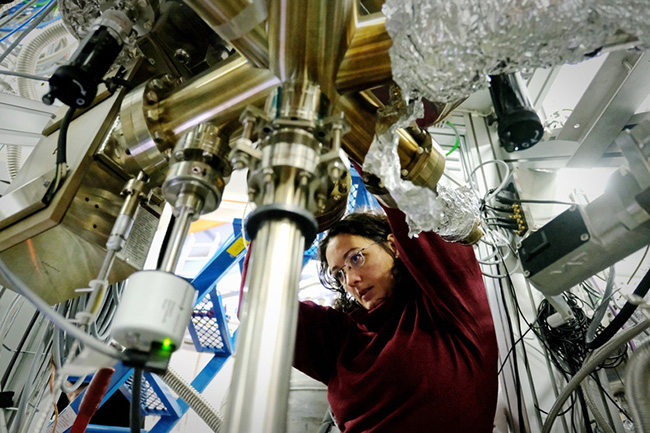
Edwige, busy transferring a sample on the DEIMOS beamline.
“Every day brings its share of challenges, unexpected discussions, new problems, doubts, and great successes.”
Beyond beamline development and research activities, Edwige and her colleagues also help future users design their experiments. “When user teams come to DEIMOS, we welcome and support them throughout the project—typically a full week, day and night—to give them the best possible chance of success. We then help interpret and analyse the results,” she explains.
“There is no typical day, which is both exciting and disorienting,” she adds. “Every day brings its share of challenges, unexpected discussions, new problems, doubts, and great successes. The hardest part is managing priorities!”
These responsibilities embody a collective contribution to scientific progress, a core value for Edwige. Synchrotron research in her field is often highly fundamental “in every sense of the word.” When applications eventually emerge, it usually takes many years. “In a way, our job is to make tomorrow’s knowledge and advances possible—and that’s no small thing!”
Respect and curiosity for others
Access to SOLEIL’s beamlines is highly selective: each one supports only a few dozen projects per year, chosen by a demanding committee of experts. “This means we work with some of the most talented French and international teams in their fields,” says Edwige. “At SOLEIL, we are lucky to be free to collaborate with these groups, who are often eager to work with us,” she adds.
She also emphasizes “the quality and goodwill of the exchanges” with the users. “It’s important to work in an environment that is both scientifically stimulating and humanly rewarding.”
“At SOLEIL, we welcome groups from all over the world who, every day, transcend political and cultural divides to work together on a common project.”
Her work requires highly technical skills as well as great adaptability: user experiments are extremely diverse, and beamline scientists interact with colleagues from many backgrounds and nationalities.
“At SOLEIL, we welcome groups from all over the world who, every day, transcend political and cultural divides to work together on a common project,” she says. “Research is a collective endeavour; you need to work as a team and respect others’ viewpoints.”
These values are “essential,” she believes, for anyone pursuing a career in the field. “If they don’t resonate with you, I imagine you’ll find far less joy in this job.”
Other indispensable qualities include “being able to question yourself, accept criticism, and recognise when you’re wrong—or when you simply don’t know something—so you can move forward.”
“Research requires time and resilience; there are plenty of opportunities to feel discouraged, and ‘victories’ rarely come from where you expect… but don’t give up!”
Sharing and collective spirit beyond research
When the SOLEIL Ambassadors programme was launched in 2024, Edwige immediately joined. This new science outreach initiative introduces the world of research and synchrotron science to younger audiences, for example through classroom visits in primary and secondary schools.
“As I said, research is about exchange and sharing knowledge,” she stresses. “Being part of the Ambassadors programme simply formalises what many of us already do at various levels: attending conferences, teaching, supervising PhD students, giving tours of SOLEIL to family and friends, organising science fairs in our children’s schools…”
Like her husband—also a CNRS researcher—she is “often surprised” at how little many people understand about the scientific method. “Perhaps it isn’t sufficiently present in society or the media, or isn’t taught well enough in schools. Or perhaps we don’t communicate about it the right way,” she wonders. “That’s why I wanted to follow the Ambassadors training.”
“Joining the Social and Economic Committee (CSE) is a way to learn how your institution works and take part in decisions; it’s very instructive when it comes to human and organisational dynamics.”
Edwige’s commitment to the life of the synchrotron takes many forms. Before joining the outreach programme, she served for nine years as staff representative on SOLEIL’s former Health, Safety, and Working Conditions Committee (now the Social and Economic Committee, CSE). “It can be time-consuming if you really want to be involved,” she notes, though she considers the experience deeply enriching: “It’s an opportunity to understand how your institution works and to take part in decisions; it teaches you a great deal about human and hierarchical relationships.”
Edwige has also been attending the CSE’s yoga class for more than 15 years. These sessions allow her to meet colleagues from other divisions she rarely interacts with in her daily work. “Informally, I now better understand their constraints and the reasons behind certain decisions that may affect my own work,” she says. A moment of breathing… and sharing.
Her two children, aged 7 and 12, constantly open up new opportunities for exploration and curiosity: “With them, it’s a bit like being on the beamline—you never know where our conversations will take us, and they often lead to a new activity or outing,” she smiles.
When she has time, she devotes it to sports and to her village’s community association, where she has served as treasurer for the past eight years. For Edwige Otero, life—like science—is something built together.
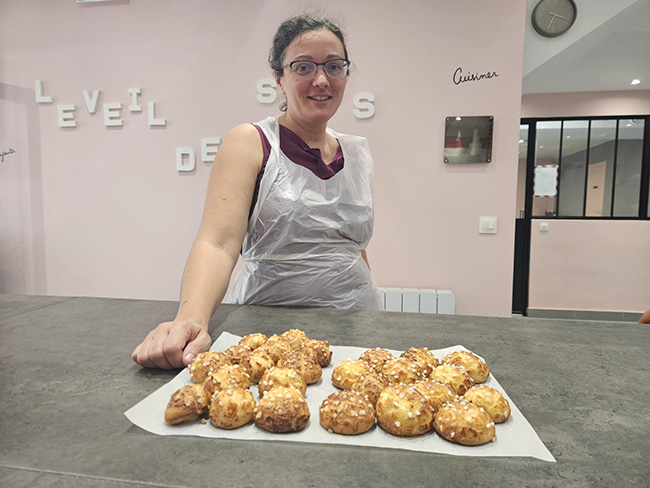
Successful “chouquettes” experiment! As Edwige says: “Cooking... it's all about chemistry and sharing!”
Edwige Otero' mini biography
1998: DUT in Chemistry, University of Metz, France
1999: Bachelor in Chemistry, Kingston University, Greater London, UK
2001: Master’s in Chemistry with industrial placement, Daimler-Chrysler, Stuttgart, Germany
2002–2008: PhD on synchrotron radiation study of organometallic molecules and polymers, University of Saskatchewan, Saskatoon, Canada
2008–2009: Postdoctoral fellow on the DEIMOS beamline, SOLEIL Synchrotron, Saint-Aubin, France
Since 2009: Beamline scientist on DEIMOS, SOLEIL Synchrotron, Saint-Aubin, France