Aller au menu principal
Aller au contenu principal
Venir à SOLEIL
Annuaire & contacts
Accès intranet
FR
EN
À propos de SOLEIL
Nous connaitre
Nous rejoindre
Recherche
Recherche Interne
Collaborations et projets de recherche
Sources et Accélérateurs
Plateformes
Savoir-Faire
Supports aux utilisateurs
Laboratoire de Métrologie Optique (LMO)
Lignes de lumière
Par domaines d'énergie
Localisation des lignes
Utilisateurs
Demande de temps de faisceau
Évaluation des projets
Préparer son expérience (scientifique)
Préparer son expérience (administratif)
Après l'expérience
ORGanisation des UtilisatEurs de SOLEIL (ORGUES)
Entreprises
Caractérisation de matériaux
Développements technologiques et valorisation
Autres prestations specifiques
Nos engagements
Documentation
Publics
Partager la culture scientifique
Se documenter
Découvrir nos vidéos
Visiter SOLEIL
Entrez votre recherche
Accueil
>
Videos
Videos
SOLEIL comme si vous y étiez
A quoi sert SOLEIL ?
Événements, Rencontres
Les grands dossiers de SOLEIL
Beamlines
R&D and supports
- Tout -
Alignement
Détecteurs
Divers
Electronique
Groupe Théorique
Informatique
Instrumentation
Laboratoire Biologie
Laboratoire Chimie
Laboratoire Matériaux
Laboratoire Matériaux Anciens
Laboratoire Microfluidique
Optique
Sources
Vous êtes
- Tout -
Entreprise
Grand public
Utilisateur / chercheur
Date
Start date
Date
E.g., 27/04/2024
End date
Date
E.g., 27/04/2024
Publié le 20/02/2024
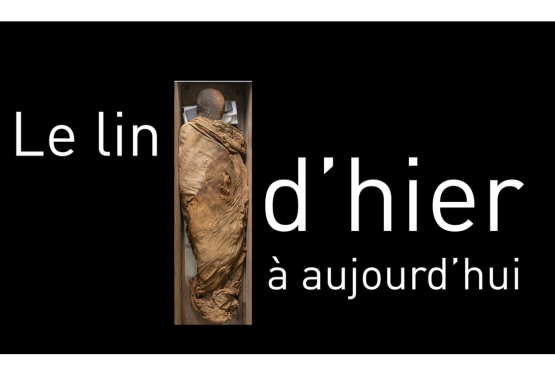
Le lin, d’hier à aujourd’hui
Quel est le point commun entre des bandelettes de momie et la coque d’un bateau ? Les deux contiennent des fibres de lin ! Très appréciée des Égyptiens, cette matière végétale aux nombreuses qualités est de nos jours étudiée dans l’optique de concevoir des matériaux plus écologiques. Pour évaluer la résistance des fibres de lin, une équipe de scientifiques est venue à SOLEIL, notamment sur...
Lire la suite
Publié le 22/12/2023
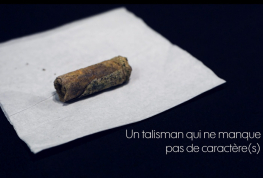
Un talisman qui ne manque pas de caractère(s)
3,5 cm de long, 1,5 cm de diamètre… Ce petit talisman, qui pourrait bientôt rejoindre les collections du musée des écritures d'Ampus dans le Haut-Var, est très mystérieux, et surtout très fragile....
Lire la suite
Publié le 22/11/2023
Présentation du laboratoire de Surfaces
Les laboratoires de matériaux de SOLEIL sont en fait divisés en deux sites, l'un pour l'analyse des surfaces, y compris les installations sous ultravide, et l'autre dédié à la recherche sur les...
Lire la suite
Publié le 22/11/2023
Présentation du laboratoire de Haute Pression
Les laboratoires de matériaux de SOLEIL sont en fait divisés en deux sites, l'un pour l'analyse des surfaces, y compris les installations sous ultravide, et l'autre dédié à la recherche sur les...
Lire la suite
Publié le 06/11/2023
Coup d’accélérateur pour la production d’hydrogène
De l’eau et de l’électricité pour produire de l’hydrogène : c’est l'électrolyse de l'eau, réaction que nombre de lycéens ont réalisé en TP de chimie. Une réaction qui semble simple, mais « ...
Lire la suite
Publié le 06/12/2022
Cure de jouvence - une nouvelle station de production d'eau glacée pour SOLEIL
Le Synchrotron SOLEIL bénéficie d'un financement dans le cadre du plan France Relance pour moderniser la station de production d'eau glacée de son site. Cette vidéo, tournée à l'été 2022 alors...
Lire la suite
Publié le 05/10/2022
La thèse de Julie - Episode 6 - La soutenance
Le 6ème et dernier épisode de notre série "La thèse de Julie" !
Lire la suite
Publié le 08/06/2022
Jurassic Park au Synchrotron SOLEIL
Quel le point commun entre SOLEIL et le cinéma ?... Alors que le troisième volet de la série de films Jurassic World sort en salles, nous vous proposons de revenir aux origines de la saga par le...
Lire la suite
Publié le 15/03/2022
La thèse de Julie – épisode 5 – l’Institut National du Patrimoine
Le cinquième épisode de notre série "La thèse de Julie" !
Lire la suite
Publié le 15/11/2021
Les messagers de poussière
A l’été 2021, quelques milligrammes de grains de poussière prélevés sur l’astéroïde Ryugu à plus de 340 millions de kilomètres de la Terre, dans le cadre de la mission spatiale japonaise Hayabusa-2,...
Lire la suite
Publié le 01/06/2021
La thèse de Julie – épisode 4 - le Laboratoire LISA et le synchrotron SOLEIL
Quatrième épisode de notre série « La thèse de Julie » !
Lire la suite
Publié le 08/03/2021
La thèse de Julie – épisode 3 - le Laboratoire MONARIS
Troisième épisode de notre série « La thèse de Julie » !
Lire la suite
Load more