Press release - Synchrotron SOLEIL's waste heat to heat 1,000 homes and the Gif-sur-Yvette aquatic center
On April 15, 2024, EPA Paris-Saclay and SOLEIL signed a partnership agreement to capture and recover the waste heat* produced by the Synchrotron. Installed on the Saclay plateau, it will supply a 5th generation heat and cold exchange network. This network will heat 1,000 homes on the urban campus and the aquatic center in the town of Gif-sur-Yvette at a very attractive cost.
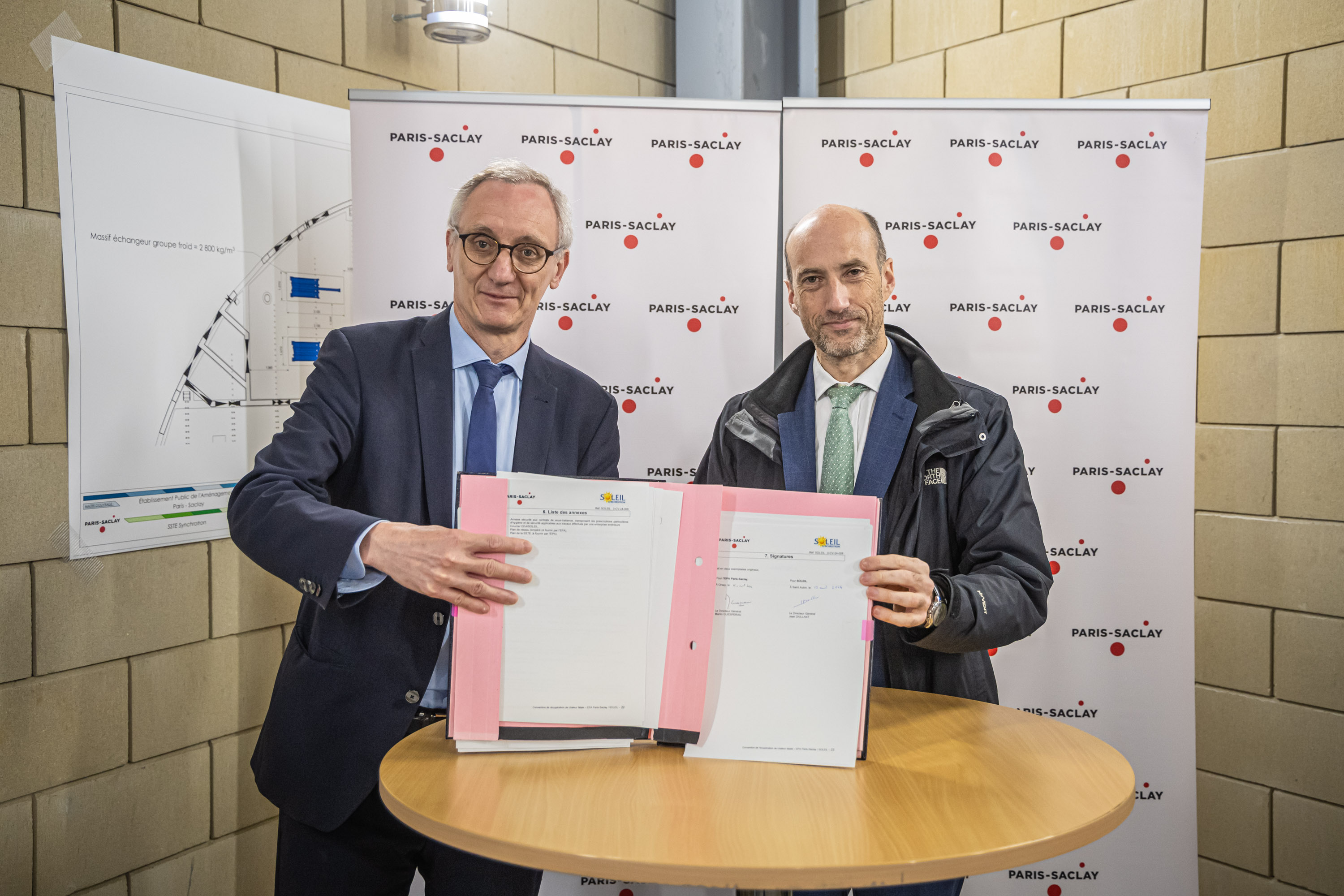
A new strategic partnership to further develop the Paris-Saclay heating and cooling network and strengthen the supply of renewable energies to the urban campus.
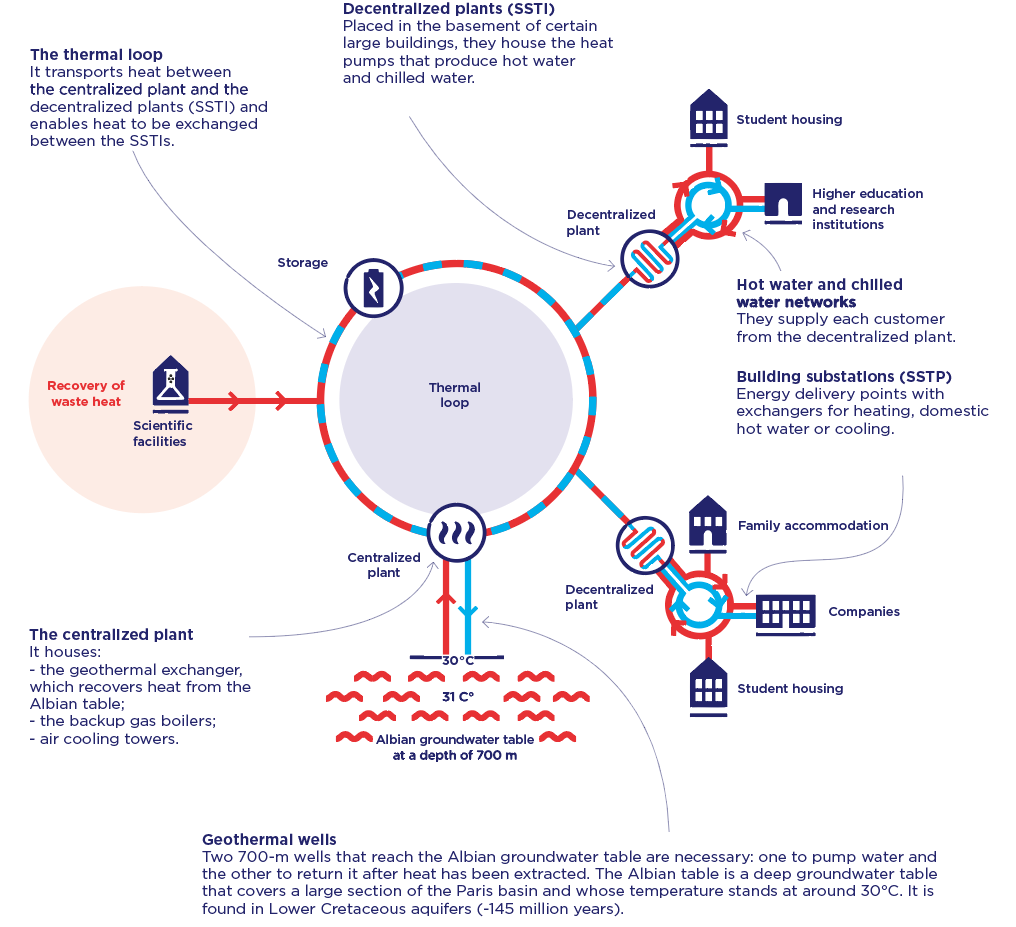
Inaugurated in 2019, the heat and cold exchange network of the Paris-Saclay urban campus is the 1st 5th generation energy network in France. It integrates deep geothermal energy and recovered energy by pooling the heating and cooling needs of the various building projects on the urban campus. The architecture of the Paris-Saclay network, based on a tempered loop (at a temperature of around 30°C), makes it possible to exploit previously untapped sources of waste heat.
The aim of this new strategic partnership between EPA Paris-Saclay and SOLEIL is to recover the waste heat generated by SOLEIL's particle accelerators and laboratories.
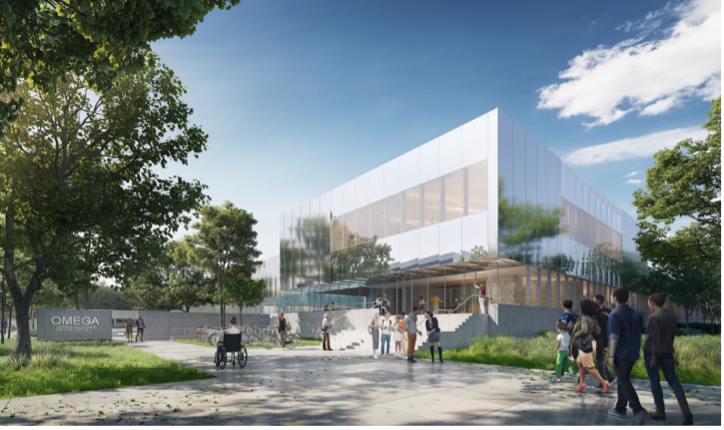
The potential heat recovered from the Synchrotron SOLEIL is estimated at almost 6,500 MWh/year, equivalent to the annual consumption of the new aquatic center in Gif-sur-Yvette, due to open in 2024, and over 1,000 new homes in the Moulon district.
This project is a further illustration of the links between the world of research and the inhabitants and users of the urban campus, which is at the heart of the Paris-Saclay project.
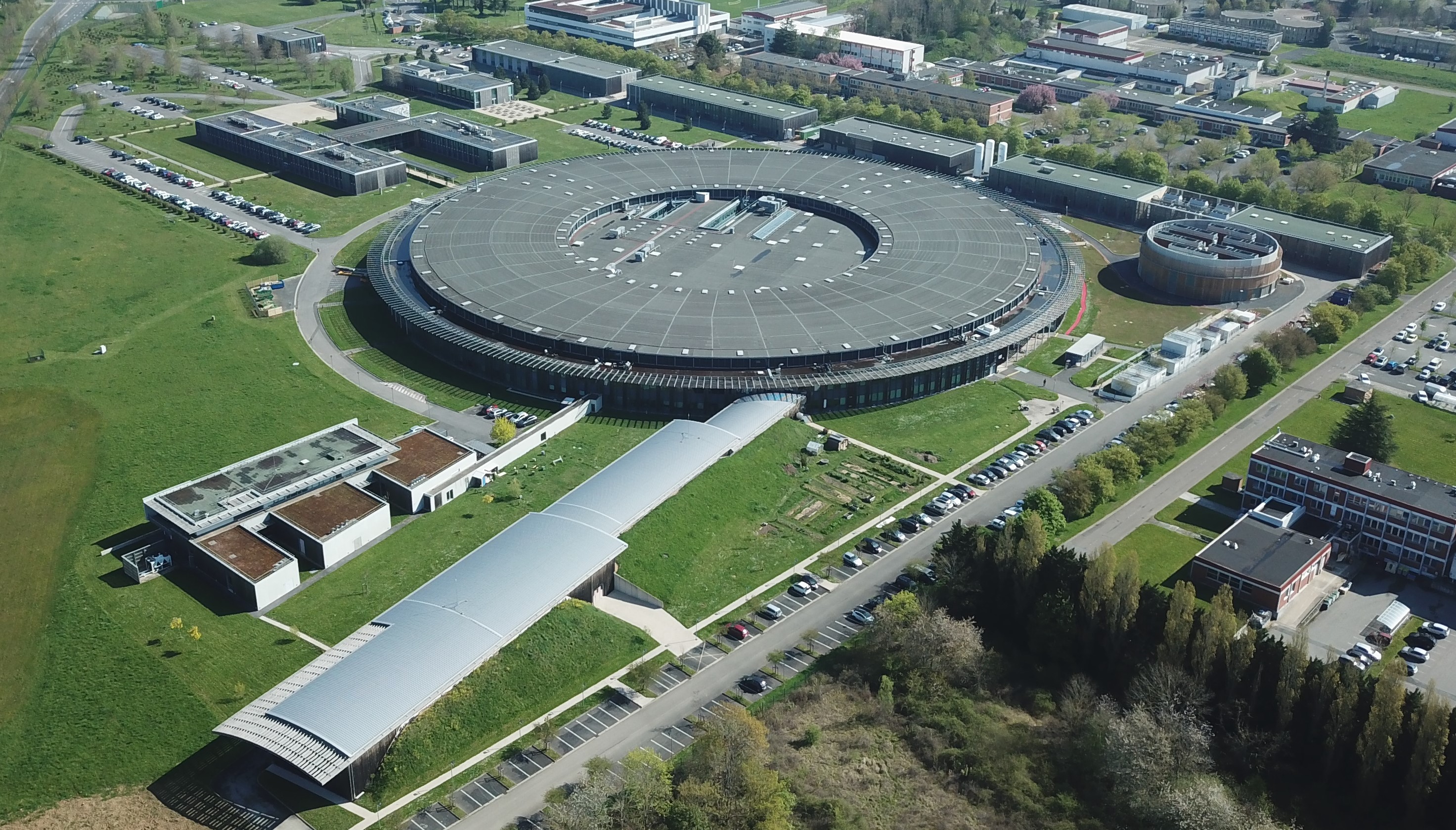
SOLEIL, a very large scale research infrastrucutre serving numerous scientific communities.
At SOLEIL, a particle accelerator is used to produce an extremely bright light, the synchrotron radiation, whose characteristics make it possible to observe and explore the properties of matter at all scales, down to that of the atom. This light is used to study all types of samples (solids, gas, liquids, etc.) in 29 laboratories, the beamlines, distributed around the accelerator, across a wide range of disciplines such as physics, biology, chemistry, astrophysics, environment, earth sciences, etc. The performance of our high-tech installations, which make SOLEIL’s reputation internationally and among its thousands of users per year, is based in particular on the temperature stability of the building and the various equipment. The commissioning in 2024 of a new chilled water and cooling production station, financed as part of the France Relance plan, was an opportunity to connect the installation to the heat and cold exchange network from Paris-Saclay.
Following an initial partnership with the CNRS in 2021 to recover heat produced by the Jean Zay supercomputer, this new collaboration between SOLEIL and EPAPS adds a new source of local, renewable energy to the heating and cooling network's energy mix, enabling the urban campus to use local, renewable energy that emits four times less CO2 than a traditional, decarbonized solution.
This alliance with the Synchrotron SOLEIL, a major player in French research, is in line with the EPA Paris-Saclay's sustainable development and social responsibility strategy to contribute to the energy transition on the scale of the Opération d'intérêt national and make Paris-Saclay a demonstrator of the sustainable city. It provides an additional link between researchers, residents, students and users of the urban campus.
How does the heat and cold exchange network work?