RESEARCH ON OUR SITE


LINAC Progress Report

Sources & accelerators Contents > Accelerators > LINAC Progress Report
LINAC Progress Report

Last Update : February 2006

 After the first beam success, the commissioning was done in July, September and October. This commissioning lasted 2.5 months. Different beam diagnostics was used to transport the beam along the Linac and to measure its characteristics with the first transfer line.


DIAGNOSTICS
To follow the beam along the Linac, different diagnostics are available:
  • 5 FCTs (Fast Current Transformer)
  • 3 viewers for beam position

FCTs are used to see the current transmission along the Linac. The current losses at the different elements can be measured. The viewers are used to control the steering and focusing of the beam with the different magnetic elements (shielded lens, solenoids, steerers).


The following diagnostics of the transfer line (TL1) are used to measure the beam characteristics:

  • 1 FCT (Fast Current Transformer)
  • 3 viewers for beam position
  • 2 Charge monitors (Bergoz)
  • Energy analyzing slit
  • Emittance measurement (straight branch)


The slit associated with the first dipole is used to measure the beam energy and the energy spread in the beam. The FCT placed after the slit allows the correlation time-energy-current. The emittance measurement uses the three gradient technique with the first four quadrupoles. The equipment consists in a in-vacuum Cerium doped YAG screen, an 5 lenses optical system with a tunable focal (from 0.15 up to 0.6 magnification), and a Video camera SONY XCHR50 with 10µs electronic shutter.


THE COMMISSIONING

The philosophy of this commissioning was to test the two working modes of Linac with small charge to minimize the “beam-loading” inside the accelerating sections and by this way to permit the different tunings (synchronization between RF and beam, working temperatures for the sections, RF power and power in the magnetic elements).


Concerning the 2 working modes, an energy spread <±1.5% and a normalized emittance e < 200p mm.mrad were specified in the 2 planes for an energy beam ≥100MeV.

  • LPM Mode (Long Pulse Mode for multibunch filling of the Storage Ring)

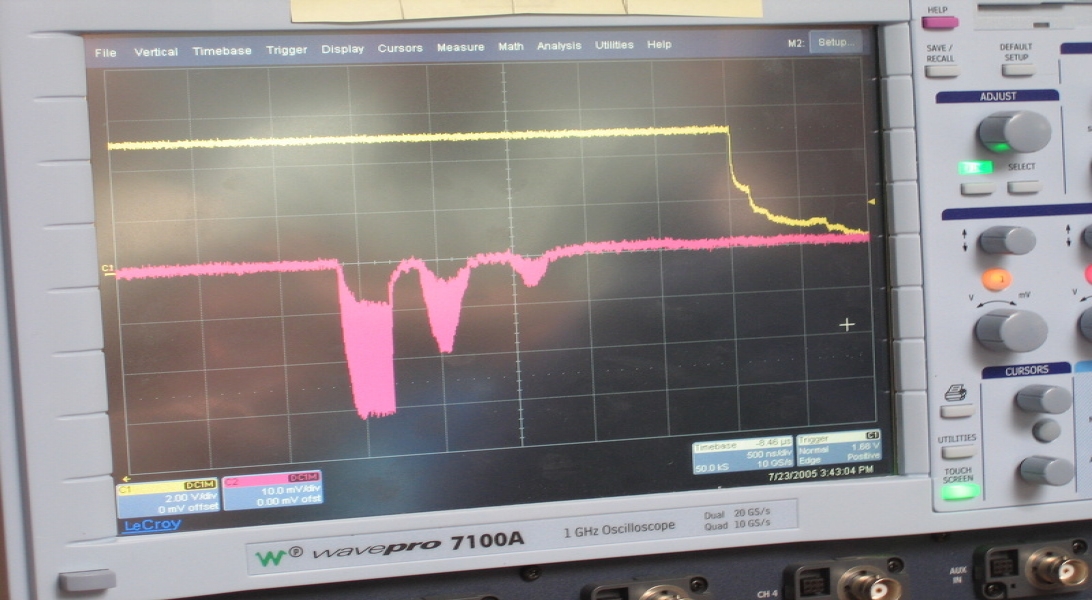
The Linac produces a train of 1.13ns pulses (requested <1.4ns) at 352MHz during 300ns and the total charge is 9.3nC (maximum required value 8nC).
The measured energy spread is < ±0.5%. This very good value is obtained using the “beam-loading” compensation technique, with an injection of the beam during the filling time of the second accelerating section.


   Figure 1: LPM mode transmission along the Linac with FCT and energy spectrum

The emittance measurement result is 47 (±10) p mm.mrad in the horizontal plane and 52 (±10) p mm.mrad in the vertical plane. These values are below the specifications with a factor 4.


Figure 2: Emittance measurement

  • SPM Mode (Single Pulse Mode for few single bunch mode in the Storage Ring, for time-resolved experiments)
 
Figure 3: SPM mode: 4 pulses production


 Figure 4 : SPM mode transmission (1 pulse) along the Linac with FCT and energy spectrum

The beam energy dispersion is ±0.58% for 1 pulse and ±0.82% for 4 pulses. The emittance is 64 (±10) p mm.mrad in the horizontal plane and 67 (±10) p mm.mrad in the vertical plane for one pulse. With 4 pulses, the emittance is 67 (±10) p mm.mrad in the horizontal plane and 78 (±10) p mm.mrad in the vertical plane.
CONCLUSION
The different measurements show that the LINAC beam characteristics are better than the specifications. The formal acceptance was pronounced by SOLEIL on November 15th .
In parallel with the commissioning, the Linac was used to inject inside the Booster an 110MeV beam (LPM mode). This running time consisted in ~ 10 shifts of 8 hours. The Linac showed good equipment reliability and excellent beam stability.

Archived progess report:

  • LINAC Progress Report : July 2005
  • LINAC Progress Report : February 2005
  • LINAC Progress Report : September 2004
Accueil