RESEARCH ON OUR SITE


Archives news 2010

SOLEIL Company Contents > All the news > News 2010
 
Elucidation of the 3D structure of chikungunya virus surface proteins

Researchers at the Pasteur Institute and the CNRS, in collaboration with the Synchrotron SOLEIL, have solved the three-dimensional structures of the glycoproteins that envelop the chikungunya virus. This discovery allows us to understand how this protein complex is activated in order to allow the virus to invade target cells. Activation is a key step in the viral life cycle, and its elucidation provides essential information for the development of antiviral strategies, for prevention and treatment.


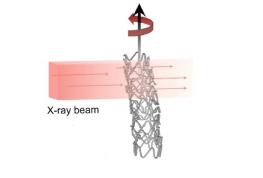
From cathedral building to radioactive waste storage - the importance of iron

Many iron parts are involved in the conservation of cultural heritage materials. For example, iron is a component of many archaeological and ethnological objects but also in historical buildings. Iron is especially very common in cathedrals, where it has recently been shown that it has always been used in large amounts since they were built.


First photons and set-ups for SIRIUS beamline

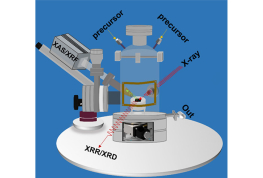
SIRIUS beamline received its first photons in the night of 1st December, 2010. And, since November 2010, the SIRIUS experimental hutch houses the beamline diffractometer, which will allow future grazing incidence X-ray scattering experiments on surfaces (diffraction, small-angle scattering and fluorescence) at fixed energy, under resonant conditions, or in energy scanning mode. The strong point of the diffractometer is that these measurements can be performed simultaneously on the same sample using both its detector arms.


SOLEIL improves its computer network

To ensure continuous and reliable operation of the synchrotron, SOLEIL has implemented highly redundant and powerful computerized solutions.


Circularly polarized light as a probe of forward/backward traveling atomic fragments and a sensor of the molecular environment in achiral species

CPL finds numerous applications ranging from modern displays and RealD 3D cinema technology, to circular dichroism of magnetic materials or chiral macromolecules in structural biology and allows addressing the fascinating origin of the homochirality of life.


Single Molecule Magnet, on the road to spintronic: a major step forward achieved by DEIMOS scientists and their collaborators

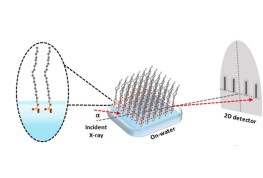
DEIMOS scientists and associates from the IMPMC (Pierre et Marie Curie University), in collaboration with Roberta Sessoli research's group (Florence University), have succeeded in preparing oriented monolayer of single molecule magnet and, thanks to X-ray Magnetic Circular Dichroism measurements, have demonstrated that the magnetic properties and the quantum spin dynamics of these remarkable molecules were preserved.


SOLEIL synchrotron and the ASTEP primary school initiative

In conjunction with the Essonne Sciences network, SOLEIL synchrotron is continuing its involvement with educational institutions by lending its support to the ASTEP initiative (Accompagnement en Science et Technologie à l’Ecole Primaire – Science and Technology Support for Primary Schools).


Two scientific medals awarded to Karim Benzerara, a scientist on the HERMES beamline

Karim Benzerara, a scientist on the HERMES soft X-ray microscopy beamline was awarded the CNRS Bronze Medal for 2009 and the 2010 Houtermans Medal awarded by the European Association of Geochemistry. This makes us want to know a bit more about the background and research undertaken by this young scientist.


Electronic properties of materials: the metal-insulator transition delivers part of its secrets under the light of the synchrotron

The behavior of electrons in materials induces two generally distinct states, either metallic or insulating depending on whether they are conducting an electrical current. Some materials, however, can change from one state to the other under the influence of external parameters...


A Nobel laureate at SOLEIL

On 25 May 2010, SOLEIL welcomed Venkatraman Ramakrishnan, molecular biologist, who is one of the 2009 Chemistry Nobel laureate. The prize honoured his work about the 3D structure of ribosomes, huge molecules that exist in each living cell and synthesize the proteins. This kind of research can only be carried out on synchrotrons.

> See video "A Nobel laureate at SOLEIL"


SOLEIL Synchrotron is 10 years old

Ten years ago, France decided to build a third generation synchrotron called SOLEIL. Since the autumn of 2000 when the synchrotron emerged out of the ground, its first users have benefited from the facilities available to them and some specialists even place SOLEIL at the top of the list of the best synchrotrons of its generation. Today, SOLEIL is still at an early stage in its scientific life but it is already providing results:
10 years, over 1,000 publications, almost 2,500 users per year, 5,000 visitors and...
1 book just published by Le Pommier.


Thai synchrotron SLRI and SOLEIL: strengthening of partnership

The scientific expertise of the research groups at SOLEIL are internationally recognized, notably in the field of infrared microscopy and PhotoElectron Emission Microspectroscopy (PEEM), techniques that are available on the SMIS and HERMES beamlines. This expertise will soon benefit scientists from SLRI (Synchrotron Light Research Institute), the Thai synchrotron, as a “Memorandum of Understanding” between SLRI and SOLEIL was signed on 25th October 2010. The aim of this agreement was to promote and strengthen a series of close collaborations in the following fields:

  • Exchanges in expertise and know-how
  • Developing specialized knowledge so as to make optimum use of the SMIS and HERMES beamlines
  • Strengthen transnational cooperation and mutual support between Thailand and France in order to promote scientific activities associated with the use of synchrotron radiation.

This 25th October was a particularly significant day for our Thai colleagues, as their synchrotron was officially inaugurated, in the presence of Princess Sirindhorn, daughter of the King of Thailand. Furthermore, two other ‘Memorandum of Understanding’ were signed, between SLRI and the Canadian synchrotron CLS on the one hand, and between SLRI and the Japanese synchrotron KEK on the other hand. 
 

From left to right:
- Osamu Shimomura, KEK Trustee (Japan)
- Michel van der Rest, SOLEIL General Director (France)
- Prayoon Songsiririttikul, SLRI Acting Director (Thailand)
- Josef Hormes, CLS Executive Director (Canada)


120 physics teachers at SOLEIL
on 20 October 2010

The physics and chemistry inspectorate of the Versailles education authority organised a conference and tour entitled “Large Hadron Collider (LHC) and SOLEIL synchrotron, two large-scale research facilities” last Thursday, 20 October, from 2 pm to 5:30 pm, at SOLEIL synchrotron.


Agreement between the Swiss synchrotron and SOLEIL

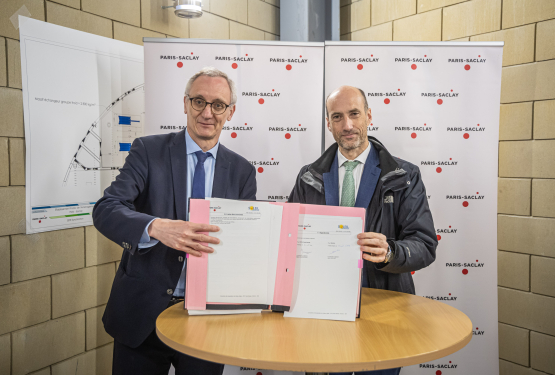
On 18th October, SOLEIL and The Paul Scherrer Institute based in Villigen (Aargau - Switzerland), in charge of the Swiss Light Source (SLS), signed a Memorandum of Understanding (MOU) to strengthen their cooperation in a certain number of scientific and technological fields linked to the development and use of synchrotron radiation: detectors, slicing, beam dynamics, coherent imaging, IR spectroscopy, magnetic dichroism, small-angle scattering and photon positioning system.
 
This MOU will provide a strategic direction to all the relations between these two synchrotrons: exchanges in information and instruments, researchers and engineers, joint development, etc. 


From left to right:
- Friso van der Veen, vice director of PSI
- Michel van der Rest, director of SOLEIL synchrotron
- Joël Mesot, director of PSI


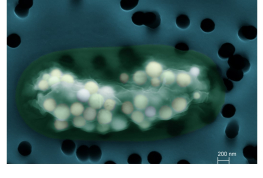
On the DISCO beamline: how to resist resistant bacteria…

Household products, such as cleaning liquids, detergents, deodorants and soaps, are found more and more often on the market in the form of “antibacterial” versions. It is now even possible to buy clothes that protect us not only from the cold but also from bacteria! But the consequences of this sanitized environment are unfortunately not as expected, in fact the opposite...


French-Swedish agreement on large-scale research facilities

SOLEIL to collaborate closely in the construction of a new Swedish synchrotron, the MAX IV.
The European Union has decided to equip itself with the most powerful neutron source in the world: The European Spallation Source (ESS), as part of a strategic plan by the ESFRI (European Strategy Forum on Research Infrastructures). This latter will be built in Sweden on the Lund University campus.

In this context, France and Sweden have decided to strengthen their cooperation.
Valérie Pécresse, the French Minister of Higher Education and Research and Peter Honeth, the Swedish Secretary of State of Higher Education and Research, signed an agreement in September 2010 to broaden the scientific partnership between their two countries, especially in the neutron, accelerator technology and climate research fields.

French and Swedish researchers will collaborate on several projects, such as research on neutrons at the “Laboratoire Léon Brillouin” (LLB). This agreement will also make it possible for Swedish students to come and follow courses on French reactors such as ISIS (technological radiation reactor) or MINERVE (experimental reactor devoted to neutron studies). The MAX lab synchrotron now on the Lund University campus will be replaced with a new synchrotron called MAX IV. Sweden made it known that it would like to benefit from the scientific know-how of SOLEIL during the construction of this new large-scale facility. As a result of this request, SOLEIL will collaborate closely with the team overseeing this project. Experts at SOLEIL will provide their technical and scientific skills and will train students and engineers who will be working on the design and running of this new Swedish synchrotron.


Nobel Prize for Physics 2010: Graphene takes Centre Stage

The 2010 Nobel Prize for Physics has been awarded to Andre Geim and Konstantin Novoselov of the University of Manchester for their work on graphene. Research on this material is in full swing in every research centre. In 2009 and 2010, several teams used the high-performance beam at SOLEIL to characterise the remarkable properties of this promising material.


Graphitization of 3C-SiC/Silicon: A step toward Graphene-Silicon technology

The graphene is nowadays one of the most promising materials for next generation electronic devices. The graphene is a carbon bidimensional single crystal (single layer). The stacking of single graphene layers forms the graphite. The promising properties of the graphene have be extensively demonstrated by Andre GEIM, from Department of Physics of Manchester University, jointly with Konstantin NOVOSELOV. They both were awarded the Nobel Prize in 2010. The graphene has attracted a much attention these last years from academic researchers as well as industrials.


2011 machine schedule
The machine schedule for 2011 is now available.
Altogether, 5208h will be dedicated to the beamlines.


Less waste tomorrow thanks to green chemistry

Plastics, detergents, solvents, adhesives: present everywhere in our daily lives, these all originate from petrochemicals. Numerous, waste products are produced during their manufacture and their destruction engenders CO2 emissions. finding alternative primary materials and using catalysts to guide chemical reactions are ways of minimizing the negative effects.


DISCO beamline opens new prospects for UV fluorescence microscopy experiments

Certain components of living tissue, such as the amino acid tryptophan, collagen, and porphyrin (one of the constituents of haemoglobin) have the property of fluorescing when excited by UV radiation in the domain of wavelengths below 350 nm (deep UV radiation, DUV). Molecules with this property can be used as probes, for example to track the development of a disease. Moreover, because they are naturally present in the tissue, there is no need for chemical linking (adding a synthetic fluorescent compound), which saves time and money, and avoids disturbing the biological activity or the behaviour of the molecule being detected.
Little use has been made of DUV radiation until now, because of a lack of light sources (lasers) in this spectral range. DISCO beamline can now be used for confocal fluorescence microscopy experiments in the DUV domain (up to 180 nm), providing both high brilliance and the spectral resolution of synchrotron radiation supplied by the beamline.

Reference :
Jamme, F., Villette, S., Giuliani, A., Rouam, V., Wien, F., Lagarde, B. & Refregiers, M.
Synchrotron UV fluorescence microscopy uncover new probes in cells and tissues
Microscopy and Microanalysis, 2010, on-line first


Fête de la science 2010

The theme of this year’s 19th annual Science Festival (Fête de la Science) will be “Biodiversity and bioethics: challenges for the future”.


Nuit des chercheurs - Septembre 24, 2010 - Meet SOLEIL at Ecole Polytechnique


Changes to the 7th call for projects

Changes to the 7th call for projects (closing date 16th September 2010): requests for beam time on the 4 French ESRF “CRG” beamlines will be evaluated at the same time as those for the 20 SOLEIL beamlines.


French, Japanese and Swedish researchers provide first experimental proof of the link between electron space distribution and nuclei motion in a molecule

When high-energy radiations, such as X-rays, interact with isolated atoms or molecules, inner-shell electrons (the closest to the atomic nuclei) may be ejected or may change their quantum state. For light atoms like C, N, O, the latter case leads to neutral highly excited species which relaxation may then cause the ejection of valence electrons (the farthest from the nuclei) called “resonant Auger electrons”. The space distribution of these ejected electrons is intimately linked to the symmetry of the electronic states involved in the excitation and deexcitation processes.
This paper reports, for the first time, the observation of strong changes of the space distribution of resonant Auger electrons emitted from acetylene, a linear molecule, as a function of the vibrational excitation of the remaining ion. This observation, made possible by the use of synchrotron radiation, has revealed that interference processes similar to those involved in the famous Young’s double slit experiment with visible light can take place at the atomic level in linear molecules. This result clearly proves that in such a case the Born-Oppenheimer approximation, assuming that the electrons and nuclei motions are not coupled in a molecule, is no longer valid.

Vibrational Scattering Anisotropy Generated by Multichannel Quantum Interference
Phys. Rev. Lett. 105, 093002 (2010)
http://prl.aps.org/abstract/PRL/v105/i9/e093002


GALAXIES, first photons for the 22nd beamline of SOLEIL

On 20th July, the GALAXIES beamline was lit for the first time, for radiation protection testing of the optical hutch. The white beam emitted by the undulator forms a thin paintbrush of light by ionizing the air molecules and illuminates the imager downstream. The tests performed for the first time at SOLEIL with a 500 mA current in the ring mark the start of installation of scientific instrumentation on the beamline.


Graphene holds promise

An international collaboration between CNRS (Grenoble), Georgia Tech (Atlanta) and the University of Paris-Sud have demonstrated that multilayer epitaxial graphene grown on SiC is composed of decoupled (non-interacting) graphene sheets.


VUV absorption spectrometry : a unique instrument, with the world’s highest resolution

The aim of the VUV-FTS project was to develop a new instrument, unique in the world: a Fourier transform spectrometer (FTS) with a interferometer based on wave-front division, possessing resolving power superior to the best beam spectrometers presently available. Such equipment would provide access to extremely detailed spectra, these being precious tools, notably in astrophysics. They would allow scientists, for example, to refine reference models used to identify bodies populating the atmosphere of planets or the constituents of stars.


Using circular dichroism to study magnetic nanostructures

The VERNANOMAG project (Versatility of self-organized magnetic nanostructures and materials: manufacture and functionality) is focused on the fabrication of nano-objects with magnetic properties and their characterization by circular dichroism using synchrotron radiation. The understanding of these magnetic properties, as well as being of great interest in fundamental research, is essential in the development of new materials for the optimization of the magnetic storage (miniaturization).


Following, understanding and modeling iron corrosion

The ARCOR project studied the scientific aspects surrounding the mechanisms involved in the corrosion of iron over long periods (centuries) in different situations: soil (under the surface or several meters deep), atmosphere (indoor or outdoor), concrete and marine environments. The aim was to diagnose and prevent this degradation, both for heritage restoration purposes (museums, historic monuments, conservation on site) and the nuclear industry (storage and disposal of radioactive waste, building structures).


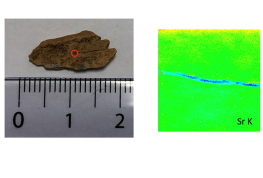
"Moon milk" and prehistoric caves

« Moon milk » is a strange substance that covers the walls of some prehistoric caves, sometimes erasing parietal works. What is it made of?

>> Watch the movie


The laser turns 50 years old in 2010

The first laser was operated on 16 May 1960 by Theodore Maiman at the Hughes Research Laboratory in Malibu (California). Dozens of events are being organized throughout France to celebrate the laser’s fiftieth anniversary in 2010. SOLEIL is a partner of the fiftieth anniversary national committee and will participate in events organized for the occasion in the Ile-de-France region, particularly on 22-23 June for the “Golden jubilee of the Laser in the City of Light” at the Ecole Polytechnique and on 24 September for researchers’ night. www.50ansdulaser.fr


Light on the carbenes chemistry

The VUV light of DESIRS beamline was employed to induce photoionization of two reactive intermediates belonging to the phenylcarbenes family, chlorophenylcarbene (CPC) and trifluoromethylphenylcarbene (TFPC), and their diazirine precursors. This allowed the determination of important gas phase thermochemical properties for the carbenes, such as ionization energies, which are difficult to obtain but interesting considering the importance of both intermediates as a model systems for carbene chemistry. In addition, thermochemical data on the ionization and dissociative ionization of the diazirine precursors were also obtained, shedding light on the photochemical properties of these compounds, important to photoaffinity labelling where photochemical activation induces the loss of nitrogen from functionalised diazirine precursors generating carbenes. The latter then form covalent bonds with specific target receptors, notably used in biomedical research.

Reference:
Noller, B., Hemberger, P., Fischer, I., Alcaraz, C., Garcia, G. A., & Soldi-Lose, H.
"The photoionisation of two phenylcarbenes and their diazirine precursors investigated using synchrotron radiation". PCCP - Physical Chemistry Chemical Physics, 2009, 11(26): 5384-5391


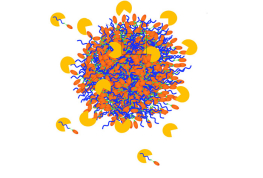
Briques nanométriques et chimie douce

Les équipes des lignes SAMBA (V. Briois) et SWING (F. Meneau) de SOLEIL ont étudié grâce aux techniques synchrotron (SAXS, EXAFS) les caractéristiques structurales de solutions de nanobriques de poly-oxo-titanate modifiées en surface par l'acide para-toluène sulfonique présentant une transition sol-gel thermo-réversible.


Le rôle du calcium dans la pathologie des plaques de Randall

Les lithiases (calculs rénaux) affectent jusqu’à 20% des populations des pays industrialisés. Depuis plusieurs années, Dominique Bazin et Michel Daudon étudient la genèse des calculs rénaux sur la ligne DIFFABS. Ils viennent de publier leurs résultats obtenus sur la composition des plaques de Randall, éléments nucléateurs des calculs.


SOLEIL au "Festiv’Archimede" de Massy (91)

Retrouvez SOLEIL au "festiv’Archimede" le festival des arts de la rue, les 18 et 19 juin au centre commercial Les Franciades, à Massy.
Au programme : expériences avec la lumière et les ondes, maquettes, films... Autant d’animations pour comprendre certaines applications de la vie quotidienne et faire de la science en s’amusant.

SOLEIL et Science ACO seront présents aux côtés de leurs autres partenaires Play math, Adis Volcan, l’école ADN, le CNRS, la compagnie des passeurs d’ondes, Les petits débrouillards, A fond la science… 

Une manifestation organisée par le réseau Sciences Essonne


IR Spectroscopy: when information technology improves the diagnosis of unhealthy cell

Infrared (IR) microspectroscopy has been used increasingly in recent years as a technique for analysing cell samples for diagnostic purposes, even in the very early stages of a disease. 


The biochemical causes of epilepsy: studies carried out on the SMIS beamline

The aggregation of proteins in certain parts of the brain (amyloid plaques) and the action of reactive oxygen species (oxidative stress) on brain cells are two of the mechanisms that are thought to be involved in epilepsy...


Towards femtosecond diffraction with the XPAD pixel detector

SOLEIL recently launched an ambitious project which aims at producing synchrotron radiation pulses of 100 femtoseconds width: the femto-slicing project. The first beamlines concerned will be TEMPO (photo-emission) and CRISTAL (diffraction). CCPM (Marseille), the CRG D2AM beamline at ESRF and the Detectors group at SOLEIL have designed and produced one of the detectors needed for the future experiments carried out on CRISTAL beamline.


Interview of F. Polack, Head of the Optics group at SOLEIL

Towards the end of the 1970s, François Polack became part of the scientific adventure linked to the conversion of the ACO1 collider into a synchrotron radiation source. Since then, this optics researcher has never left the professional world of synchrotrons. Involved in the rejuvenation of LURE2 then, from the early1990s, in the design of SOLEIL beamlines, he is now Head of the Optics group at SOLEIL.


Budding researchers

The support of SOLEIL’s partners mainly concerns its scientific policy, but also includes a “Science and Society” component. This is true for the General Council of the Essonne and the Ile de France Region, but also for the Centre Region: secondary school students from Chartres could come perform a “real experiment” on the PROXIMA1 beamline.


TEMPO - Nanoparticles on a Mediterranean diet
Although silicon has been the main constituent of photovoltaic cells up to now, new-generation cells are currently in the research and development phase.
 
Transverse Feedback System at SOLEIL
Stability of the electron beam is one of the quality criteria in synchrotrons. It requires means of controlling, on the one hand, the disturbances that can modify the beam’s position, and on the other, the instabilities intrinsic to the electron bunches that could affect its dimensions.
The SOLEIL Sources and Accelerators Division has set up several systems that control and improve this stability on a permanent basis. This effort is paying off.

 
Current-induced magnetization dynamics in magnetic nanowires revealed by time-resolved XMCD-PEEM imaging

Domain walls in magnetic nanowires have been proposed to constitute a new type of fast and cheap magnetic storage medium, the so-called race-track memory. For the first time, the displacement of such domain walls was imaged during the short (ns) current pulses that induce this displacement, using X-PEEM. These experiments were carried out on TEMPO beamline.


Characterization of strongly curved mirrors: comparison between SOLEIL and ESRF

The optics group metrology laboratory (OML) is responsible for characterizing the optics mounted on the beamlines. As smaller and smaller beams are required, there is a need for optics with ever greater curvatures and smaller slope errors.


The pathogenesis of Randall’s plaque: a papilla cartography of Ca compounds through an ex vivo investigation

Randall’s plaques are intratissular calcifications located in the deep renal medulla and skirting the surface of the epithelium of the papilla, where they act as nucleating elements for kidney stones. These superficial plaques are described as being composed of carbapatite (poorly crystallized carbonated calcium phosphate, or carbonated apatite, abbreviated CA). Dominique Bazin’s team wanted to check the nature and the exact proportions of the mineral phases present in Randall’s plaque as you move from the top of the papilla to the deep medulla.
To do this, x-ray absorption spectroscopy was the method chosen because it is able to characterise a Randall’s plaque without any preparation protocol likely to alter the physicochemical state of the sample.

[Full story]


Osteoporosis in the light of SOLEIL

Researchers at INSERM have decided to enlist the DISCO beamline’s UV radiation to study the changes to our skeletal system caused by osteoporosis and the effectiveness of treatments...

[Watch video]


Time resolved EXAFS/XANES measurements on ODE beamline - microsecond resolution

ODE beamline allows x-ray spectroscopy absorption (XANES/EXAFS) measurements at a microsecond resolution. This technical performance relies on the combined use of two devices.


From synchrotron to hospital

A patient at the Necker Hospital suffering from a hereditary disease has just benefited from early diagnosis that should prevent her from losing her kidneys. Yet, another capability of the SMIS beamline, the SOLEIL synchrotron infrared microscopy endstation.


Infrarouge and chemotherapy

IR spectroscopy reveals effect of low doses of anti-tumour drug on cancer cells.


 Archives 2011

 Archives 2009

 Archives 2008

 Archives 2007

 Archives 2006 and Archives of the previous years

Archives Workshops

Accueil