RESEARCH ON OUR SITE
 
 
SOLEIL in 3 questions
Outreach area Contents > SOLEIL in 3 questions

SOLEIL is an extraordinary light source serving research and industry. In 2007, more than 300 staff members will welcome some 2,000 researchers per year, coming from all the fields that, today, drive science and industry: biology, pharmacy, environment, physics, materials, chemistry, geoscience, and heritage.

What is SOLEIL?
What does SOLEIL do? 
How does SOLEIL work?
 
What is SOLEIL ?

SOLEIL, an acronym for “Optimized Source of LURE* Intermediary Energy Light,” is a research center located on the Plateau de Saclay in Saint Aubin, Essonne. More concretely, it is a particle (electron) accelerator that produces the synchrotron radiation, an extremely powerful source of light that permits exploration of inert or living matter.

This multidisciplinary tool, indispensable in the fields of research and industrial applications, will welcome more than 2,000 users per year as of January 2007.

Financed by two principal shareholders, the CEA and the CNRS and its other partners, the region of Ile de France, the state of Essonne, the Central Region, and the state (Ministry of Research), SOLEIL holds a private statute as a “Public Company.”

The ESRF (European Synchrotron Radiation Facility), the other synchrotron radiation facility in France, located in Grenoble, and which is 25% supported by the French state, unfortunately is not able to cover the entire need of the French scientific community.
The SOLEIL synchrotron provides France with a second source of very high-tech synchrotron radiation.

* LURE:  The Laboratory for Electromagnetic Beam Use was a pioneering laboratory in the field of synchrotron radiation, located on the premises of the Université d’Orsay, where research and development of the use of the synchrotron radiation were cultivated on several machines (ACO: Orsay Collision Ring; DCI: Igloo Collision Machine, and SUPER ACO). SOLEIL has taken up the torch passed by LURE, which closed in 2003.


What does SOLEIL do?

SOLEIL is a source of light endowed with extraordinary and necessary properties for the scientific community (great brilliance: 10,000 times brighter than sunlight), a wide spectral “white” source range ranging from infrared (1eV) to hard X-rays (50 keV), polarization (linear, circular, etc.), and pulsed light. It provides new perspectives in the study of matter with a resolution down to millionths of meters and sensitivity to all types of materials.


SOLEIL covers fundamental research needs in physics, chemistry, material sciences, life sciences (notably in the crystallography of biological macromolecules), earth sciences, and atmospheric sciences. It offers the use of a wide range of spectroscopic methods from infrared to X-rays, and structural methods in X-diffraction and diffusion.

In applied research, SOLEIL is applied in very different fields such as pharmacy, medicine, chemistry, petrochemistry, environment, nuclear energy, and the automobile industry, as well as nanotechnologies, micromechanics and microelectronics, and more.

SOLEIL also has a volunteer policy of openness to applications for industry and important national challenges (environment, energy, scientific police, archaeology, and heritage), with the intent to facilitate small and mid-sized businesses’ access to synchrotron radiation techniques.

How does SOLEIL work?

  
The synchrotron radiation is light emitted by relativist electrons (at virtually the speed of light) of very high energy (SOLEIL’s nominal energy is 2.75 GeV), that spin in a storage ring 354 m in circumference. This is done tangentially to the trajectory in an extremely fine beam, and the trajectory of the electrons is curved with a magnetic field (Lorentz strength).

• A beam of electrons as fine as a strand of human hair, emitted by an electron cannon  , is first accelerated in a 16 meter long linear accelerator, the linac. The electrons reach the speed of light and an initial energy level of 100 MeV.

After this initial acceleration, the electron beam is directed towards a second, circular accelerator called the Booster that brings the energy level up to the SOLEIL operating value of 2.75 GeV.

At this energy level, the electrons are injected into the 354 meter circumference storage ring (113 meters in diameter) and spin for several hours.

• In the storage ring, magnetic devices (dipoles [curving magnets] and wavers or wigglers [a succession of alternating magnets]) control the trajectory of the electrons or make them oscillate. The electrons then lose energy in the form of light, the synchrotron radiation.
 
The energy lost by the electrons in emitting the synchrotron radiation is made up for by radiofrequency sockets.

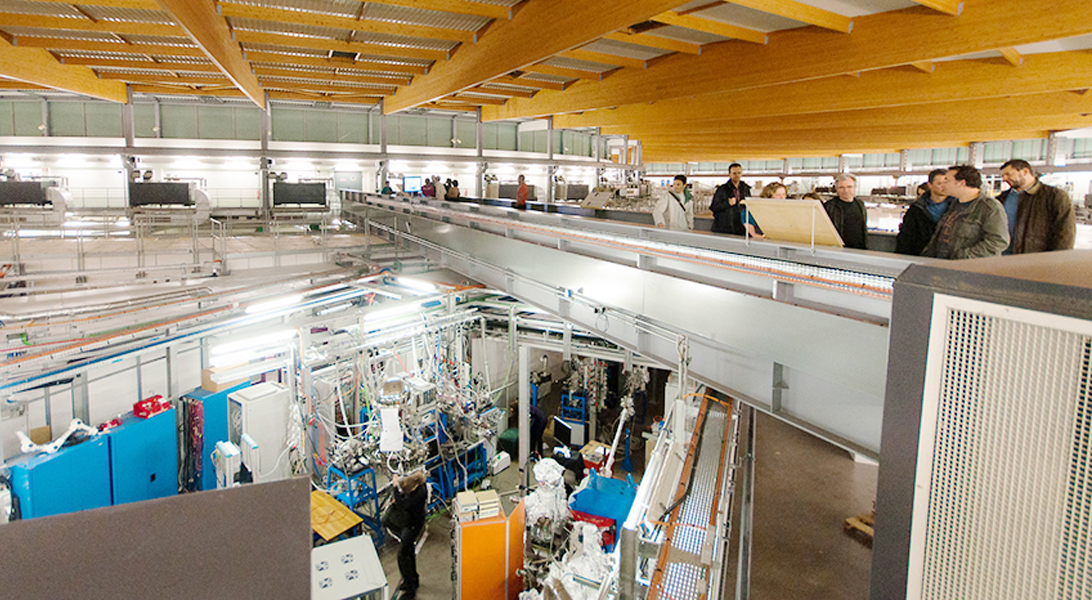
• The synchrotron radiation produced in the curving magnets and insertion parts (wigglers or wavers*) is directed, selected, and stored by optic systems toward experimental stations called beamlines.

* The addition of the wiggler and the waver to 3rd-generation synchrotrons provides light that is even more brilliant than with dipoles (1,000 times brighter with the waver than with the dipole).

• Each beamline constitutes a true laboratory for biology, chemistry, and Earth sciences, equipped to prepare and analyze samples to be studied and process the information gathered. Of SOLEIL’s 43 possible slots, 24 lines are planned.


 Online documentation

 Glossary

Accueil