

La ligne de lumière AILES est optimisée pour la spectroscopie d’absorption infrarouge de la matière condensée jusqu’aux molécules en phase gazeuse. Le domaine spectral couvert s’étend de l’infrarouge moyen aux ondes submillimétriques (ou THz), mais le performances les plus intéressantes sont obtenues entre 8 et 1000 cm-1. Les sujets de recherche développés sur AILES vont de la spectroscopie moléculaire aux études des propriétés optiques des matériaux, avec un large éventail de sujets se rapportant à la physique, la chimie et la biologie.
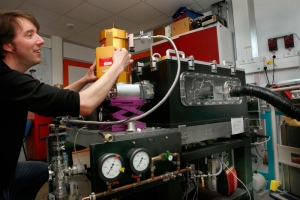 La ligne AILES exploite la spectroscopie d’absorption infrarouge pour l’étude de molécules ou de matériaux.
Elle couvre la gamme s’étendant des Infrarouges (IR) aux Térahertz (THz) ou IR lointains (5 à 1500 cm-1).
En plus des gains en intensité et en brillance permis par le rayonnement synchrotron, la ligne se doit d’être aussi stable que possible afin de maintenir un très faible niveau de bruit.
Pour ce faire, elle est dotée d’un système d’extraction et d’éléments optiques de grande stabilité compatibles avec la technique interférométrique. Les photons émis dans un aimant de courbure sont collectés et exploités grâce à deux interféromètres de type Michelson (IRTF).
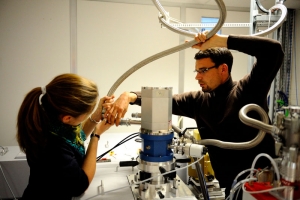 Ces deux stations spectroscopiques sont consacrées respectivement aux études optiques de matériaux condensés (AILES B) et aux études ro-vibrationelles de systèmes moléculaires (AILES A). Cette dernière est la station expérimentale de SOLEIL ayant la plus haute résolution spectrale absolue : 0.1 micro eV.
Les deux postes expérimentaux, complétés par des environnement échantillons adaptés, permettent ainsi l’étude d’échantillons solides, gazeux ou liquides, et ce, sous des conditions variées.
Les études sur AILES couvrent des applications en physique, biologie ou encore en chimie.
La ligne répond aux besoin des applications pour lesquelles il est nécessaire de combler le gap spectral entre IR et micro-ondes avec une intensité importante et une grande stabilité.

L'équipe

Données techniques
1 à 400 meV (8 à 3000 cm-1)
CSR (Coherent Synchrotron Radiation) 40.325-322.6 meV (5.40cm-1)
Interféromètre 1: 0.0001 meV (0.001 cm-1)
Interféromètre 2 (HR) : 10-4 meV (0.0007 cm-1)
Aimant dipolaire 18x80 mrad² (VxH)
Bord d'aimant et champ constant
5.10e13 Phot/s/0.1%bw @ 100 cm-1
1.10e13 Phot/s/0.1%bw @ 10 cm-1
8 miroirs entre l'extraction et les interféromètres.
2 interferomètres :
Haute résolution pour les études de la matière diluée (AILES A)
Résolution intermédiaire pour les études de la matière condensée (AILES B)
- Polariseurs MIR et FIR
- Cellule de White multipassages (0.8m - 8m)
- Cellule de White multipassages (4m - 150m)
- Cellule de White à décharge
- Cellule long parcours refroidie
Ensembles optiques:
- Condenseur de faisceau pour la transmission sur petits échantillons
- Réflectivité incidence normale et/ou rasante
- Réflectivité incidence variable
- Réflexion totale atténuée (ATR)
- Polariseurs MIR et FIR
Environnements échantillons:
- Cellules pour liquides et poudres
- Contrôleur de température par circulation de liquide (+ 80°C / -70°C)
- Cryostat à hélium à haute stabilité spatiale (363K à 5K)
- Cellules enclumes de diamant pression jusqu'à 14 GPa
Thématiques scientifiques
| Spectroscopie haute résolution en phase gazeuse | Détermination des spectres caractéristiques de molécules d’intérêt astrophysique dans la région térahertz (infrarouge lointain, proche des micro-ondes). Préparation à la mission Herschel. Applications en astrophysique |
|---|---|
| Dynamique des molécules en solution | Étude de molécules dans des structures de confinement micellaires ou lamellaires : excipients pour médicaments, supports pour nanomatériaux. Applications en pharmacologie, nanotechnologie |
| Physico-chimie des interfaces | Étude des couches minces notamment en microélectronique Applications : synthèse de nouveaux matériaux aux propriétés optimisées pour les applications industrielles |
| Propriétés optiques de solides | Étude de solides cristallins non conventionnels tels que les supraconducteurs à haute température critique (HTCS), les supraconducteurs organiques et les aimants moléculaires Application : nanotechnologie |
Spectromètres
The AILES Beamline use two Bruker 125 Interferometers (Branch A and B) as stations for spectroscopic analysis. The collected Synchrotron Radiation (SR) can be steered by a movable mirror toward either one of these two interferometers.
The Branch B interferometer has a lower resolution (max unapodized resolution = 0.008 cm-1) and therefore should be the choice for condensed matter studies.
A complete range of optimized beam splitters and detectors is available to cover the whole near- to very far infrared range. The strong point of the AILES Beamline being experimentation in the far IR, a special effort has been the implementation of fast bolometers (ca. 1 kHz bandpass) enabling an increase in signal to noise ratio (S/N) with respect to standard detectors.
EXP Station A
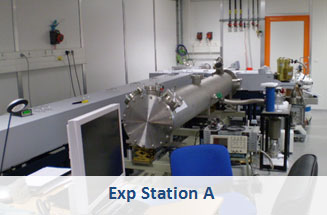
The optimum range for the beam splitters are:
0 to 50 cm-1 (125 µm Mylar)
20 to 100 cm-1 (50 µm Mylar)
30 to 650 cm-1 (Composite Si + 6 µm Mylar)
400 to 4500 cm-1 (Ge on KBr)
1200 to 9000 cm-1 (Si on CaF2)
8500 to 25000 cm-1 (TiO2 on Quartz)
The available detectors:
1.6 K Bolometers for 0-30 cm-1 (slow response) or 0-100 cm-1 (fast response).
4.2 K Bolometers for 30-650 cm-1.
77 K Photoconducting and Photovoltaic HgCdTe for 600-4500 cm-1.
77K Photovoltaic InSb for 1900-7500 cm-1.
Room temperature Photovoltaic InGaAs and Si for 6500 to 20000 cm-1.
Vacuum systems:
As both experimental stations must be operated under vacuum to minimize atmospherical absorption and acoustic perturbations, both interferometers and the beam line have been equipped with magnetic bearing turbopumps to provide almost vibration-free operation down to 10-5 mbar. A separate gas vacuum line and a range of thermostated precision capacitance manometers are available for assisting in preparing the samples.
Exp Station B
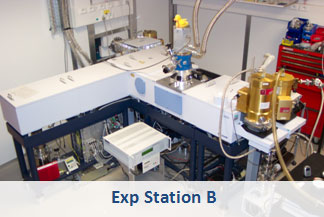
The optimum range for the beam splitters are:
0 to 50 cm-1 (125 µm Mylar)
20 to 100 cm-1 (50 µm Mylar)
30 to 650 cm-1 (Composite Si + 6 µm Mylar)
400 to 4500 cm-1 (Ge on KBr)
1200 to 9000 cm-1 (Si on CaF2)
8500 to 25000 cm-1 (TiO2 on Quartz)
The available detectors:
1.6 K Bolometers for 0-30 cm-1 (slow response) or 0-100 cm-1 (fast response).
4.2 K Bolometers for 30-650 cm-1.
77 K Photoconducting and Photovoltaic HgCdTe for 600-4500 cm-1.
77K Photovoltaic InSb for 1900-7500 cm-1.
Room temperature Photovoltaic InGaAs and Si for 6500 to 20000 cm-1.
Vacuum systems:
As both experimental stations must be operated under vacuum to minimize atmospherical absorption and acoustic perturbations, both interferometers and the beam line have been equipped with magnetic bearing turbopumps to provide almost vibration-free operation down to 10-5 mbar. A separate gas vacuum line and a range of thermostated precision capacitance manometers are available for assisting in preparing the samples.
Performances
What is special about SR for IR spectroscopy?
Synchrotron radiation flux extracted on some infrared beamlines
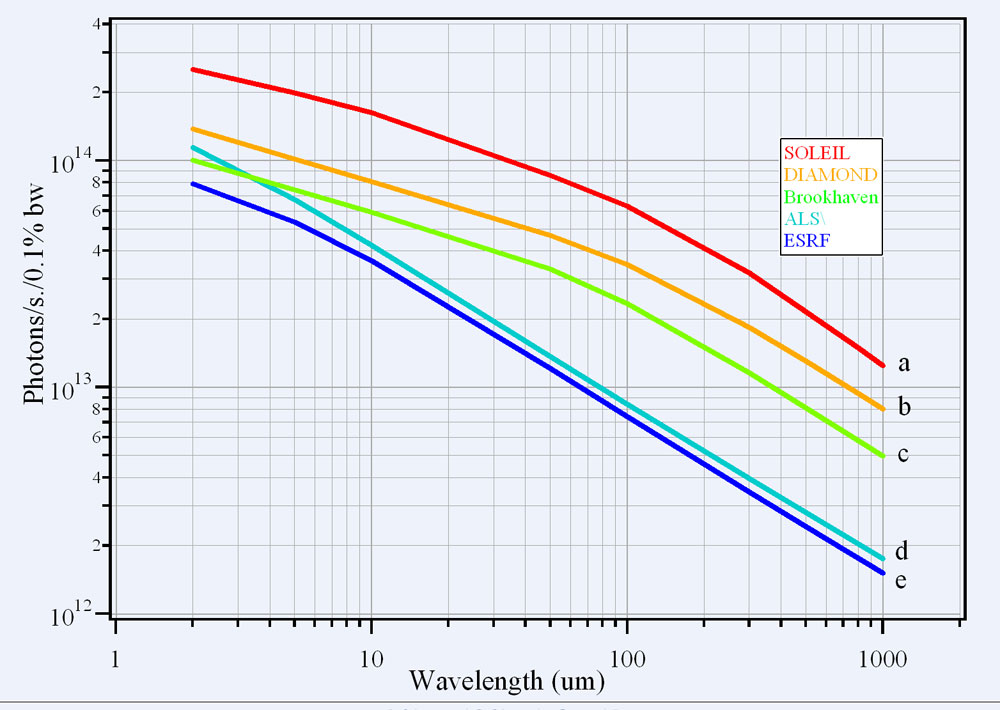
Synchrotron radiation constitutes a high flux and brightness broad band source used in various facilities around the world.
Beam intensity profile (near 1000 cm-1) at the interferometer entrance focal plane on AILES.
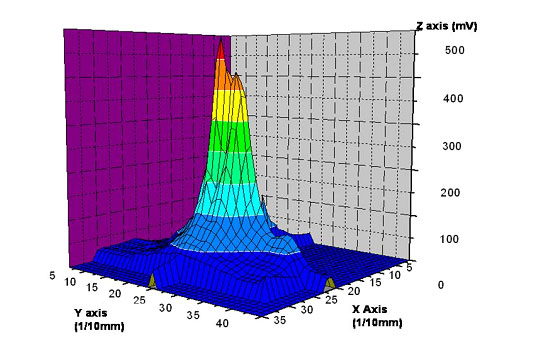
For example, around 1000 cm-1, the beam, although slightly asymmetrical in profile due to the asymmetry in the emission and shape in the front extraction mirror, can focussed to have 95 % of the total flux ( 5 x 10¹³ photons/sec/cm-1) contained within 0.75 mm from the beam axis.
Φmeasured = 4.5 ± 1.5 1013 photons/s/0.1% B.P. @ IRS = 500
Such properties are crucial for studies limiting the source or sample surface area such as condensed studies on small sample cells or crystals and high resolution gas phase work.
For high resolution studies, the input SR IR beam can be used in many instances without entrance iris (Note that the effective beam size at the spectrometer entrance varies with wavelength, a good rule of thumb being d(mm) = 25 (ν (in cm-1)-½ ).
The following figure presents the S/N enhancement achieved for high resolution measurement as measured at AILES :
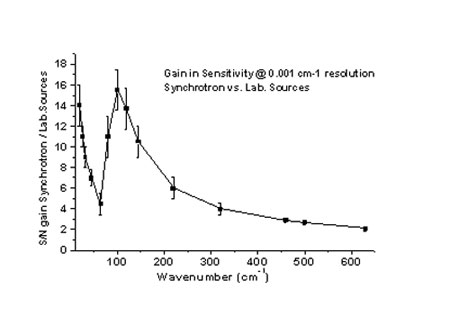
Thus a 6-fold enhancement means that an equivalent S/N ratio would require some 36 days of measurement around 200 cm-1 to reach a S/N ratio of about 80 without SR…
The dependence in beam size following approximatively the requirement in source size for work at the highest resolution, optimum conditions can be met in one measurement without repeating measurements with different aperture stops.
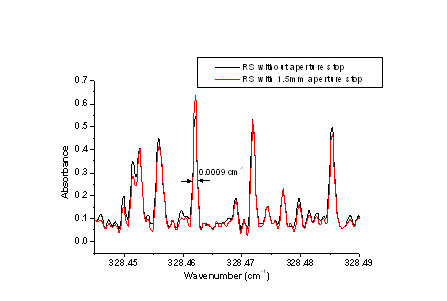
Comparison of two successive HR measurements with aperture stop Ø = 1.5 mm (red) and without aperture stop (black). Detail of one the low J R branch cluster of the ν4 band of OsO4.
Close cycle highly stable cryostat
A cryogenic system allowing infrared transmission measurements for samples at temperature ranging from 400K to 4K has been developed for the condensed matter measurements (branch B). This system includes a pulse tube Helium close cycle cryogenerator provided by Cryomech (PT 405) working with a closed loops of helium cooling down samples at 4K in 1h30.
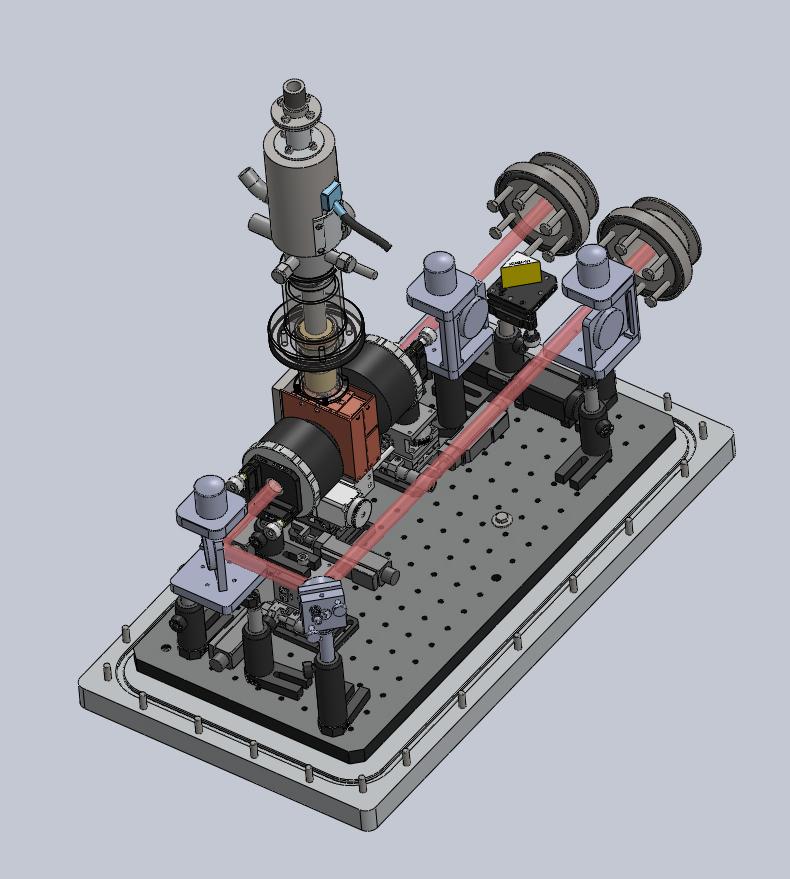
A specific chamber connected to the spectrometer IFS125 BRUKER, the cold head and the sample holder of the cryostat were designed and developed at SOLEIL (see figure below). Specific optic reduces the spot size at the sample by a factor 2 allowing measurement of small sample (less than 1mm) as well as an optimal alignment under vacuum. The vacuum level of the spectrometer and the beam-line (less than 10-5 mbar) allows connecting directly (without supplementary windows) the cryostat chamber and the spectrometer thus avoiding absorption and/or multiple fringes by windows.
Specifics sample holders adapted for solid samples, pellets and liquid samples have been developed.
We are currently mounting an optical set-up permitting reflectivity measurement with the cryostat. A thermal gold evaporator for the measurement of the reference will be implemented in the vacuum chamber.
Main features :
- High stability in temperature
- Temperature control from -268°C to 80°C (5°K - 353°K)
- Computer controled temperature ramp
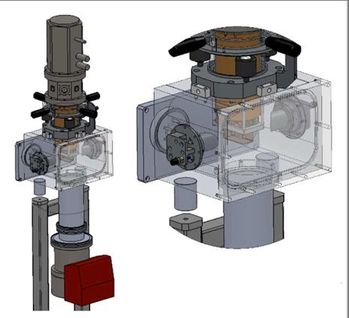
Schematic view of the low vibration cryostat inserted in the sample chamber (represented as transparent ). A turbo molecular pump placed under the chamber allows for a vacuum compatible with the cold head. Two focusing mirrors can be adjusted under vacuum for optimising the alignment after the pumping. Left: details of the chamber: the sample mounting is rigidly fixed to the top flange by ceramic poles while cold is transmitted from the cryostat to the sample by copper mesh.
Schematic view of the low vibration cryostat inserted in the sample chamber (represented as transparent ). A turbo molecular pump placed under the chamber allows for a vacuum compatible with the cold head. Two focusing mirrors can be adjusted under vacuum for optimising the alignment after the pumping. Left: details of the chamber: the sample mounting is rigidly fixed to the top flange by ceramic poles while cold is transmitted from the cryostat to the sample by copper mesh.
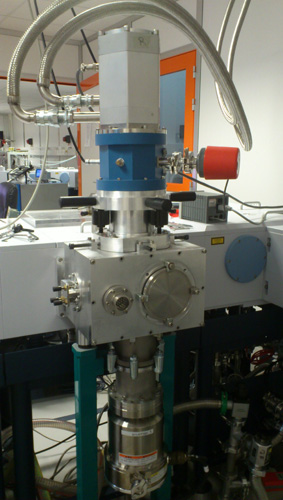
Photo of the close cycle cryostat AILES SOLEIL
Photo of the close cycle cryostat
Optical Set-up
The study of solids or liquids is possible either in transmission or in reflection using the commercial set-up described here.
The A513/Q Bruker reflection accessory allows the measurement of the solids (or liquids) reflectivity for variable incidence angles between 13 and 85 degrees. The sample is placed in the horizontal plan of the set. The development of a motorized translation stage allows the simultaneous positioning and then the successive measurement of reflectance for 3 different samples. This setup is particularly well adapted for the study of non-transparent materials (Infrared Refection Absorption Spectroscopy of monolayers or sub-monolayers, Langmuir-Blodgett films, corrosion analysis, semiconductors,…). The control of the angle of incidence is made directly through the acquisition software, without breaking the vacuum in the spectrometer. The coupling with a motorized polarizer (also computer controlled) is possible.
The A513/Q, for more informations:
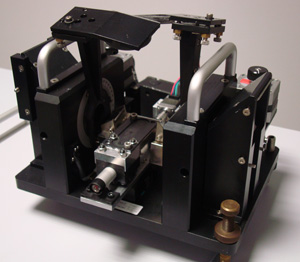 for more informations click here
The unit A510/Q-T is an accessory designed for both transmission and reflection measurements mainly in the MIR region. The great advantage of this unit is that the sample can be measured in transmittance and reflectance at exactly the same spot without the need of interrupting the spectrometer purge or venting the sprectometer (when working under vacuum condition). Typical applications are the spectroscopic analysis of solids (e.g. crystals, semiconductors), optical filters and window materials, accurate absorbance determination as well as low temperature transmittance and reflectance studies.
The A510/Q-T, for more informations:
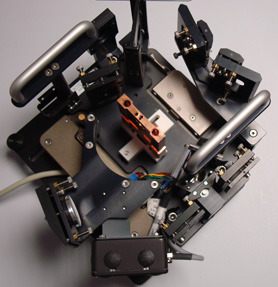 for more informations click here
A500 (description à venir)
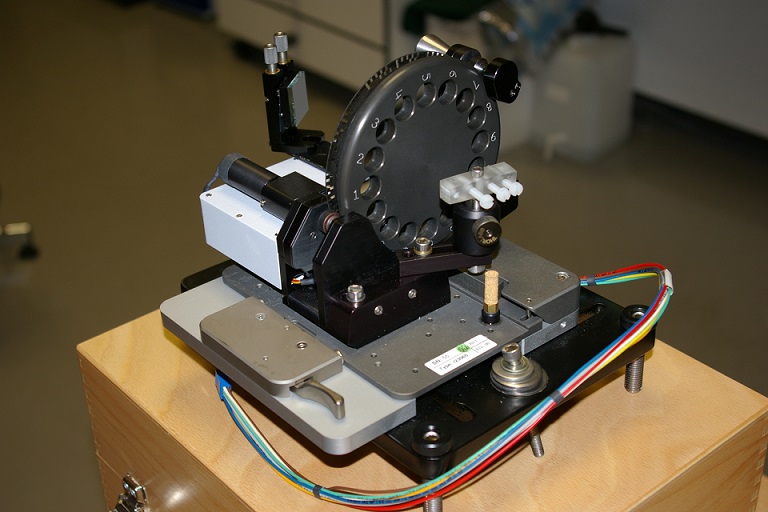
The motorized polarizer holder A121 allows a computer-controlled operation of the polarizer, i.e. measurement at different polarization angles without the necessity of opening the spectrometer sample compartment are possible. The polarizer holder can be rotated by 360° with an angle resolution of 0.25°.
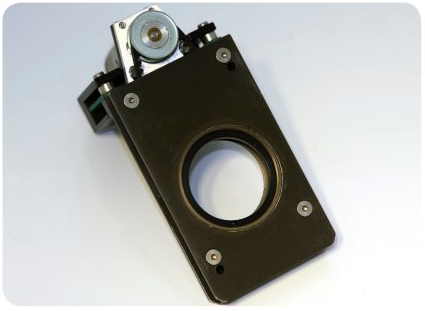
The A121, for more information
Spectroscopic measurements with polarized light are used, for example, for the analysis of:
- Molecular orientation of crystals or films
- Thin film layers
- semiconductor materials
- Langmuir-Blodgett films
Temperature controlled Liquid cell
The transmission studies of liquids as a function of the temperature in the range -75°C to 100°C is offered on the AILES beamline. The set-up is composed of a motorized tree axis motion, which allows the adjustment of the cell containing the sample without breaking the vacuum.
This tree axis supports a sample holder and the circulating liquid system for cooling or heating the sample. Various windows (Diamond, Polyethylene, TPX, CaF2, ZnSe) allow spectroscopic studies in all the infrared range from 5cm-1 to 20000cm-1.
The thickness of the sample is defined by Mylar spacers ranging from 1 μm to 100 μm. In order to measure the temperature of the sample a Pt100 sensor is connected to the liquid cell containing the sample.
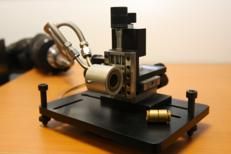
ATR Set-up under vacuum
Attenuated Total Reflection (ATR) is a sampling technique which enables solid, liquid or thin films samples to be examined directly in the infrared range. The ATR uses the evanescent wave, a property of total internal reflection to probe the sample. A beam of infrared light is passed through the ATR crystal in such a way that it reflects off the internal surface in contact with the sample.
This reflection gives rise to the evanescent wave which extends into the sample. The penetration depth into the sample is typically close to the wavelength of light, but is also affected by the angle of incidence and the indices of refraction for the ATR crystal and the medium being probed. This results in the technique to be adapted to the spectral range: a long path in the far infrared where the sample is usually less absorbing and a shorter path in the mid infrared where the sample usually absorbs more.
As the AILES beamline is working under vacuum, we have developed a mechanical device combining the ATR optics of a commercial set-up (Smart-Orbit, ThermoNicolet) and the sample compartment of the spectrometer under vacuum. With this configuration the entire optical path is under vacuum (preventing atmospheric water vapour absorption) except for the attenuated wave redirected toward the sample pressed at the diamond crystal interface. In addition, as the set-up optics only exploits reflective optics (no refocusing lenses are used) this configuration is adapted to the entire visible, infrared and THz ranges.
Furthermore, although the interferometer is evacuated and changing samples does not require breaking the vacuum system. Other advantages consist in the ability to obtain a reference by measuring a simple "total reflection" (without pressed sample)
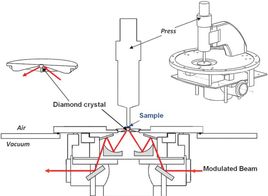
Cut schema (center) and 3D view (right) of the ATR ensemble. A highly focusing optics is placed in the sample compartment of the medium resolution interferometer (under vacuum) while the press and the sample are in the atmosphere. The modulated beam coming from the interferometer is refocused at the position of the diamond prism. After the attenuated total reflection took place at the interface between the diamond and the pressed
sample, the beam is redirected to the detector.
Cut schema (center) and 3D view (right) of the ATR ensemble. A highly focusing optics is placed in the sample compartment of the medium resolution interferometer (under vacuum) while the press and the sample are in the atmosphere. The modulated beam coming from the interferometer is refocused at the position of the diamond prism. After the attenuated total reflection took place at the interface between the diamond and the pressed
sample, the beam is redirected to the detector.
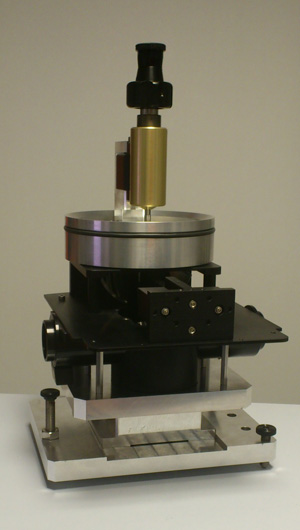
Photo of the ATR used at the AILES beamline
Photo of the ATR used at the AILES beamline
High Pressure and Low Temperature
Despite the importance of the information that it provides for condensed matter studies, far Infrared spectroscopy nowadays much less exploited than other methods for very high-pressure studies. The high brilliance of synchrotron radiation allow the interfacing of a Diamond Anvil Cell (DAC) with an infrared interferometer. The studies of materials under extreme pressure is possible.
A device dedicated to high pressure and low temperature measurements have been developed recently.
This set-up is placed into a separated compartment and use two focusing Cassegrain optics. Infrared measurements can be made in transmission and reflectivity, using a diamond anvil cell.
A small quantity of the sample to study is mixed to a binder transparent in infrared (polyethylene in the FIR, KBr or NaBr in the MID) and then loaded in a 250 µm hole drilled in a pre-indented gasket. A ruby inserted in this space is used to calibrate pressure. The pressure is controlled in the range up to 14GPa and the set-up allow measurements by steps of 1 to 2 GPa after a stabilization of for 5 to 10 min at each pressure point. The sample can be cooled down to 50K thanks to a cryostat.
Thin path electrochemical cell
To analyze metal-ligand vibrations and provide key answers for the understanding of metal site properties in metalloproteins and in metallocomplex, the Far-infrared (Far-IR) difference spectroscopy technique is the ideal tool.
In order to extract the part of the signal corresponding to the metal-ligand vibrations imbedded in the massive water absorption, it is necessary to record difference spectra obtained at specific points during an oxidoreductive cycle applied on liquid samples.
This transmission cell is an optimization of an existing set-up [1] equipped with 2 CVD diamond windows (transparent in the 2000 to 50 cm-1 spectral range) together with a 4µm thick gold grid as a working electrode [2, 3, 4].
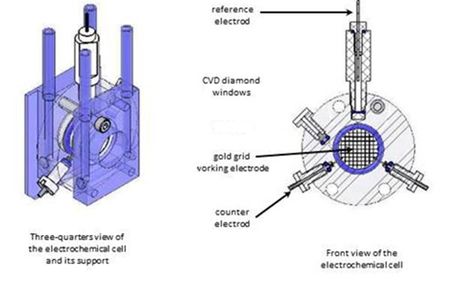
This set-up has been adapted for use with the synchrotron beamline AILES spectrometers. In particular, it can work under vacuum a necessary condition to increase the stability of the optics, the sensitivity of the measurements (less than 10-4 unity of absorbance), and hence the spectral resolution.
[1]Moss et al., Eur J Biochem (1990) 187, 565-572.
[2]Berthomieu C et al., Biopolymers (2006) 82, 363-367.
[3]Marboutin L. et al., J Phys Chem B, (2009) 113, 4492-4499.
[4]Vita, N., Brubach, J. B., Hienerwadel, R., Bremond, N., Berthomieu, D., Roy, P., & Berthomieu, C.
Electrochemically-induced far-Infrared difference spectroscopy on metalloproteins using advanced synchrotron technology.
Analytical Chemistry, 2013, 85(5): 2891–2898
Hydration Cell
We designed a copper cell allowing: (i) temperature control between 380 K and 40 K; (ii) dosage of the desired amount of adsorbed gas; (iii) pumping down to 10-6 mbar for reference measurements free from molecular adsorption. The cell was designed to study the modifications to the infrared spectra following molecular adsorption. The use of a unique cell, in a wide spectral domain, provides complementary information and insures the reproducibility of the adsorption and gas dosage.
The cell is made in copper in order to allow for good thermal exchange and has a volume of ~1 cm3 to limit gas absorption at ambient pressure. It is UHV-compatible (leak rate > 1·10-9 mbar·l/s). The cell is connected to a closed-cycle cryostat by a copper braid for cooling and temperature resolved experiments (from 40 K to 380 K). A thermocouple and a resistive heater allow controlling the sample temperature during measurements with a precision of ± 0.1 K. The cell is equipped with two diamond windows (10 mm in diameter, 0.5 mm in thickness at center, 0.5° wedge) allowing to measure the transmission of material from the THz to the mid infrared region with reduced spectral channelling effects. The sample is fixed on a sample holder at precise normal incidence relative to the incident beam. An entry for the gas input/output or the vacuum pump is also present in the body of cell. Gas dosage can be done in static conditions.
During hydration measurements, the system is studied at equilibrium for a given value of relative humidity (defined as the ratio of partial water vapour pressure p and water vapour pressure p0 (31.7 mbar at 25°C) at a given temperature, RH=(p/p0)*100). A tube containing outgassed deionized liquid water (18.2 MΩ·cm-1 at 25°C) provides the vapour source. The vapour pressure is monitored by a thermostated gauge (0-100 mbar at ±0.02 mbar) and, once at equilibrium, the measurements are performed.
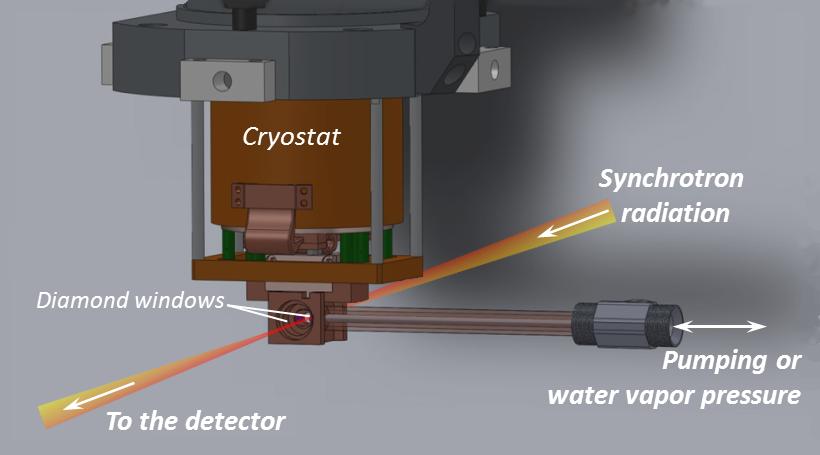
Schematic view of the hydration cell designed at AILES beamline. The cell is connected to the cold finger of a closed cycle cryostat and focusing optics allows the modulated beam to pass through the sample in contact with a controlled amount of gas.
White-type cell dedicated to the study of stable molecules
A multi-reflections White-type cell dedicated to the study of stable molecules has been developed and installed on the AILES beamline thanks to ISMO laboratory financial funding. This set-up is open to external users since the end of year 2008.
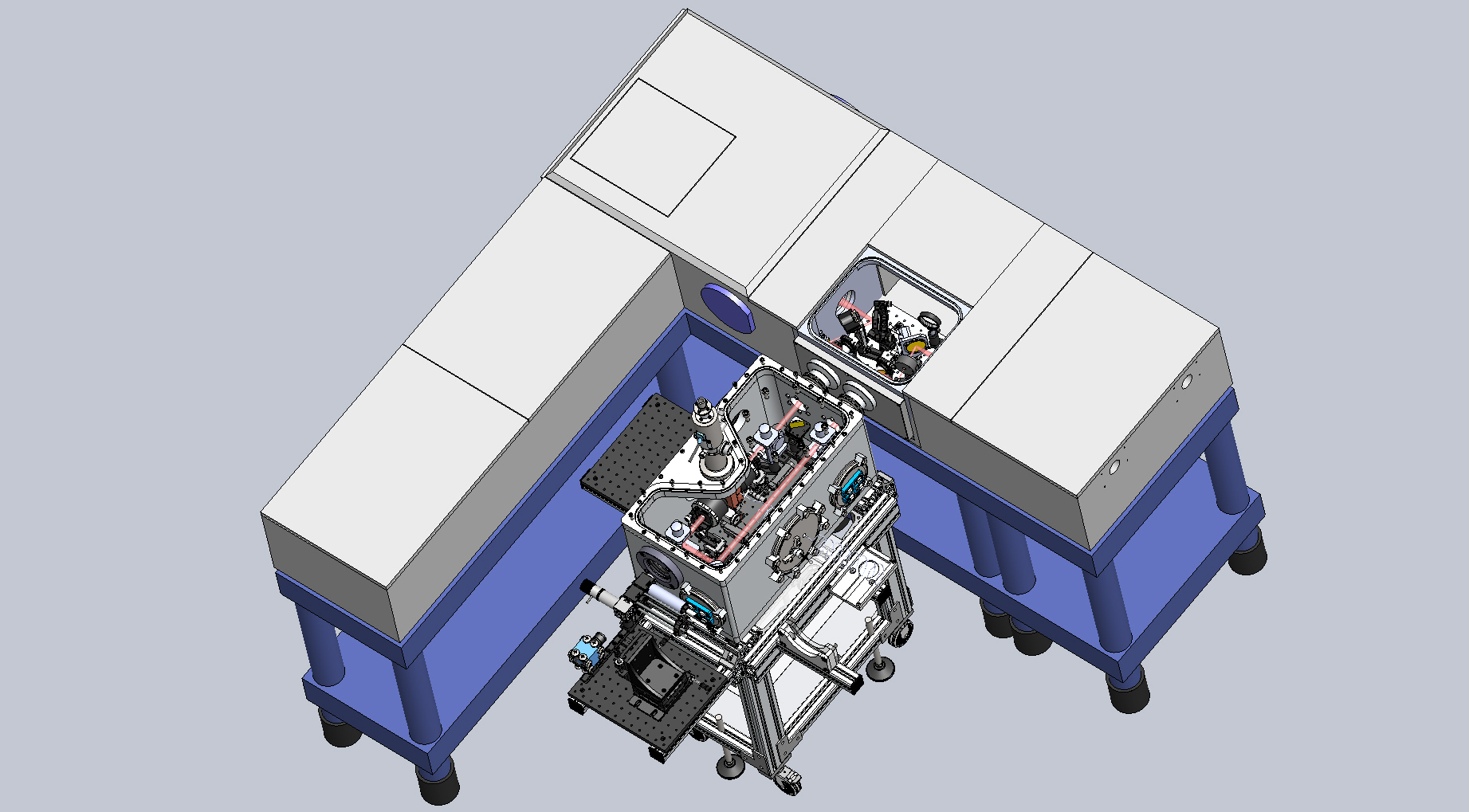
This multipass cell consists in a stainless steel cylindrical vacuum chamber of 2853 mm length and 600 mm diameter equipped with three mirrors in a White-type arrangement. The hard gold coated optics are spherical concave mirrors with 2526 mm radius of curvature and diameters of about 200 mm. An absorption path length of about 10 up to 180 m can be reached in this cell. Using this set-up one can perform gas-phase absorption spectroscopy in the FIR region for several kinds of samples. Thanks to the relatively long absorption pathlength, pure rotation as well as rovibration transitions of low frequency modes were obtained for samples with low vapor pressure at room temperature. Since 2009, 17 external projects have been successfully realized with that set-up (8 publications, 2 accepted papers). For more absorbing compounds, a smaller cell is available to cover the 0.8- 8 meter path length range.
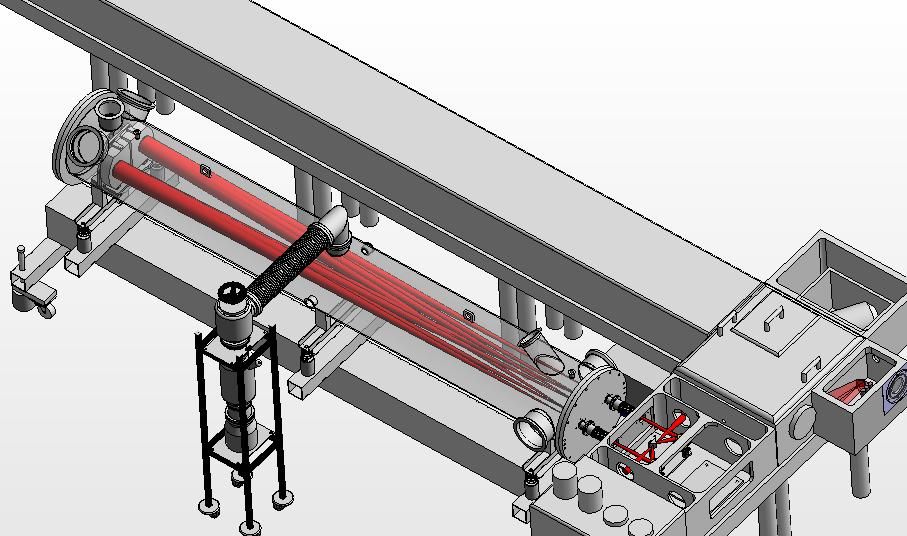
Schematic view of the long pass White cell with the interferometer. The modulated beam represented in red is undergoing multiple reflections before being redirected toward the detector.
Discharge cell dedicated to the study of transient species
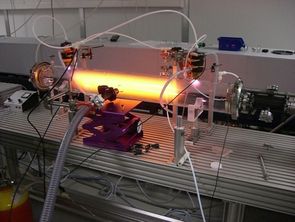
A discharge set-up based on a White-type cell has recently been developed on the AILES beamline by the ISMO team thanks to grants from National program PCMI obtained in 2009 and from the ISMO laboratory. Spectra of transient species such as small carbon chains, radicals or high temperature molecules synthesized in the positive column of the DC discharge plasma are obtained using absorption spectroscopy.
This discharge cell of relatively large diameter (13 cm) and length (110 cm) has been specially designed for an optimal coupling with the Bruker FT interferometer using either internal sources or synchrotron emission continua. A set of gold coated spherical concave mirrors with 82.5 mm diameters is placed in a White-type arrangement and allows an absorption path length of 24 meters. These three spherical concave mirrors have a 1000 mm radius of curvature. The cell is connected to the spectrometer by means of two DN25 to enter and exit the modulated infrared light.
The stainless steel water cooled electrodes, supplied by a continuous high voltage (1 kV / 2 A), create a high current discharge. Several inlets in the Pyrex discharge tube are used to continuously inject mixture of helium (He) and precursors species. Relatively fast gas flow (required to record absorption spectra of transient species) is obtained thanks to an EH500 Edwards booster pump associated to an ACP28 primary dry pump. Thanks to the relatively long absorption path length of the cell, the synchrotron radiation source and the direct probe inside the positive column of the discharge where radicals are produced, this absorption technique appears quite sensitive and allows the use of the highest resolution of the interferometer.
This set-up is now open to external user groups for the study of radicals or reactive molecules.
Cryogenic long path optical cell
The need for a cryogenic long path cell for high resolution rovibrational spectroscopy has been expressed by the user community of the AILES beamline. Indeed, the study at low temperatures can be necessary to model the absorption by molecules of atmospheric or astronomic interest. In many instances the ro-vibrational spectrum measured at cold temperature is necessary for an accurate analysis with molecules with many low energy vibrational modes to reduce hot band spectral congestion.
The laboratory LISA (Laboratoire Interuniversitaire des Systèmes Atmosphériques CNRS-University Paris 7 and 12), in association with the AILES team is currently developing such a cell. The goal is to generate optical paths of the order of hundred meters in a controlled enclosure between 350 and 100K, with vacuum systems capable of handling the appropriate gas mixtures without generating extraneous vibration, harmful to the quality of the measure.
The major challenges of the system are:
• Allowing an optical path of 150 m with at least 10% transmission.
• Compatibility with a wide optical range (2 to 300 µm).
• High stability and accuracy measurements even at low temperature and pressure.
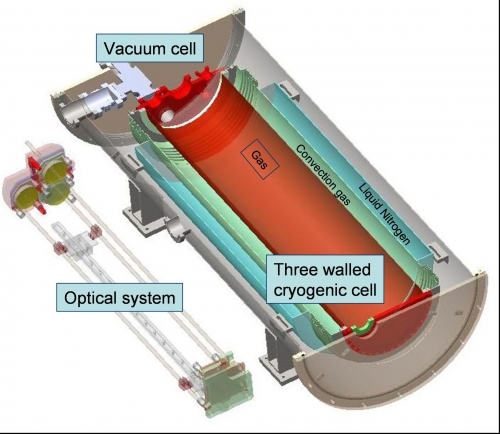
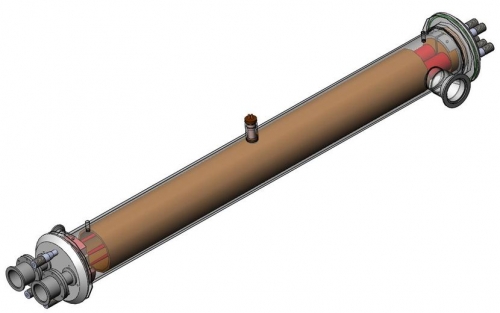
We chose an optical set-up as proposed by S. Chernin [1] because it allows the use of the entire surface of the mirror field, through the use of a system of 5 mirrors (figure 1). This set-up can generate longer optical paths and has a lower sensitivity to vibrations and deformations. The maximum optical path will be 144 meters and the minimum of one pass in the cell will be 4 meters.
Usual device for cooling cell requires a continuous flow of cryogenic fluid, whose regulation generates low frequency vibration, inconsistent with the operation of a Fourier Transform spectrometer. A design with four walls was chosen : an inner envelope (containing the gas and the optical system), a double wall convection cooling from liquid nitrogen and an inert gas, and an outer vacuum cell for the first three-walled cell (figure 2). The temperature range will be 80-300 K ±1K. The pressure will be controlled from 100 to 0.1 with an accuracy of 0.001 mbar. Because of the lower accuracy of commercial cryogenic pressure gauges, we are developing a home-made pressure gauge in collaboration with the vacuum group to reach the 0.001 mbar accuracy, based on capacitive sensors using flexible electrodes.
Supersonic jet facility (Jet-AILES)
R. Georges, A. Moudens, M. Goubet, T.R. Huet M. Cirtog, P. Asselin, P. Soulard
O. Pirali, P.Roy.
IPR, LADIR and PhLAM laboratories
Absorption FTIR spectroscopy in supersonic jets combines several advantages: (i) very low rovibrational temperatures attainable in supersonic expansions are essential to reproduce not only the diluted and cold environments of planetary atmosphers but also to simplify the spectral congestion within rovibrational bands of polyatomic molecules, as well as to stabilize weakly bound molecular complexes, (ii) the broad spectral coverage of the interferometer enables to realize precise structural studies for a large variety of molecular systems, (iii) finally the detection sensitivity of this spectroscopic tool can be notably improved due to the availability of large molar flows and to the implementation of efficient optical multipass devices , particularly when using the low divergent synchrotron radiation.
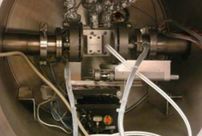
The continuous supersonic expansion takes place in a 400 mm diameter chamber directly evacuated by a combination of two Roots blowers (Edwards EH 500 and 2600) backed by a dry primary pump (Edwards GV 80 Drystar) leading to an effective pumping capacity of 2000 m3/h. The mechanical vibrations are efficiently damped by decoupling the pumping unit from the chamber thanks to two dedicated bellows mounted on the pumping line. In addition, the roots pumps are mounted on a concrete block and the chamber is rigidly fixed to the ground.
A large flow supersonic jet facility (Jet-AILES) was developed around the AILES beamline by a consortium involving three expert groups from the laboratories: IPR, LADIR and PhLAM. Jet-AILES provides a larger column-density of complexes whose sizes can be controlled by tuning the backing pressure and takes advantage of the high radiance of the SR in the FIR range. first slit nozzle of 60 mm in length is used for reaching moderate stagnation pressures (ca. 700 mb), in a single absorption pass configuration (SPC).
To know more : Cirtog, M., et al Journal of Physical Chemistry A, 115(12): 2523–2532 (2011).
Hollow cathode discharge for positive ions
IR and far-IR absorption spectroscopy of positive ions in hollow cathode discharge
The ISMO team received grants from the National program PCMI for the period 2009-2013 to develop an experimental set-up permitting to record absorption spectra of positive ions of astrophysical relevance using FT spectrometers. This hollow cathode cooled to liquid nitrogen optimizes the ion production in the negative glow of the discharge.
Basse Résolution
Grazing incidence : en cours
Platine chauffante Linkam 0-1200°C
The study of infrared response of condensed matter under high temperature provides information about the transition in the condensed matter. The goal of this setup is to combine a Linkam Stage (TS1200V), normally used for microscopy, and the Bruker interferometer IFS125. We are currently developing a support, which could be placed in the high pressure box, between the two Cassegrains optics. The Linkam Stage would be placed under vacuum. The two Cassegrains optics allow us to have a very small beam that allows us to measure very small part of a sample. The support will be mounted on a YZ motorized micrometer positioning stage, that allow us to move across the sample, and focalize in one or another part of the sample.
The Linkam Stage can heat up to 1200°C; have a sample of maximum 10 mm diameter
In order to reach such high temperature a water cooling circuit is implemented for cooling the stage.
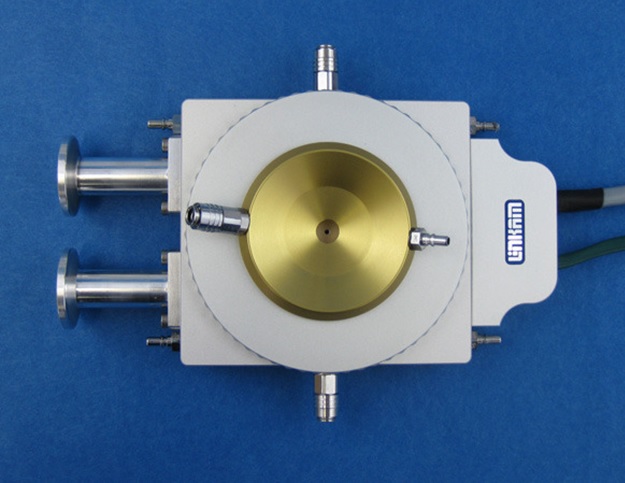
Photo of the set-up heating Stage of Ailes Beamline at Soleil
Ultra low temperature cryostat 50mK-300K (description+photo à venir)
Haute Résolution
Long path glass cell for corrosive gazes
For many highly reactive or corrosive gases (strong oxidizers such as ozone, chlorine nitrogen oxides, metal oxides, oxo-halogeno compounds, or strong acids) quantitative spectroscopic studies are needed for retrieval of atmospheric concentrations following remote sensing measurements. These compounds are however catalytically decomposed on metal surfaces and require special handling equipment. A new variable path cell is thus under development on AILES, thanks to cooperation and funding by CEA (Commissariat à l’Energie Atomique) and the LISA (CNRS-Université Paris Est). The equipment is made of glass and Teflon-coated materials and special optics. A special, homemade capacitive pressure gauge is developed for precise pressure measurements of reactive or highly corrosive gases.
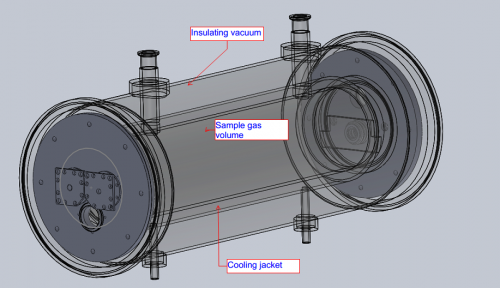
Figure 1. Schematic view of the long path glass cell.
The cell is designed to provide a variable path length between 2.5 and 25m and variable temperatures between 350 and 200K, to help stabilize reactive species or evidence thermodynamical equilibria. Foreseen studies will be devoted to ruthenium oxide, pure nitric acid, isomeric forms of nitrous acid and chlorine nitrate.
Heated cell for low vapor pressure cell
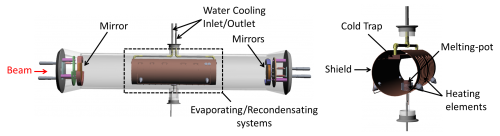
Room temperature measurements of isolated molecules are limited to relatively high vapor pressure species. Yet, many large carbon bearing molecules of high astrophysical relevance shows very low vapor pressure values. We nevertheless used a White cell (maximum absorption path length of 200m) to study the anharmonic effects on the naphthalene spectrum recorded at room temperature (Pirali et al. PCCP, 2009).
In order to extend this study to larger molecular systems (which show lower vapour pressure at room temperature), we are now building a heated cell containing multipass optics ( maximum pathlenght 48 m) in order to record the high resolution spectra at controlled temperature (less than 400K). The temperature will be adjusted to increase the vapour pressure of PAHs samples in order to obtain the high resolution spectra of the IR/FIR modes which permit to extract anharmonic parameters from hot band sequences, combinaison bands and overtones. A cold element will permit to condensate the sample on its surface. Once the capabilities of the forthcoming cell stated and the first results on PAHs obtained, the set-up will be proposed to external groups to record absorption spectra of samples showing low vapour pressure.
This set-up is developped by the ISMO team through the GASPARIM ANR funding
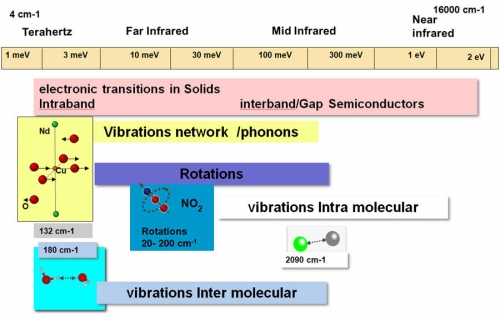
Main transitions observed in infrared on AILES beamline
Thèmes de recherche
| Spectroscopie haute résolution en phase gazeuse | Détermination des spectres caractéristiques de molécules d’intérêt astrophysique dans la région térahertz (infrarouge lointain, proche des micro-ondes). Préparation à la mission Herschel. Applications en astrophysique |
|---|---|
| Dynamique des molécules en solution | Étude de molécules dans des structures de confinement micellaires ou lamellaires : excipients pour médicaments, supports pour nanomatériaux. Applications en pharmacologie, nanotechnologie |
| Physico-chimie des interfaces | Étude des couches minces notamment en microélectronique Applications : synthèse de nouveaux matériaux aux propriétés optimisées pour les applications industrielles |
| Propriétés optiques de solides | Étude de solides cristallins non conventionnels tels que les supraconducteurs à haute température critique (HTCS), les supraconducteurs organiques et les aimants moléculaires Application : nanotechnologie |
Collaborations
Actions Nationales de Recherches :
- ULTRASYNC (2019-2023)
- QUASARS (2019-2023)
- HEROES (2018-2022)
- SANTA (2018-2022)
- HEXSIGE (2017-2021)
- PS2FIR (2013-2017)
- DYMAGE (2013-2016)
- Dynaco (2010-2014)
- ProMetTHz (2008-2012)
- MINOS ( 2007-2011)
- FTID (2006-2010)
Collaborations :
 LPCA : Laboratoire de Physico-Chimie de l'Atmosphère, Université du Littoral (Dunkerque)

SPEC CEA : Quantum coherence and many-body correlations (Saclay)
 Institut NEEL (Grenoble)
 LPS : Laboratoire de Physique des Solides (Orsay)
 LADIR : Laboratoire de dynamique, interaction et réactivité
 ICMMO : Institut de Chimie Moléculaire et des Matériaux de Orsay
 LISA : Laboratoire Inter-Universitaire des Systèmes Atmosphériques -Jussieu Créteil

Université de Tours (Région Centre)

ISMO : Institut des Sciences Moléculaires d'Orsay
 PhLAM (Lille) : Laboratoire de Physique des Lasers, Atomes et Molécules
 Université de Rennes
L'accès aux lignes de lumière SOLEIL est ouvert à tout scientifique venant du monde entier. Chaque année, la ligne de lumière infrarouge AILES accueille des chercheurs et ingénieurs de la recherche scientifique mais aussi des utilisateurs industriels. Pour bénéficier de temps de faisceau, vous devez au préalable soumettre votre projet via le portail SunSet.
|
Dépôt de projets Les projets doivent être déposés via le SunSet |
Préparer votre demande de temps de faisceau : voir Le guide général des Utilisateurs
Documents à télécharger

 poster-ailes-2016.jpg (705.14 Ko - jpg) (705.14 Ko)