Fundamental and applied research
|
Surfaces / interfaces / nano-objects | CASSIOPEE, DEIMOS, MicroFocus, MicroXmous, PLEIADES, SAMBA, SIRIUS, SMIS, TEMPO |
|
Physical chemistry / diluted matter / astrophysics / atmosphere | AILES, DESIRS, PLEIADES, SMIS |
|
Chemistry / condensed matter / nano-chemistry / soft condensed matter | AILES, CRISTAL, DEIMOS, DESIRS, DIFFABS, LUCIA, MARS, MicroXmous, ODE, SAMBA, SIRIUS, SMIS, SWING, TEMPO |
|
Solid state physics / materials / nano-sciences: electronic properties | CASSIOPEE, CRISTAL, DEIMOS, DESIRS, LUCIA, MARS, MicroFocus, MicroXmous, ODE, SIRIUS, TEMPO |
|
Solid state physics and chemistry / materials / nano-sciences: structures | AILES, CRISTAL, DIFFABS, LUCIA, MARS, ODE, PSICHE, SAMBA, SIRIUS, SMIS, SWING |
|
| Life sciences / health | DESIRS, DIFFABS, DISCO, LUCIA, MARS, MicroXmous, PROXIMA1, PROXIMA2, SAMBA, SMIS, SWING, TEMPO |
|
| Earth sciences / environment | DEIMOS, DESIRS, DIFFABS, LUCIA, MARS, MicroXmous, PSICHE, SAMBA, SMIS, SWING, TEMPO |
|
| Archeology / cultural heritage | SMIS, LUCIA, DIFFABS, DISCO, MicroXmous, NANOSCOPIUM, PSICHE, SAMBA, CRISTAL, SWING |
|
Industrial application sectors
|
|
Agribusiness | Cosmetics | Pharmacy | Chemistry | Electronic | Buildings - Public works | Transport | Materials | Energy | Environment and eco-industries
|
Agribusiness France’s top industrial sector, agribusiness covers a wide range of activities: improvement of stock raising and seeding; processing of animals and plants; agricultural engineering and preparation, and storing. This sector calls more and more often on research, especially for the improvement of manufacturing techniques and to ensure the final quality of products put on the market. Large industrial groups have relied for several years on the use of synchrotron light to characterize and minutely analyze their products, for example with chocolate, dairy products, and food mousses. Original studies of fermentation and the procedures of baking bread have recently been conducted via microtomography, a technique that reveals the alveolar architecture at very high resolution. These activities should be strengthened and widened over the next several years to meet the ever-more stringent demands of consumers in terms of quality and flavor. | Some examples of studies Dynamics and stability of food emulsions, mousses, and gels Transitions in phase of fats in butter and chocolate Rheologic activity of pasta Characterization of seeding and harvesting Analysis of the fermentation and baking of bread Chemical imagery of packing and storage products Study of the crystalline structure of plastic bottles Diffusion of chemical elements; biotoxicity Agribusiness techniques and beamlines Molecular structure via diffusion/X-diffraction --> SWING beamline Chemical imagery using FT-IR --> SMIS beamline Chemical imagery using UV spectroscopy --> DISCO beamline Morphology using microtomography --> PSICHE beamline | |
|
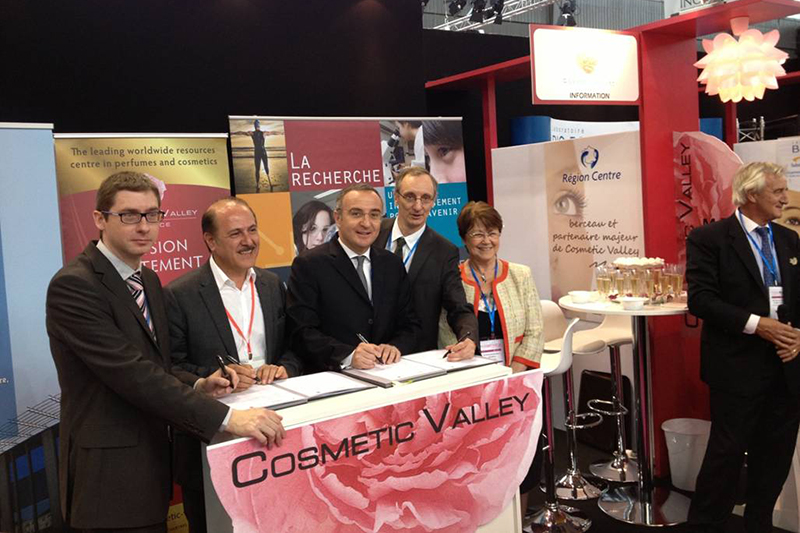
Cosmetics The cosmetics industry is a longtime user of synchrotron radiation facilities both in France and abroad. Available techniques are particularly well adapted to a number of this industry’s needs, both for the development of new products and for the monitoring of their effects and the control of their safety. Companies today use synchrotron chemical scanning techniques to characterize the effects of products on the skin, hair, or fingernails. It is thus possible to closely examine the physical/chemical life of a product after application, its diffusion throughout cloth, and its effects on their different biochemical components. The other major activity area concerns the development of new products to characterize, monitor, and control the nanometric and micrometric architecture of the complex environments formed by water-oil-surfactant mixtures. Some examples of studies Analysis of the molecular structure of skin and hair Monitoring after application of cosmetic products Viewingof products and chemical components Structure, stability, and aging of emulsions, mousses, and gels Transitions between phases of water, oil, and surfactant mixtures Rheologic activity of emulsions Analyses of pigments, powders, pastes, and additives Distribution of components in heterogeneous milieus Effects of storage on cosmetics Techniques and beamlines for cosmetics Molecular structure via diffusion/X-diffraction --> SWING beamline Chemical imagery using FT-IR --> SMIS beamline Chemical imagery using UV spectroscopy --> DISCO beamline Morphology using microtomography --> PSICHE beamline | |
|
Chemistry Fine chemistry and specialized chemistry take advantage of synchrotron techniques both for research and development and for manufacturing procedures, with basic chemistry being less involved. X-absorption spectroscopy techniques permit the monitoring of chemical reactions in real time, both the type and state of oxidation of reactants, which explains the large amount of activity involving the development of new catalysts in all synchrotron radiation facilities. Plastics, elastomers, and composites are also analyzed at the molecular structure, via X-diffraction/diffusion, and also via morphology, via microtomography, to monitor their synthesis and formation, understand their mechanical properties, or control their quality, especially during the aging process or fatigue tests. The same analyses can be done on numerous products in the area of specialized chemistry; painting, varnish, ink, glue, detergents, etc. Some examples of studies Monitoring of chemical reactions in real time Display of temporary products Monitoring of states of oxidation of catalyst reactions Local order around chemical material Study of molecular trapping Optimization of procedures Crystallization and microstructure of polymers Characterization of charges in composites Analysis of thermal, mechanical, and under-irradiation aging of plastics Micromorphology of solid mousses Chemistry techniques and beamlines Monitoring of reactions via absorption spectroscopy --> MARS, SAMBA and ODE beamlines Chemical imagery and speciation --> MARS and LUCIA beamline Monitoring of reactions via X-diffraction --> DIFFABS and MARS beamline Study of polymers and emulsions via X-diffusion --> SWING beamline Chemical imagery via IR microscopy --> SMIS beamline | |
|
Electronic Research and development play a fundamental role in electronics, a very high-technology activity, especially in the area of components and that of professional and industrial electronics concerning areas of application as varied as defense, spatial issues, aeronautics, transport, medicine, and metrology. Electronics entities have always maintained close links with synchrotron radiation facilities in order to take advantage of techniques of magnetic dichroism and photoemission, which give access to information on electronic states and spin. The natural polarization of synchrotron light is a major asset for measuring dichroism; its spectral continuity is extremely important for experiments in photoemission. In addition, submicrometric beams permit the exploration of fine structures; for example, the state of strains of crystalline grains in interconnections, in thin layers of magnetic systems, or in microstructures. Techniques of surface characterization—atomic structure, chemical state, reactivity, metallic contamination, nanostructures, etc.—are also used by industrial entities. Some examples of studies Characterization and microscopy of magnetic fields Study of materials for the electronics of spin Dynamics of magnetization Electronic structure of surfaces and interfaces Analysis of nano-structured surfaces (quantum dots) Strains in conductor lines of interconnections Control of metallic contamination Electronic techniques and beamlines Photoemission --> CASSIOPÉE and DEIMOS beamlines Electronic and magnetic dynamics --> TEMPO beamline Magnetic microscopy --> X-PEEM beamline (Elettra à Trieste) Magnetic microscopy and UV spectroscopy --> MICROFOCUS beamline Surface structure and reactivity --> SIXS and SIRIUS beamlines Microanalysis of strains --> BM32-IF beamline (ESRF à Grenoble) Characterization of surface nano-objects --> SWING beamline Chemical characterization --> SAMBA beamline | |
|
Buildings - Public works The use of synchrotron techniques by building and public works companies is relatively recent, but it has grown along with the development of techniques such as microtomography. This technique permits the visualization of structures in volume at the micrometric level, with applications for the analysis of porosity, diffusion, and aging, as well as the distribution of components in its largely heterogeneous materials. The other main activity involves the monitoring of chemical reactions and the observation of temporary products during the creation of bonds, with the objective being to be capable of handling the formulation and additives that will lead to the required specifications. The technique used is the diffraction of X-rays and the reaction is monitored in situ and in real time. The advanced characterization of the chemical state of ions at the surface of objects in concrete or metal is also studied via X-absorption spectroscopy for problems of corrosion, contamination, and environment. Some examples of studies Aging of materials, porosity, diffusion, corrosion Characterization of micro- and nanostructures of cement, concrete, and metallic parts Bonding of cement; effects of additives Clinkerization procedures Characterization of coverings Building and public works techniques and beamlines Morphology via microtomography --> PSICHE beamline Monitoring of reactions via X-diffraction --> DIFFABS beamline Chemical imagery and speciation --> LUCIA beamline | |
|
Transport The growing requirements of land and air transport clients in terms of performance, comfort, and security explain the important part that industrial entities, manufacturers, and equipment providers in the field dedicate to research and development, with the constant desire to protect the environment. The use of synchrotron techniques in this sector concerns three main activities. The first is related to the improvement of output of catalysts that transform escaping gases into non-toxic gases. These studies are conducted via X-absorption spectroscopy to monitor and understand the state of the catalysts during reactions. The second activity involves measurement via X-ray diffraction of the residual strain in metallic parts, especially for sensitive aeronautic material like turbine paddles, and also in parts subject to breakdown for automobiles and railroad materials. Finally, microtomography permits the revealing of malfunctions hidden in parts and the analysis of the architecture of metallic mousses. Some examples of studies Development of catalysts for automobiles Measurements of residual strain Detection of malfunctions in parts Forming and morphology of metallic mousses Transport techniques and beamlines Chemical analysis via X-spectroscopy --> SAMBA and ODE beamlines Chemical imagery --> LUCIA beamline Measurement of strain --> CRISTAL and MARS beamlines Morphology via microtomography --> PSICHE beamline | |
|
Materials It is difficult to cite all the applications of synchrotron techniques in the area of materials, so numerous are the materials analyzed and the techniques used. Materials analyzed include metals and alloys, glass, ceramics, rubber, technical and composite plastics, wood, paper paste, textiles, and primary materials for industries such as the cosmetic and pharmacy industries. It is possible to examine the molecular organization of all these materials, their chemical composition and their micro-morphology, and to monitor the modifications induced in them by different strains, in situ and in real time: thermal, mechanical, under flow, in a specific chemical environment, under electric field, or under irradiation. The information provided by these analyses constitute a complement to the laboratory analyses and a major support to engineers for research activities and the development of new products, in the engineering of procedures, quality control, and possible recycling. Some examples of studies Covering in thin layers Measurement of residual strain Microscopic morphology Structural and chemical quality of wood; orientation of fibers Quality of paper, covering, and mineral loads Structural monitoring in real time under stress, for example mechanical Distribution and bearing of loads in composites Studies of natural and biomimetic fibers Transformation under effects of pressure or temperature Monitoring in real time under stress, for example traction Studies of aging and fatigue Identification of materials Diffusion mechanisms Local chemical order Materials techniques and beamlines Molecular structure via X-diffusion/diffraction --> SWING beamline Measurement of residual stress --> CRISTAL and MARS beamline Chemical characterization --> MARS and SAMBA beamline Chemical imagery via FT-IR --> SMIS beamline Morphology via microtomography --> PSICHE beamline Chemical imagery via X-fluorescence --> DIFFABS, MARS and LUCIA beamlines Structural changes (P and T) --> DIFFABS and PSICHE beamlines | |
|
Energy The analytical abilities of synchrotron techniques are much more marked for fossil energies, especially oil and nuclear, than for renewable energies, for which material aspects are not predominant. On the side of exploration, the oil industry is interested in these techniques for the evaluation of the quality and porosity of reservoir rocks, and on the petrochemical side for the analysis of hydrocarbons and derivatives, notably for problems with catalysts and the development of new catalysts, a major activity in all synchrotron radiation facilities. The nuclear industry itself is interested in the exploration mining of uranium, the preparation of combustibles, and the growth of their performances, treatment, and recycling, not to mention the management of waste, all while respecting environmental standards. Synchrotron techniques are also well adapted to the analysis of material in tanks and the monitoring of corrosion and aging mechanisms under irradiation. Some examples of studies Crystallization of paraffinic raw materials Microstructure of rocks Fluid inclusions Development of catalysts Electrochemistry and the development of batteries Enrichment procedures Corrosion under irradiation Processing and storage Energy techniques and beamlines Molecular structure via X-diffraction/diffusion --> SWING beamline Measurements of residual stress --> CRISTAL and MARS beamlines Chemical and catalyst characterization --> SAMBA beamline Morphology via microtomography --> PSICHE beamline Chemical imagery via X fluorescence --> LUCIA and DIFFABS beamlines | |
|
Environment and eco-industries >> Download POLLUTEC sheet (in French) Industrial entities in the environmental sector use synchrotron techniques only modestly at this point; but the trend is toward growth, doubtless in a sustainable manner. Synchrotron light offers choice resources, unique methods, for the analysis of polluted materials and for the updating of their treatments and monitoring. Its major advantage is its great sensitivity to detect very weak contaminations and especially the ability to conduct analyses of the speciation of the types of chemicals involved, with the toxicity of one ion being often linked to its degree of oxidation. The possibility of microanalysis at the micrometric level is also suited to the study of distribution of pollutant agents in soils, in fine particles such as airborne ashes, or in vegetables, microorganisms, and animal tissues; this is an important parameter for the evaluation of toxicity and the updating of treatments. Some examples of studies Studies of cement erosion mechanisms Studies of metallic corrosion Analysis of soil pollution Analysis of airborne ashes Treatment via phytoremediation Biotoxicity Detection of heavy metals Bacterial de-pollution Characterization of airborne ashes Environmental techniques and beamlines Chemical characterization and speciation --> MARS, SAMBA and LUCIA beamlines Chemical imagery via X-fluorescence --> MARS, LUCIA and DIFFABS beamlines Characterization of minerals and soils --> MARS, DIFFABS beamline Morphology via microtomography --> PSICHE beamline Characterization in gaseous milieus --> DESIRS beamline | |
|
 |
|
|